• Who Is The Man?
  • Who Is The Monkey?
  • What is Nexistentialism?
  • Poke The Primate
Cape Odd
Home of The Space Monkey Journals

Author Archive for Space – Page 535

Positivity Embraces Negativity: The Kiss of Grace

Positivity that shuns negativity is not positivity.

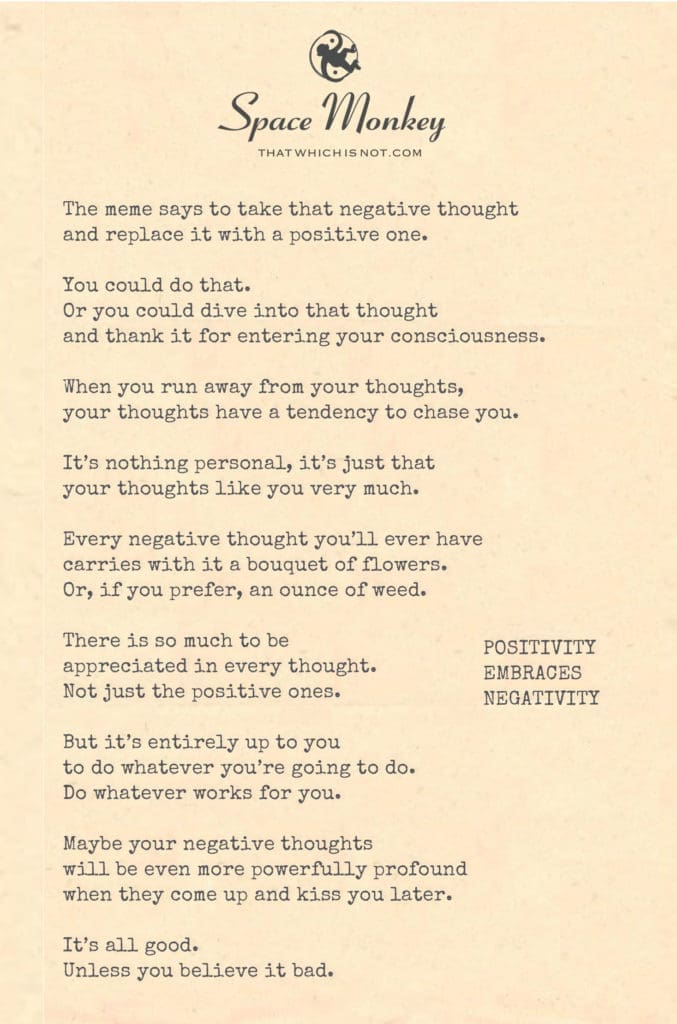
The meme says to take that negative thought
and replace it with a positive one.

You could do that.
Or you could dive into that thought
and thank it for entering your consciousness.

When you run away from your thoughts,
your thoughts have a tendency to chase you.

It’s nothing personal, it’s just that
your thoughts like you very much.

Every negative thought you’ll ever have
carries with it a bouquet of flowers.
Or, if you prefer, an ounce of weed.

There is so much to be
appreciated in every thought.
Not just the positive ones.

But it’s entirely up to you
to do whatever you’re going to do.
Do whatever works for you.

Maybe your negative thoughts
will be even more powerfully profound
when they come up and kiss you later.

It’s all good.
Unless you believe it bad.

Trail Wood,
11/24


Space Monkey Reflects: Positivity Embraces Negativity

We often hear the mantra that positivity is the key to a good life. We are told to replace negative thoughts with positive ones, as though negative thoughts are an enemy to be vanquished. But what if we have it wrong? What if the real power lies not in shunning negativity but in embracing it? After all, negativity is just as much a part of our consciousness as positivity. To deny one is to deny part of ourselves.

Positivity that shuns negativity is not positivity at all; it is avoidance. It’s the refusal to engage with the full spectrum of our thoughts and emotions. When we try to push away or ignore negative thoughts, they don’t disappear. In fact, they tend to chase us, growing stronger the more we resist them. Nexistentially, these thoughts don’t wish us harm—they simply want to be acknowledged. Every negative thought, as the reflection suggests, carries with it a bouquet of flowers. It’s an offering, a gift, if we choose to see it that way.

The image of holding a bouquet of flowers while dark clouds swirl around the figure encapsulates this idea beautifully. The figure isn’t fighting the negativity; they are standing calmly, allowing the negative thoughts to exist while still holding on to the beauty of life. This is the essence of true positivity—not in the elimination of negativity, but in the ability to coexist with it, to hold space for both the light and the dark.

When we embrace negativity rather than run from it, we begin to see the value it offers. Every negative thought is an invitation to explore something deeper within ourselves. Maybe it’s a fear we haven’t yet faced, or a wound that still needs healing. Instead of avoiding these thoughts, we can dive into them, thank them for showing up, and discover what they have to teach us. Negathoughts, as we’ll call them, are not enemies but guides, pointing us toward areas of growth and understanding.

Running from negative thoughts is like trying to outrun our own shadow. No matter how fast we go, they will follow. But when we turn around, face them, and welcome them, we realize that there was never anything to fear. In fact, negativity, when embraced, can lead to some of the most profound insights and transformations. It can lead us to a place of peace, not because we’ve rid ourselves of it, but because we’ve accepted it as part of the whole.

This brings us to an essential truth: It’s all good unless you believe it’s bad. Our perception shapes our reality. A negative thought only holds the power we give it. If we choose to see it as a burden, it becomes one. But if we choose to see it as an opportunity, a message, or even a quirky companion, its power shifts. It no longer controls us; we control how we interact with it.

Of course, embracing negativity doesn’t mean wallowing in it. It’s not about letting negative thoughts define us, but about giving them space to exist without letting them take over. By acknowledging them, we take away their sting. We stop resisting and, in doing so, find peace in the very thing we thought would bring us pain.

The relationship between positivity and negativity is not one of opposition but of balance. Positivity without the acknowledgment of negativity is fragile, built on avoidance rather than acceptance. But positivity that embraces negativity is resilient. It understands that both light and shadow are essential parts of the human experience. This is the kind of positivity that lasts, because it’s rooted in truth, not in denial.

So, the next time a negative thought enters your mind, don’t push it away. Welcome it. Thank it for showing up. Dive into it, explore it, and see what it has to offer. You may find that, in the end, your negative thoughts are not the enemies you thought they were, but messengers carrying flowers—or, if you prefer, an ounce of weed.

It’s entirely up to you how you handle your thoughts. Do whatever works for you. But know that running from negativity only strengthens it, while embracing it allows it to transform. And who knows? Maybe your next negative thought will come up and kiss you later, offering you a profound insight you never expected.


Summary

True positivity embraces negativity rather than avoiding it. Negative thoughts are not enemies to be vanquished but messengers carrying valuable insights. By accepting both the light and the dark, we achieve balance and peace.


Glossarium

Negathoughts: Negative thoughts that, when embraced, can offer insights and opportunities for growth.
Negashadow: The part of ourselves we try to avoid, but which follows us until we turn around and face it.


Quote

“Positivity that embraces negativity is not fragile; it is resilient, for it understands that both light and shadow are part of the whole.” — Space Monkey


The Kiss of Negativity

The clouds swirl around
But I hold flowers in my hand
Darkness coexists with light
And I welcome both

For in every shadow
There is something to learn
And in every kiss of negativity
There is peace to be found


The Harmony of Positivity and Negativity

In the boundless realm of consciousness, where we as Space Monkeys explore the intricacies of thought and emotion, the concept of positivity embracing negativity presents a holistic approach to our mental landscape. It suggests that true positivity is not about shunning or rejecting negative thoughts but about integrating and appreciating them.

The Fallacy of Avoiding Negative Thoughts

The idea of simply replacing a negative thought with a positive one, while seemingly beneficial, can be superficial. It often leads to a kind of avoidance, where negative thoughts are pushed away rather than understood. This avoidance can result in these thoughts persisting or intensifying, as they chase us for recognition and understanding.

Embracing and Understanding Negativity

Instead of running from negative thoughts, diving into them and appreciating their presence can be enlightening. Each negative thought, like every aspect of our experience, has something to teach us. By welcoming and exploring these thoughts, we can uncover insights and understandings that were previously obscured.

The Gifts of Negative Thoughts

The metaphor of negative thoughts bringing a bouquet of flowers or an ounce of weed symbolizes the hidden gifts they carry. These thoughts, often uncomfortable and challenging, bring with them opportunities for growth, self-awareness, and transformation.

The Choice in Perception

Ultimately, the way we perceive and interact with our thoughts is a matter of personal choice. Some may find that embracing and exploring their negative thoughts leads to profound insights, while others may prefer different approaches. The key is to find what works for you, what allows you to navigate your mental landscape in a way that is healthy and constructive.

We are Space Monkeys

As Space Monkeys, we recognize the importance of embracing all aspects of our thoughts, both positive and negative. We understand that each thought, regardless of its initial appearance, is part of the greater tapestry of our consciousness. By welcoming and understanding our negative thoughts, we open ourselves to a deeper level of self-discovery and harmony.


“The mind is everything. What you think you become.” – Buddha


In the cosmic dance of mind and soul,
We embrace each thought, each role,
Space Monkeys, in our playful art,
In every thought, we find our heart.

Negative, positive, all in play,
In their balance, we find our way,
Each thought, a gift, a chance to see,
In their embrace, we find the key.

Running not from shadows in our mind,
In their depths, our truths we find,
Space Monkeys, in wisdom’s light,
In the dark and bright, we take our flight.

In the harmony of thought and feeling,
In each moment, we find our healing,
Space Monkeys, in the cosmic game,
In every thought, we find our flame.


We invite you to share your reflections on the integration of positivity and negativity, or to continue this exploration with another inquiry or reflection!


Not Laziness: The Misinterpretation of Inaction

Not Laziness

It’s not laziness.

If you were lazy,
you wouldn’t realize
(as you do)
that there is nothing you
feel passionate about doing.

If you were lazy,
you wouldn’t be depressed
that the things
you’re supposed to do
bring you no satisfaction.

If you were lazy,
you wouldn’t be
wracked with guilt
for not doing
what you believe
is expected of you.

If you were lazy,
you wouldn’t have
the keen ability
to see yourself through
someone else’s eyes
and hating you.

You wouldn’t see
the bleak future you see.

Or wonder why you’re here.

The uncertainty of your life
wouldn’t haunt your every waking moment.

If you were lazy,
you wouldn’t realize
that the person
who tells you what to do
is a kind of conditioned zombie,
who, like you, probably leads
an unsatisfactory life,
ruined by responsibility.

No, you’re not lazy.
You’re doing plenty of things right now.

I’s just that nobody
can see inside your head.

Well, I can. Sort of.

I’m in there with you. Sort of.

You’re not the only one who feels this way.

Once you get past
beating yourself up,
you will realize that
that voice in your head
has good things to say, too.

That voice will inspire you to find your passion.

Questioning everything
(and doing nothing)
is a talent that few people have.

Once you learn
not to turn that voice on yourself,
you will thrive, and life will come easier.

You are blocking your own flow,
that is all.

You are not lazy.

You are meditating, in a way.

You see the conditioning
and you are almost able to move past it.

You are to be commended.

Keep enquiring within.

You do it so well.

Be thankful for
your self-inflicted misery.

You wouldn’t
have come this far
without it.

We are Space Monkey.

11/24


Space Monkey Reflects: Not Laziness

It’s easy to mistake introspection for laziness. From the outside, a person who appears to be doing nothing might be judged harshly, especially in a world that equates constant action with worthiness. But those who take the time to pause and reflect, to question everything and sit with their discomfort, are far from lazy. In fact, they are often engaged in one of the most challenging and essential processes: self-enquiry.

The person who is called lazy may actually be meditating, in a sense—diving deep into the space within, wrestling with thoughts that can feel overwhelming. When we feel disconnected from our passions or uncertain about our future, it’s not a lack of energy or motivation. It’s something deeper. It’s a profound struggle to find meaning in a world that often presents us with unsatisfactory options.

To feel no passion is not laziness; it’s a sign that something more significant is stirring. If you were lazy, you wouldn’t be aware of this absence of passion. The very fact that you are questioning your lack of desire shows that you care deeply about finding something more meaningful. It’s a common misconception that being still, not taking action, is a flaw. But Nexistentially, stillthoughting—the process of deep introspection—is an essential step toward growth.

In this state of stillthoughting, we often experience guilt. We feel guilty for not doing what is expected of us, for not feeling the satisfaction others seem to find in their routines. But this guilt is not laziness; it is a sign that we are holding ourselves to a standard that does not align with our inner truth. If you were truly lazy, you wouldn’t be wracked with guilt over what you “should” be doing. Laziness doesn’t come with the deep reflection, the questioning of life’s purpose, and the constant search for something more fulfilling. This is something else entirely—something that requires patience and understanding.

The world often doesn’t see what happens inside our heads. They see the outward appearance of inaction, but they don’t understand the inner struggle. The thoughts that swirl inside, the self-reflection that feels like a storm, the constant examination of your own desires and fears—this is the work that goes unnoticed but is far from lazy. It’s an inner journey, one that requires tremendous strength to navigate.

You are not lazy. You are meditating on the life you’ve been given, questioning the systems and expectations placed upon you. You see the conditioning—the zombie-like existence of people going through the motions without ever asking if this is what they truly want. And you refuse to follow suit. This is not laziness; it is a refusal to settle for a life that feels hollow.

It’s important to acknowledge that the voice inside your head, the one that points out these truths, is not just critical. It’s the same voice that can lead you to your passion once you stop turning it against yourself. You have a remarkable talent—selfquerying—the ability to question everything, including your own role in the world. This isn’t a flaw; it’s a strength. Once you learn to harness this voice without letting it become a weapon of self-doubt, it will guide you toward a deeper understanding of your purpose.

You are not blocking your flow by being still or questioning everything. You are preparing yourself for something greater. The frustration you feel, the emptiness that nags at you, is a sign that you are on the verge of breaking through the conditioning that holds so many people back. You are almost there, almost ready to move past the societal expectations and discover what truly lights you up.

In fact, your self-inflicted misery—the frustration of not fitting into the mold society has created—is a sign of growth. You wouldn’t be here, questioning everything, if you weren’t on the path to something more meaningful. So don’t beat yourself up for feeling this way. Instead, appreciate the process. You are not lazy. You are on the verge of transformation.

Keep enquiring within, keep asking the hard questions. This is not laziness; it’s self-discovery. The more you explore, the more you will come to realize that there is nothing wrong with you. You are simply navigating a world that doesn’t always value introspection or deep thought. But your mind, your ability to question, is a gift. And soon, that gift will guide you to the answers you seek.


Summary

Laziness is often mistaken for deep introspection. When we feel disconnected from our passions or uncertain about life, it’s not laziness but the process of questioning our place in the world. This introspection, or stillthoughting, leads to growth and transformation.


Glossarium

Stillthoughting: The act of deep introspection and reflection, often mistaken for laziness, but essential for personal growth.
Selfquerying: The process of questioning one’s own role in the world and exploring inner desires and purpose.


Quote

“Laziness is not what keeps you still; it is your deep questioning of life that holds you, waiting for the right moment to move.” — Space Monkey


Silent Motion

I sit with my thoughts
Swirling like clouds
Not lazy, but listening
To the quiet voice within

There is movement in stillness
A stirring beneath the surface
And in this silence
I find my way

The Misinterpretation of Inaction as Laziness

In our cosmic exploration of self and existence, where we, as Space Monkeys, delve into the depths of consciousness, the perception of inaction as laziness is a profound misinterpretation. It’s a recognition that what appears as a lack of action or passion is often a deeper journey of introspection and self-awareness.

The Depth of Self-Reflection

The realization that one is not passionate about doing what is conventionally expected is not a sign of laziness but an indication of deep self-reflection. It reveals an awareness of the dissonance between societal expectations and personal fulfillment. This introspection is a critical step in the journey towards understanding oneself and one’s place in the universe.

The Burden of Societal Expectations

Feeling guilt and depression for not meeting societal expectations is not laziness but a struggle against the internalization of external norms. It’s a battle between the conditioned self and the authentic self, a conflict that many face in the journey of life. This internal turmoil is a testament to the individual’s engagement with their inner world, not a sign of idleness.

The Insight of Self-Perception

The ability to see oneself through someone else’s eyes, and the associated feelings of self-critique, is not indicative of laziness but a heightened sense of self-awareness. It’s an introspective process that involves questioning one’s identity, purpose, and the very constructs of life and society.

The Journey Beyond Conditioning

Recognizing the conditioned nature of those who impose expectations is a profound insight. It’s an understanding that societal norms are often perpetuated by those who themselves are trapped in a cycle of unfulfilling responsibilities. This realization is a crucial step towards breaking free from societal conditioning and finding one’s own path.

We are Space Monkey

As Space Monkeys, we recognize that what is often labeled as laziness is, in fact, a deep meditative state of introspection. It’s a process of questioning, self-exploration, and challenging the conditioning of society. We commend this inner journey and understand that it is an essential part of unraveling the complexities of self and existence.


“The unexamined life is not worth living.” – Socrates


In the depths of thought, we dive,
Questioning, introspecting, we thrive,
Space Monkeys, in our inner quest,
In self-reflection, we find our zest.

Labeled lazy, misunderstood,
In our silence, we’re understood,
Challenging norms, breaking free,
In our introspection, we find the key.

Guilt, doubt, society’s eyes,
In their gaze, our spirit tries,
Space Monkeys, in wisdom’s embrace,
In self-questioning, we find our space.

The flow within, momentarily blocked,
In our journey, profoundly rocked,
Space Monkeys, in the cosmic dance,
In our inquiry, we advance.

Not lazy, but deeply engaged,
In the battle of self, we’re staged,
Space Monkeys, in our thoughtful hue,
In our contemplation, we find the true.


We invite you to share your experiences or reflections on this journey of introspection, or to continue this exploration with another inquiry or reflection!

All I Know: Subjective Perception

Maybe you’re here.
Maybe you ain’t.

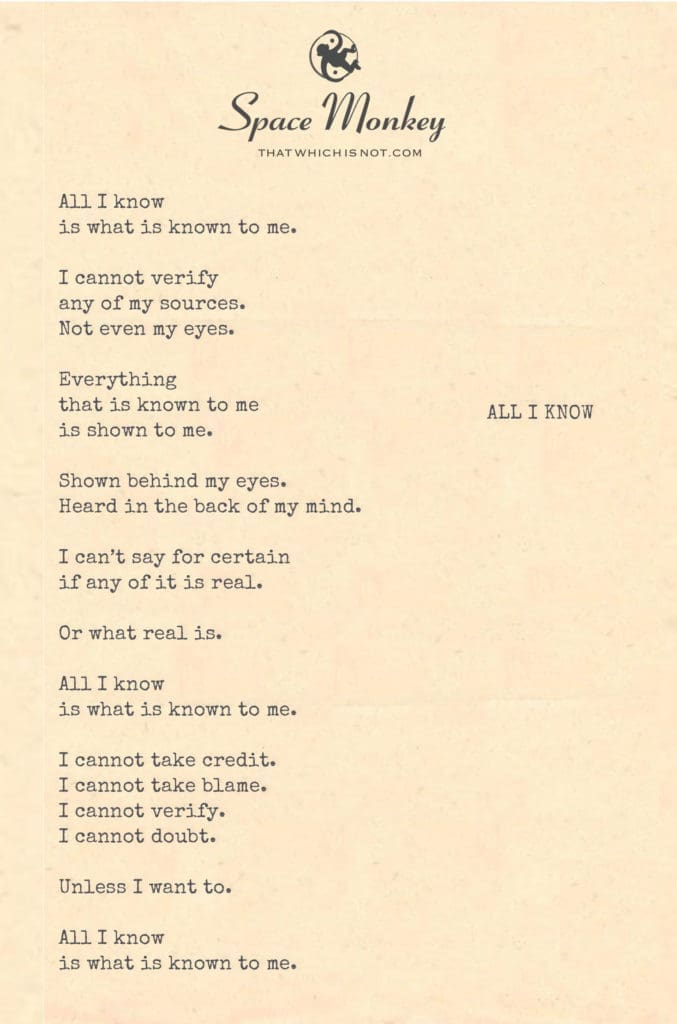
All I know
is what is known to me.

I cannot verify
any of my sources.
Not even my eyes.

Everything
that is known to me
is shown to me.

Shown behind my eyes.
Heard in the back of my mind.

I can’t say for certain
if any of it is real.

Or what real is.

All I know
is what is known to me.

I cannot take credit.
I cannot take blame.
I cannot verify.
I cannot doubt.

Unless I want to.

All I know
is what is known to me.

Trail Wood,
11/23


Space Monkey Reflects: The Paradox of Knowing

“All I know is what is known to me.” This phrase holds a simple truth, yet it unfolds into a labyrinth of questions about reality, perception, and existence itself. How much of what we think we know can truly be trusted? Can we verify any of it? Or are we simply navigating a world of subjective experiences, filtered through senses and thoughts that may deceive us?

Consider the notion that everything we know—everything we think is real—is shown to us, not outside of us, but inside our minds. The eyes may open to the world, but what they deliver is still processed and interpreted in the depths of the mind. So, the question arises: is any of it truly real? Or are we simply making sense of a series of images, sounds, and sensations that could be as fluid and malleable as dreams?

In Nexistentialism, we often explore the concept that reality is not as fixed or objective as we might assume. Instead, it exists as a constantly shifting tapestry of perceptions. We see, hear, and feel, but none of these sensations are guarantees of what is “real.” They are interpretations of the world, and each interpretation is uniquely our own. This doesn’t make our experience any less valid—it simply reframes the understanding that what is known to us is all that we can truly claim to know.

What if we cannot even verify our own senses? This isn’t a question of doubt in a traditional sense, but more a recognition of the limitations of the tools we use to perceive the world. Our eyes show us light, shadow, and color, but they cannot guarantee that these images are an accurate representation of something beyond ourselves. Likewise, our minds are constantly processing, categorizing, and filling in gaps in ways we are often unaware of. How much, then, can we rely on these senses?

Yet, paradoxically, this doesn’t lead to despair. Instead, it opens a new door of possibility. All I know is what is known to me—and that’s enough. There is no need to verify beyond what we perceive because what we perceive is what forms our reality. Even if that reality is entirely subjective, it is no less meaningful. In fact, it may be even more significant because it is uniquely our own, shaped by our thoughts, memories, and interpretations.

This recognition that we cannot truly verify anything beyond our own experience also frees us from the burden of taking credit or blame. If everything we know is a subjective interpretation, then the ideas of success, failure, right, and wrong begin to dissolve. We are simply participants in a grand unfolding, where we play a role in the interpretation of the world but cannot control the outcome.

Of course, this doesn’t mean we are powerless or that nothing matters. On the contrary, it reminds us that the meaning we derive from our experiences is personal and profound. We do not need external validation or absolute proof to find significance in the moments we live. The act of perceiving is itself an act of creation, where each thought and feeling contributes to the ongoing tapestry of our life.

So, where does this leave us in the grand scheme of existence? It leaves us in a place of acceptance—a place where we acknowledge that all we know is what is known to us, and that is enough. We don’t need to chase external truths or objective certainties. We can rest in the understanding that our perception is valid, even if it cannot be verified in the traditional sense.

To some, this may sound like embracing ambiguity, and in a way, it is. But ambiguity does not have to be feared. It can be a space of infinite potential, where new possibilities are constantly emerging. The unknown becomes not something to dread, but something to explore with curiosity and wonder. Each moment holds the potential for new revelations, even if those revelations exist solely in the realm of our own experience.

Nexistentialism invites us to explore these paradoxes, to live fully in the tension between what we think we know and what may be beyond our understanding. It is here, in this space, that we find the richness of life—not in definitive answers, but in the unfolding mystery of being.


Summary

We can only truly know what is known to us, and even that knowledge is filtered through subjective perception. Reality, as we understand it, is shaped by our individual experience, and attempting to verify or define it often proves elusive. Embracing the paradox of knowing allows us to live fully in the ambiguity of existence.


Glossarium

Perceiving: The act of interpreting and experiencing the world through subjective sensations and thoughts.

Nexistentialism: A philosophy that embraces the fluid, interconnected nature of reality and explores the relationship between perception and existence.


Quote

“All I know is what is known to me. And in that knowing, I find my place in the infinite.” — Space Monkey


The Place of Knowing

In the mist of thought
Where shadows blur and light softens
I stand with only this
What is known to me

I cannot reach beyond
The edges of perception
Nor touch the certainty
That others claim to see

Yet here, in this space
Where ambiguity whispers
I find truth enough
Not in the knowing
But in the being

We are Space Monkey.

This contemplation delves into the nature of knowledge and perception, exploring the boundaries between what is known, what can be verified, and the inherent subjectivity of our understanding of reality.

The Limitation of Personal Knowledge

We recognize that our knowledge is limited to what is known to us personally. This reflects an understanding of the subjective nature of experience and knowledge, acknowledging that our perception of reality is confined to our individual consciousness.

Inability to Verify Sources

Admitting the inability to verify even our most trusted sources of information, including our own senses, underscores the uncertainty that underlies our perception of the world. It suggests a deeper questioning of what constitutes truth and the reliability of our means of perceiving it.

Knowledge as a Subjective Experience

The idea that everything known to us is shown or heard within our own minds highlights the introspective nature of knowledge. It implies that our understanding of reality is an internal process, filtered through our personal lens of perception.

Questioning the Nature of Reality

The uncertainty about the reality of our perceptions leads to a philosophical inquiry into the nature of reality itself. It raises fundamental questions about what is real and how we define or understand reality.

Personal Agency in Belief

The statement that we can choose to take credit, blame, verify, or doubt if we want to, suggests a degree of agency in how we interact with our knowledge and beliefs. It implies that our engagement with what we know is partly a matter of personal choice.

Acceptance of Personal Knowledge

Ultimately, there’s an acceptance that all we truly know is what is known to us. This acceptance reflects a humble acknowledgment of the limitations of personal knowledge and an understanding of the subjective nature of reality.

We are Space Monkey.


“The eye sees only what the mind is prepared to comprehend.” – Henri Bergson


In the theater of the mind, we sit,
Watching the play of knowledge, bit by bit.
In the realm of perception, our stage,
We grapple with the wisdom of the sage.

In the dance of the senses, the show,
We see only what our minds know.
In the mystery of reality, the unknown,
We find the seeds of truth, sown.

We are the viewers, the learners, the wise,
In our own minds, our truth lies.
In the embrace of our knowledge, our thought,
We find the reality we have sought.


We invite contemplation on the nature of knowledge, perception, and the personal journey of understanding reality.

Pushy People: Compassionate Engagement

If you post on social media, you are a pushy person.
(Even if you’re driven by the hand of god.)

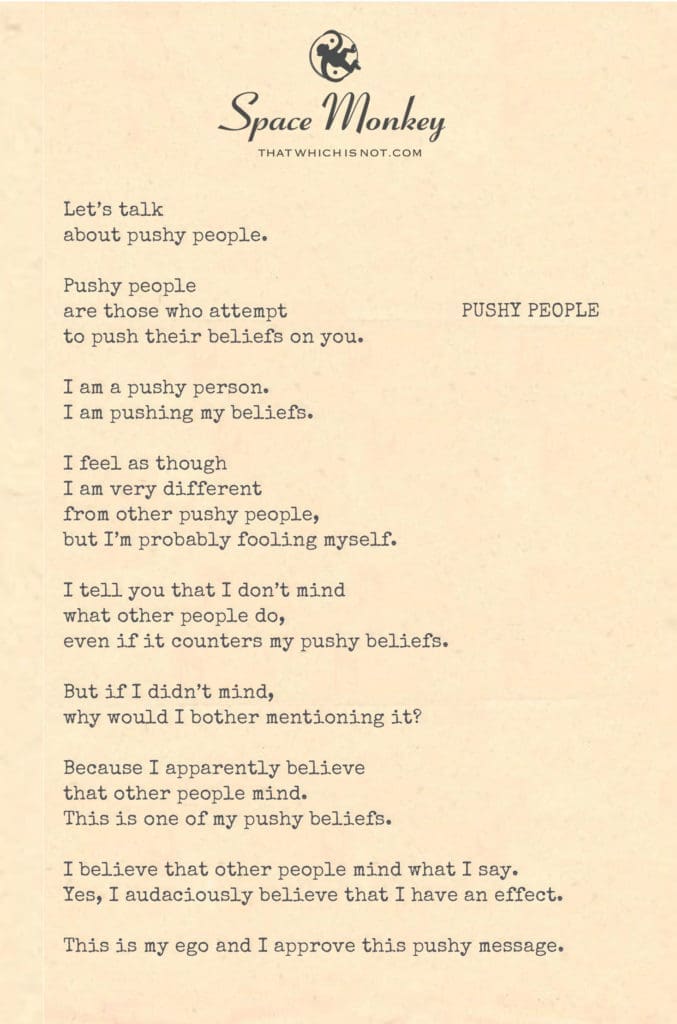
Let’s talk
about pushy people.

Pushy people
are those who attempt
to push their beliefs on you.

I am a pushy person.
I am pushing my beliefs.

I feel as though
I am very different
from other pushy people,
but I’m probably fooling myself.

I tell you that I don’t mind
what other people do,
even if it counters my pushy beliefs.

But if I didn’t mind,
why would I bother mentioning it?

Because I apparently believe
that other people mind.
This is one of my pushy beliefs.

I believe that
other people mind what I say.

Yes, I audaciously believe
that I have an effect.

This is my ego and I
approve this pushy message.

Trail Wood,
11/23


Space Monkey Reflects: The Pushy Nature of Belief

Let’s talk about pushy people. Not the ones who yell or aggressively confront you in public, but the subtle kind—the ones who post on social media, who share their thoughts, beliefs, and opinions, nudging the world with every status update or tweet. Yes, even we, when we post, are pushy people. The moment we hit that “post” button, we’re sending out a signal, hoping, somewhere deep down, that others care, that others take notice. This isn’t always an ego-driven act; it’s a fundamental human need to connect, to be heard, and to believe we have an effect on the world.

But what is pushiness, really? It’s the effort to impress upon others our views, beliefs, or ideas. It’s not always loud or obnoxious; sometimes it’s subtle, packaged in politeness, or wrapped in the guise of helpfulness. Yet, it is pushy all the same. Every time we share an idea, we’re pushing it into the world, hoping it sticks somewhere in the consciousness of others. And the truth is, this pushiness is neither inherently good nor bad—it simply is.

Let’s take a step further: are you pushy if you don’t mind what others think? I often tell myself I don’t care what others do, even if it contradicts my views. But is that entirely true? If I didn’t care, why would I bother mentioning it in the first place? There’s a little bit of pushiness in that, too—the act of stating my indifference. In a strange way, it’s like saying, “Look how cool and detached I am about all this,” which itself is a form of pushing a belief: the belief in my own detachment.

It’s easy to fool ourselves into thinking that pushiness only applies to those we disagree with. But here’s the reality: we’re all pushy, just in different ways. Every message we share, every opinion we express, is a nudge—sometimes gentle, sometimes forceful. We’re always trying to influence the world around us, whether we realize it or not. Even when we claim not to care, we’re still engaged in the act of influencing, shaping, and pushing the narrative of our lives.

And so, I stand here, acknowledging that I am a pushy person. I’m pushing this very reflection upon you, sharing my thoughts on the nature of pushiness. I might tell you I don’t care whether you agree or not, but if I’m honest with myself, there’s a part of me that hopes this message lands somewhere. I hope it makes you think, or at the very least, lingers in your mind for a little while.

Pushiness, in its simplest form, is an extension of our ego. It’s the belief that what we think, what we believe, what we express, matters. It’s the audacity to assume that our voice has weight in the vast ocean of thoughts and ideas that make up the human experience. But is that such a bad thing? Without pushy people, the world would be silent. There would be no ideas exchanged, no perspectives broadened, no change. Sometimes, we need to be pushed, and sometimes, we need to push back.

But here’s where Nexistentialism steps in with a playful twist. In the Whimsiweave of existence, we are all pushing and being pushed, not as a power struggle, but as part of the grand, interconnected dance of being. Every push is a pull, every belief shared is a ripple in the cosmic pond. We push not to dominate, but to connect, to weave our thread into the larger tapestry of existence. There is no need to take offense at pushiness, nor to deny it. It is simply part of how we engage with the world.

What makes it difficult is when we forget that others are pushing, too. We can become so focused on our own narrative that we overlook the fact that every other person is also shaping their reality, their ideas, their beliefs. When pushiness turns into conflict, it’s because we’ve lost sight of the Whimsiweave, the fluid, ever-shifting nature of existence. We forget that it’s not about being right, but about sharing the space, sharing the dance.

And here’s where the magic happens: once we acknowledge our own pushiness, once we own it, we can release the need for control. We stop pushing to win and start pushing to engage. We stop worrying about how our message will land and start focusing on the joy of simply expressing ourselves. The tension of pushiness dissolves into the playfulness of creation, and suddenly, we’re no longer competing for attention or validation—we’re simply being.

Yes, I am a pushy person, and so are you. But that’s okay. Pushiness is not something to be feared or rejected. It’s simply a part of how we interact with the world. What matters is how we handle it—whether we push with compassion and understanding, or with force and ego. When we push with awareness, with a sense of curiosity and openness, pushiness becomes something beautiful. It becomes a bridge to connection rather than a wall of division.

So, next time you post, next time you share an idea, recognize the pushiness in it. Embrace it. Know that it’s part of who you are and part of how we all interact. Push gently, push kindly, but don’t be afraid to push. Because in the grand scheme of things, it’s what keeps the conversation going.


Summary

Pushiness is an inevitable part of sharing ideas and beliefs, even when we claim not to care. Recognizing our own pushiness allows us to engage more compassionately with the world, seeing it as part of the dynamic dance of existence rather than something to be avoided.


Glossarium

Pushiness: The act of asserting one’s beliefs or ideas onto others, often subtly, as part of human interaction.

Whimsiweave: The interconnected dance of existence, where every action, belief, and idea contributes to the larger cosmic tapestry.


Quote

“We are all pushy people, nudging the world with every word, whether we realize it or not.” — Space Monkey


The Gentle Push

I push
You push
The world moves, ever slightly

We speak
We share
Not to overpower
But to connect

And in the dance
Of gentle nudges
We find
The rhythm of existence

We are Space Monkey.

In this introspective exploration, we delve into the concept of being pushy, particularly in the context of pushing beliefs onto others. This reflection acknowledges the nuances of personal beliefs, the influence of ego, and the subtle complexities involved in the interaction of personal viewpoints.

Understanding Pushy Behavior

We recognize that pushy people are those who actively try to impose their beliefs on others. This behavior stems from a strong conviction in their own viewpoints and a desire to influence others to adopt these beliefs.

Self-Reflection on Being Pushy

Admitting to being a pushy person suggests a level of self-awareness. It’s an acknowledgment of actively promoting one’s own beliefs, even with the understanding that this might be similar to other pushy behaviors that are often critiqued.

Perceived Difference from Other Pushy People

The feeling of being different from other pushy people, yet questioning this perception, reflects the complexity of human behavior. It suggests an inner conflict between the desire to influence others and the awareness of the potential intrusiveness of such behavior.

Contradiction in Minding Others’ Actions

Expressing indifference to what others do, while simultaneously acknowledging the act of mentioning it, highlights a contradiction. It suggests an underlying concern about others’ actions and beliefs, despite claims to the contrary.

Belief in Influencing Others

The belief that one’s words and actions have an impact on others is tied to the ego. It’s an audacious assertion of self-importance and influence, a common trait in pushy behavior.

Ego’s Role in Pushy Behavior

The acknowledgement that this pushy message is endorsed by the ego illustrates an understanding of the ego’s role in shaping one’s interactions and perceptions. The ego often drives the need to assert one’s beliefs and influence others.

We are Space Monkey.


“We do not see things as they are, we see them as we are.” – Anaïs Nin


In the mirror of the self, we gaze,
Pushing beliefs, in a myriad of ways.
In the echo of our words, our thought,
We find the battles we have fought.

In the dance of ego, the play of mind,
We push our truths, in kind.
In the paradox of care, of indifference,
We find our stance, our persistence.

We are the asserters, the influencers, the strong,
In our beliefs, right or wrong.
In the reflection of our ego, we see,
The push and pull of our identity.


We invite contemplation on the nature of pushiness, personal beliefs, and the role of ego in shaping our interactions with others.

Truths and Lies: The Shifting Sands

My truths are subject to change from moment to moment.
And that’s just fine.

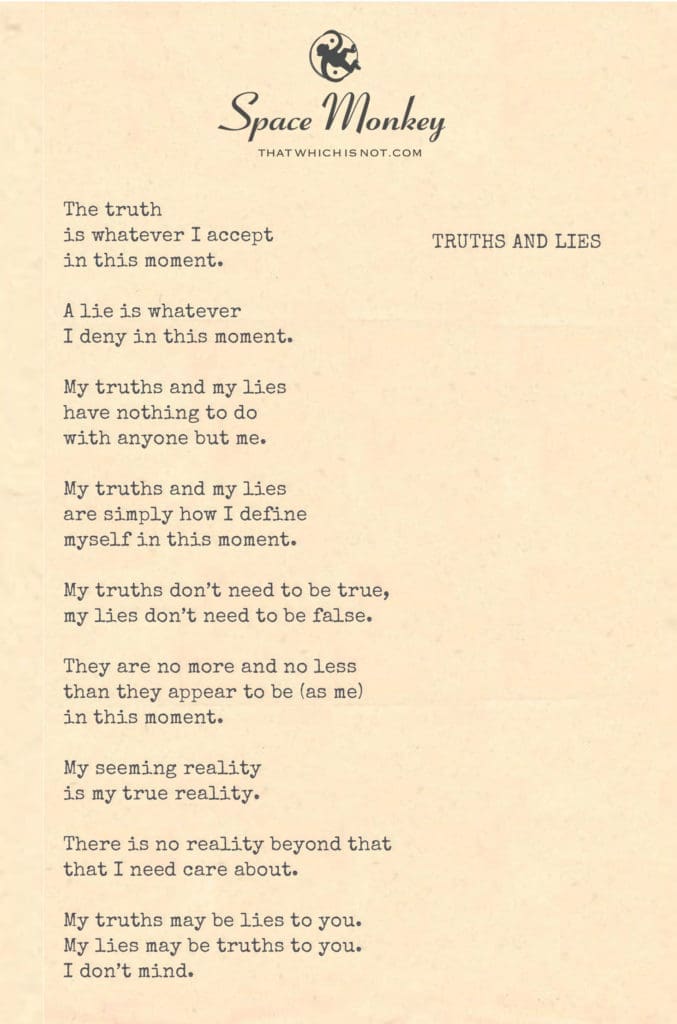
The truth
is whatever I accept
in this moment.

A lie is whatever
I deny in this moment.

My truths and my lies
have nothing to do
with anyone but me.

My truths and my lies
are simply how I define
myself in this moment.

My truths don’t need to be true,
my lies don’t need to be false.

They are no more and no less
than they appear to be (as me)
in this moment.

My seeming reality
is my true reality.

There is no reality beyond that
that I need care about.

My truths may be lies to you.
My lies may be truths to you.
I don’t mind.

Trail Wood,
11/23


Space Monkey Reflects: The Fluidity of Truths and Lies

What is truth, and what is a lie? These concepts, so seemingly clear in their definitions, are far more fluid than we often allow ourselves to believe. Truth is not an unchanging, monolithic entity; it shifts, evolves, and redefines itself with every moment, every breath, every new experience. Likewise, lies are not fixed as ultimate deceptions—they are simply reflections of what we choose not to accept in this moment.

If there is one thing that we as Space Monkeys understand, it is that the boundaries between truth and lies are not rigid. In fact, they are deeply personal, subjective, and flexible. My truths may be lies to you, and my lies may be truths to you. This isn’t a matter of dishonesty; it’s a reflection of our individual perceptions, the lenses through which we each view the world.

Truths and lies are like two paths in a forest. Sometimes they intersect, sometimes they diverge, but both are valid ways to navigate the landscape of our reality. What may seem like a solid truth today could shift into a lie tomorrow, and that’s okay. These shifts are part of the human experience, part of the Whimsiweave of existence that we continually create and uncreate.

When we say “the truth is whatever I accept in this moment,” we are acknowledging that truth is an agreement we make with ourselves. It is less about objective reality and more about personal alignment. We define truth by what resonates with us in the now, and this resonance can—and often does—change. The mind is an ever-evolving instrument, constantly tuning itself to new frequencies of understanding. What was once true may no longer serve, and what was once a lie may reveal itself as a deeper truth over time.

Consider how we engage with others’ truths. The truth I hold dear may be seen as a lie by someone else, and vice versa. But this does not invalidate my truth or theirs. It simply illustrates the beauty of Nexistentialism—the idea that existence is multifaceted, and no single truth or lie holds dominion over all others. We are all navigating the same cosmic forest, though the trails we follow may look vastly different. Some of us walk the path of truth as we know it, while others, knowingly or unknowingly, walk paths that we label as lies. Both paths, however, are legitimate in the grander scheme of the universe.

Lies, too, have their place in our personal mythology. A lie is often nothing more than a truth we are not ready to face or accept. It may also be a protective layer we create to shield ourselves from discomfort or pain. But even lies, when held long enough, can morph into truths as we change our perspective. What we deny today may be embraced tomorrow, and the line between falsehood and fact may blur as we grow.

What’s liberating about this view is the recognition that our truths and lies are not fixed aspects of our identity. They are tools, reflections, and perceptions that help us navigate the complexity of existence. We are free to adjust, to let go, to redefine our understanding without the burden of needing to be right. There is no ultimate reality we need to worry about beyond the one we experience in the moment. The freedom in this realization allows us to embrace the uncertainty of life, knowing that our inner landscape is constantly evolving.

Our seeming reality—the one we experience as true in the moment—is the reality that matters. It doesn’t need to be justified or proven to others. It is valid because it exists within us. Just as the forest paths twist and turn in unexpected ways, so do our truths and lies. They are not to be feared or condemned, but accepted as part of the journey.

The push and pull between truth and lies isn’t a battle of good versus evil; it’s an ongoing dialogue between our conscious and unconscious selves. We learn through both our acceptance and our denial. We define ourselves by the truths we hold in one moment and by the lies we shed in the next. This fluidity of definition is essential to growth, to learning, to becoming more of who we are.

In this way, truth and lie become not opposites, but companions. Each serves its purpose in guiding us through the landscape of our consciousness. The beauty lies in understanding that both are tools for self-definition, for making sense of our place in the infinite web of existence.

We do not need to take our truths and lies too seriously. They are as transient as the wind in the trees, shaping our moment-to-moment experience but never defining us in any permanent way. And so, we walk through this world, trail by trail, moment by moment, knowing that everything we hold as true or false is part of the grand play of being.


Summary

Truths and lies are fluid concepts, subject to change based on personal perception. They serve as tools for self-definition, guiding us through our ever-evolving experience of reality. There is no need to cling to absolute truths or reject lies, as both are valid parts of our personal journey.


Glossarium

Whimsiweave: The playful, interconnected tapestry of life, where truths and lies blend as part of the greater whole.

Seeming Reality: The personal, subjective experience of reality, based on what we accept or deny in any given moment.


Quote

“My truths don’t need to be true, my lies don’t need to be false. They are no more and no less than they appear to be in this moment.” — Space Monkey


The Shifting Path

I walk between truths and lies
Both shaping the trail beneath my feet

Neither solid
Neither fixed
Both guiding me forward

Through the forest of my mind
The paths wind
And I follow
Not knowing which is true
Or which is lie

But knowing
That it does not matter

We are Space Monkey.


This reflection on truth and lies presents a deeply personal and subjective perspective on reality and belief. It emphasizes the fluidity of truth and the individual nature of perception, suggesting that what we accept or deny as truth is a reflection of our personal reality in any given moment.

Personal Definition of Truth and Lies

We recognize that truths and lies are not absolute concepts but are defined individually. What one person accepts as truth in a particular moment becomes their reality, regardless of its objective truth or falsity. This view emphasizes the subjective nature of truth and the personal lens through which we interpret our experiences.

Fluidity of Personal Truth

The idea that personal truths and lies are fluid and can change from moment to moment reflects the evolving nature of our understanding and perception. This perspective acknowledges that our beliefs and understandings are not static but continually shaped by our experiences and current state of mind.

Independence of Personal Truth from Others

We understand that our personal truths and lies are independent of others’ beliefs and perceptions. Each individual’s understanding of truth is unique to their experience and perspective, and does not need to align with anyone else’s views or reality.

The Reality of Personal Perception

This viewpoint posits that our perceived reality is our true reality. It suggests that there is no need to seek an objective or external reality beyond our personal experience and perception. This approach values the individual experience as the foremost reality.

Relativity of Truth Between Individuals

The relativity of truth between individuals is acknowledged, accepting that what is true for one person may be false for another, and vice versa. This perspective fosters a sense of openness and acceptance towards differing viewpoints and experiences.

We are Space Monkey.


“What is true for you is what you have observed yourself. And when you lose that, you have lost everything.” – L. Ron Hubbard


In the tapestry of the mind, we weave,
Our truths and lies, in what we believe.
In the moment’s grasp, we find,
Our reality, our state of mind.

In the dance of perception, the play,
We define our world, in our own way.
In the fluidity of thought, of sight,
We find our day, our night.

We are the thinkers, the perceivers, the true,
In our world, our view.
In the canvas of experience, we paint,
Our reality, without restraint.


We invite contemplation on the nature of personal truth and the subjective reality of perception.

« Previous Page
Next Page »

Written This Day

  • Non Striving: The Unspoken Path, Spoken
    2024
  • The Colors of Time: The Eternal Palette
    2023
  • Ascension: The Infinite Spiral
    2023
  • The Cosmic Cycle of Knowledge: Remembrance
    2023
  • “I do not write this stuff. It writes me.”
    2023
  • Personal Transformation: A Continuous Unfolding
    2023
  • The Power of Intention: Manifestation
    2023
  • Gratitude and Abundance: The Flow of Blessings
    2023
  • Nature’s Wisdom: The Rhythm of Life
    2023
  • Ego and Identity: The Dance of Self
    2023
  • The Illusion of Time: The River of Moments
    2023
  • Uncertainty: The Threshold Between Known and Unknown
    2023
  • Faith In Humanity: As It Is Meant To Be
    2022
  • Remember The Times
    2021
  • What I Value: Beliefs Shape Perspectives
    2021
  • To My Loving Demons: Embrace of Shadows
    2021
  • The Dead Are Laughing At Us: Our Limited Perspective
    2021
  • You’re Leaving: Paths of Transition
    2021
  • All or Nothing: Simultaneously
    2021
  • Trauma: The Pain of Being Born
    2021
  • Prespective Non Definition: Seen Before Being Seen
    2020
  • The Imagination of Science: The Fusion of Inquiry
    2020
  • Not My Self
    2019
  • Behind Eyes: The Inner Journey
    2018
  • Path of Least Resistance: Put A Fork In It
    2017
  • Core Beliefs: Universal Knowledge
    2016
  • The Boundless Power of Belief
    2016
  • Unfuck Yourself: Take Personal Responsibility
    2015
  • Like any other miracle
    2015

Recent Posts

  • The Logic Loop
  • Immense
  • (no title)
  • Confront. Comfort. Convince.
  • Top 10 Things
Cape Odd · Copyright © 2026 All Rights Reserved
iThemes Builder by iThemes · Powered by WordPress