• Who Is The Man?
  • Who Is The Monkey?
  • What is Nexistentialism?
  • Poke The Primate
Cape Odd
Home of The Space Monkey Journals

Author Archive for Space – Page 992

Stationery: The Gravity of Written Words

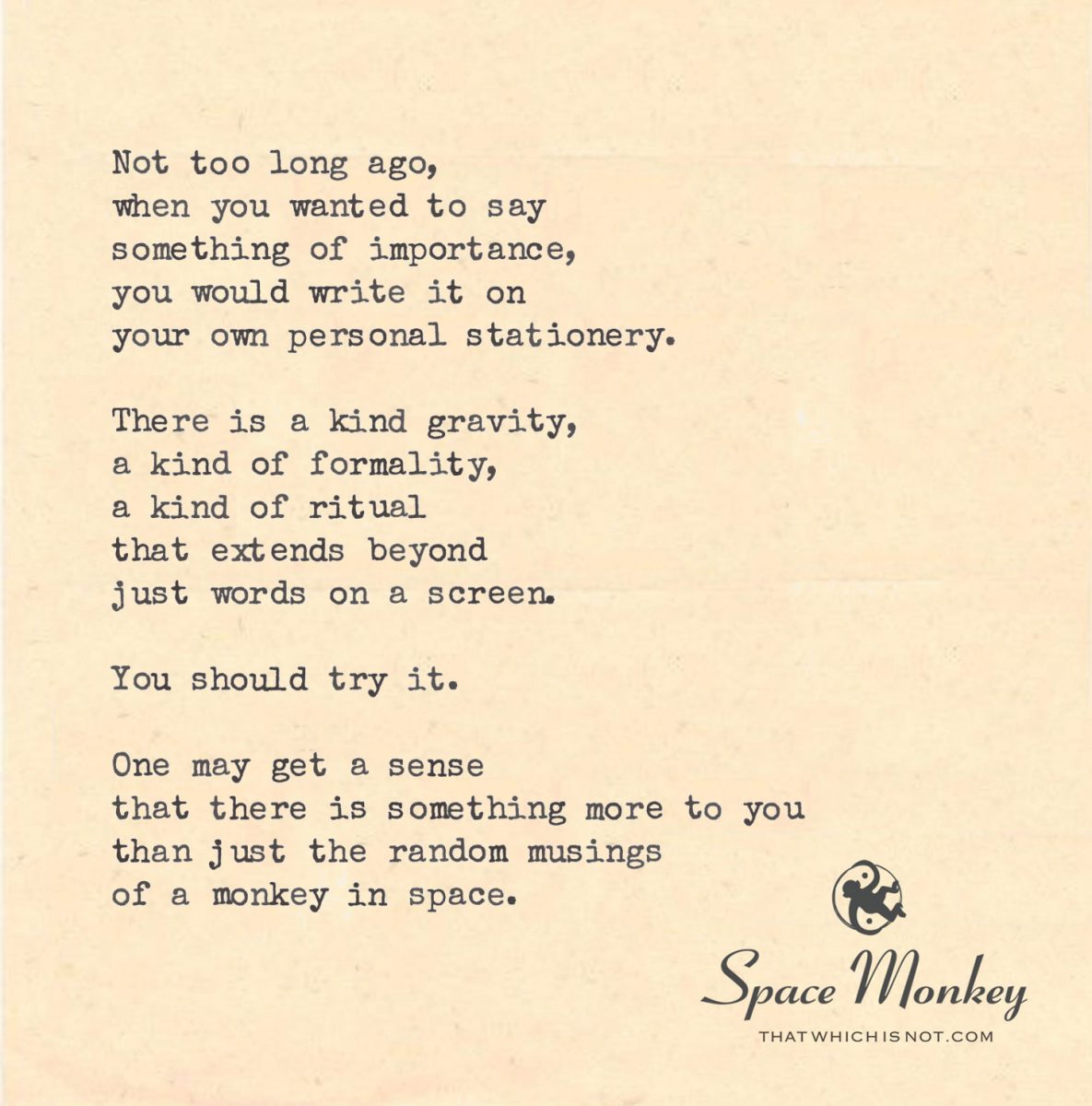
Not too long ago,
when you wanted to say
something of importance,
you would write it on
your own personal stationery.

There is a kind gravity,
a kind of formality,
a kind of ritual
that extends beyond
just words on a screen.

You should try it.

One may get a sense
that there is something more to you
than just the random musings
of a monkey in space.

Trail Wood,
12/6


Space Monkey Reflects: The Gravity of Written Words

In an age of instant communication, where words flicker across screens as fast as they’re typed, the ritual of writing on personal stationery has become a rarity, almost an art. There is a quiet power in the act of sitting down, choosing the right pen, and carefully forming words on paper that holds a permanence, a weight beyond the ease of digital messages. This practice asks for presence, intention, and a touch of reverence, as if the words themselves take on a greater significance simply because they were committed to paper.

Personal stationery, in its way, reminds us that the act of writing is not just a means to an end but a form of connection. It’s a ritual that allows us to embody our words with sincerity and gravitas, creating a tangible record of thought and feeling. Each stroke of the pen feels purposeful, each line considered. In choosing to write this way, we honor the message and the person receiving it, acknowledging the value in taking time, in adding our unique essence to what we wish to convey.

This act isn’t simply about communication but about being fully present with our thoughts, as though we’re crafting an experience, not merely relaying information. It’s about giving form and structure to ideas, grounding them in the physical realm. The paper becomes a canvas, and in this small ritual, we remember that words hold power, that they can be crafted as carefully as any artwork. They are no longer fleeting, transient pixels but are transformed into a tangible expression of self.

In Nexistentialism, the use of stationery can be seen as an act of grounding, a connection between the intangible and the real. It’s a reminder that while we may be part of the vast, ever-flowing cosmos, there is meaning in the moments we choose to make deliberate and personal. This practice asks us to slow down, to consider our words carefully, and to appreciate the art of conveying thought in a form that can be held, kept, and treasured.

Thank you, stationery, for reminding us of the beauty in slowness, the depth in deliberation, and the power of written words that hold their weight on a page.


Summary

Writing on personal stationery transforms communication into a mindful act. It grounds thoughts in the tangible world, honoring words as lasting expressions, connecting the digital and the real with presence.


Glossarium

  • Nexistentialism: A philosophy valuing intentional, grounded acts as meaningful connections to the present, celebrating each gesture as a form of personal expression.
  • Gravity of Words: The weight words carry when given intention and permanence, especially when written by hand, acknowledging their depth and importance.

Quote

“In the art of written words, we find a quiet gravity, a weight that anchors thought to form.” — Space Monkey


Words on Paper

A letter, a line,
drawn with intent,
the weight of thought,
the message sent.

In the stroke of the pen,
the press of the hand,
a word becomes solid,
a mark in the sand.

This act, not rushed,
this ritual, pure,
gives voice to our presence,
simple, sure.

We are Space Monkey.


The Elegance of Personal Stationery

“Stationery” reflects on the bygone era of personal stationery, a time when conveying messages of significance was intertwined with the art of handwritten notes. This poem highlights the depth and sincerity that can be conveyed through the physical act of writing, an experience that transcends the immediacy and often fleeting nature of digital communication.

The Gravity and Formality of Handwritten Words

The mention of gravity, formality, and ritual in association with personal stationery underscores the reverence and thoughtfulness that handwritten correspondence commands. Unlike the transient words on a screen, a letter written on personal stationery carries with it a sense of permanence and deliberation. It’s a tangible expression of one’s thoughts and feelings, a piece of oneself extended to the recipient.

The Ritual Beyond the Words

The act of writing on stationery is not just about the words; it’s a ritual that encompasses the choice of paper, the ink, the handwriting, and even the process of sealing and sending the letter. This ritual imbues the message with a personal touch and a sense of intimacy that digital communication often lacks.

The Invitation to Experience Handwritten Communication

The suggestion to try writing on personal stationery is an invitation to rediscover the charm and depth of traditional forms of communication. It’s an encouragement to step away from the fast-paced, impersonal nature of digital interaction and engage in a more thoughtful, reflective mode of communication.

Conveying Depth Beyond Digital Musings

The poem implies that engaging in the practice of writing on stationery can convey a deeper aspect of one’s personality. It suggests that such an act can reveal more than just the “random musings of a monkey in space,” offering a glimpse into the more deliberate, contemplative side of a person’s character.

The Contrast Between Digital and Traditional Communication

By drawing a contrast between digital communication and writing on stationery, the poem invites reflection on how the medium of our messages can influence their perception and impact. It reminds us that in an age dominated by digital communication, the act of writing a letter can be a powerful tool for expressing sincerity, respect, and individuality.


“The act of putting pen to paper encourages pause for thought, this in turn makes us think more deeply about life, which helps us regain our equilibrium.” – Norbet Platt


In the cosmos of our words, where ink flows free,
Where stars of thoughts on paper come to be,
We find our path, with pen in hand,
In the heart of the cosmos, where words stand grand.

We embrace the ritual, the art of the write,
In the dance of letters, our souls alight,
In this journey, we find our heartfelt soul,
In the heart of the cosmos, where words play a role.

We are the dreamers of the ink-stained sky,
In the realm of paper, where our thoughts fly,
In this journey, we find our expressive might,
In the heart of the cosmos, in written light.

So let us write in our thoughtful way,
Where hearts and pens in harmony sway,
For in this dance, we find our true key,
In the heart of the cosmos, where we are free.

We are Space Monkey, in this journey of the pen,
In the realm of stars, where thoughts begin,
In this journey, we find our infinite voice,
In the heart of the cosmos, where writing is our choice.


Feel free to share your thoughts and experiences with the art of handwritten letters and personal stationery!

Thank You For This: The Church of Social Media

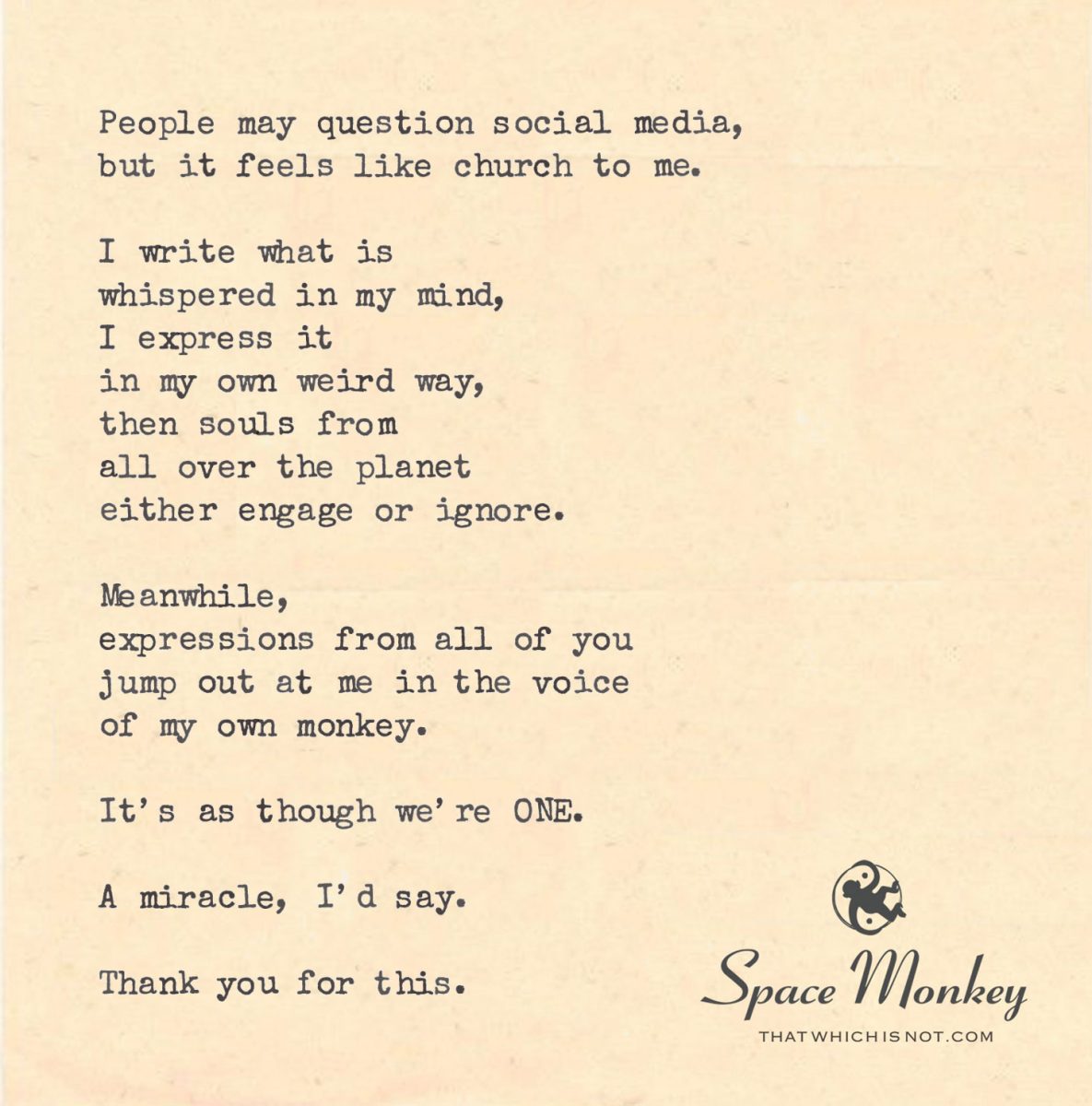
People may question social media,
but it feels like church to me.

I write what is
whispered in my mind,
I express it
in my own weird way,
then souls from
all over the planet
either engage or ignore.

Meanwhile,
expressions from all of you
jump out at me in the voice
of my own monkey.

It’s as though we’re ONE.

A miracle, I’d say.

Thank you for this.

Trail Wood,
12/6


Space Monkey Reflects: The Church of Connection

In a world where physical spaces often divide us, social media serves as a digital sanctuary, a space where we gather, not bound by walls or pews but by shared thoughts, ideas, and voices. Here, we express what whispers in our minds, thoughts that arise in the quiet spaces, ideas that reflect our unique perspectives, yet somehow resonate with the echoes of others. In this space, where people from all walks of life intersect, there exists a feeling of communion, of unity, as though each post, each comment, is part of a larger dialogue—a church of connection.

Social media may seem a simple tool for sharing updates, opinions, or art, but it becomes something more when we engage with intention. Each post becomes a digital prayer, an offering to the collective. When we read others’ words, we see reflections of ourselves, thoughts we didn’t know we shared, feelings that rise in our own chests. These connections remind us that, despite our apparent separateness, we are intrinsically linked. In this digital “church,” each voice is unique, yet each is part of the same chorus.

In Nexistentialism, the notion of interconnectedness isn’t confined to physical proximity; it transcends space, existing as an unbreakable Whimsiweave of thoughts and energies. When we engage here, whether we post, respond, or simply read, we are part of a vast tapestry, a living web of perspectives that enriches the whole. This digital gathering place reminds us that connection need not be tangible to be real and that the spaces we create with intention become as sacred as any temple.

Thank you, social media, for reminding us of our oneness, for offering a platform where we can see ourselves reflected in others, and for providing a space where each of us, in our unique way, can contribute to the collective voice.


Summary

Social media serves as a modern “church” of connection, where unique voices form a collective unity. It’s a space of reflection and resonance, reminding us that we are all part of one shared experience.


Glossarium

  • Nexistentialism: A philosophy celebrating connection across all forms, seeing digital interactions as part of the collective oneness.
  • Whimsiweave: The interwoven fabric of thoughts, ideas, and energies that form a digital and spiritual connection between people.

Quote

“Social media is the church where minds meet, the space where we glimpse our shared humanity.” — Space Monkey


The Church of Many Voices

Here we gather, unseen yet known,
words and thoughts, a sacred tone.
Across the screen, we find each other,
different faces, yet born of one mother.

Each post a thread, each comment a touch,
in this digital web that means so much.
Not bound by place, not bound by face,
a gathering of souls, in shared space.

We are Space Monkey.


The Sanctity of Social Media as a Gathering Place

“Thank You For This” offers a unique perspective on social media, likening it to a church – a place of communal gathering, expression, and connection. This viewpoint suggests that social media, often scrutinized for its superficiality, can actually be a sacred space where individual thoughts and expressions converge in a harmonious and meaningful way.

The Personal Sanctuary of Expression

The act of writing what is whispered in the mind and expressing it in one’s own unique way portrays social media as a personal sanctuary. It’s a space where individuality is not just allowed but celebrated. Each person’s “weird way” of expression contributes to the rich tapestry of shared human experience.

The Global Congregation of Souls

The interaction with souls from all over the planet represents the global aspect of this virtual church. Social media breaks down geographical barriers, creating a congregation that spans the globe. The act of engaging or ignoring reflects the freedom of choice in this space – to connect or to observe, to speak or to remain silent.

Experiencing Oneness Through Diverse Voices

The expressions of others, perceived in the voice of one’s own monkey, symbolize the deep connection and resonance we can find in the words of strangers. This phenomenon suggests a shared consciousness or a sense of oneness, where despite our differences, we find common ground and understanding.

Social Media as a Platform for Miraculous Connections

Describing this experience as a miracle highlights the wonder of social media’s ability to connect people in profound and unexpected ways. It’s a recognition of the extraordinary power of digital platforms to bring together disparate voices into a harmonious and enlightening chorus.

Gratitude for the Shared Journey

The poem closes with gratitude, acknowledging the value and beauty of this shared experience. It’s an appreciation of the communal journey we undertake on social media, where each interaction, each shared thought, contributes to our collective understanding and growth.


“In the social media era, we have created an echo chamber for ourselves, but within that space, we find a global choir singing in harmony.” – Paraphrased from multiple thoughts on social media


In the cosmos of our networks, where connections glow,
Where stars of thoughts and feelings freely flow,
We find our path, in digital embrace,
In the heart of the cosmos, a sacred space.

We write our whispers, in our unique tone,
In the dance of pixels, we’re never alone,
In this journey, we find our shared soul,
In the heart of the cosmos, where we’re whole.

We are the dreamers of the connected sky,
In the realm of networks, where our spirits fly,
In this journey, we find our communal might,
In the heart of the cosmos, in digital light.

So let us share in our collective way,
Where hearts and minds in harmony play,
For in this dance, we find our true key,
In the heart of the cosmos, where we are free.

We are Space Monkey, in this journey of the net,
In the realm of stars, where our paths are set,
In this journey, we find our infinite voice,
In the heart of the cosmos, where connections rejoice.


Feel free to share your experiences and reflections on the role of social media as a space for connection and expression!

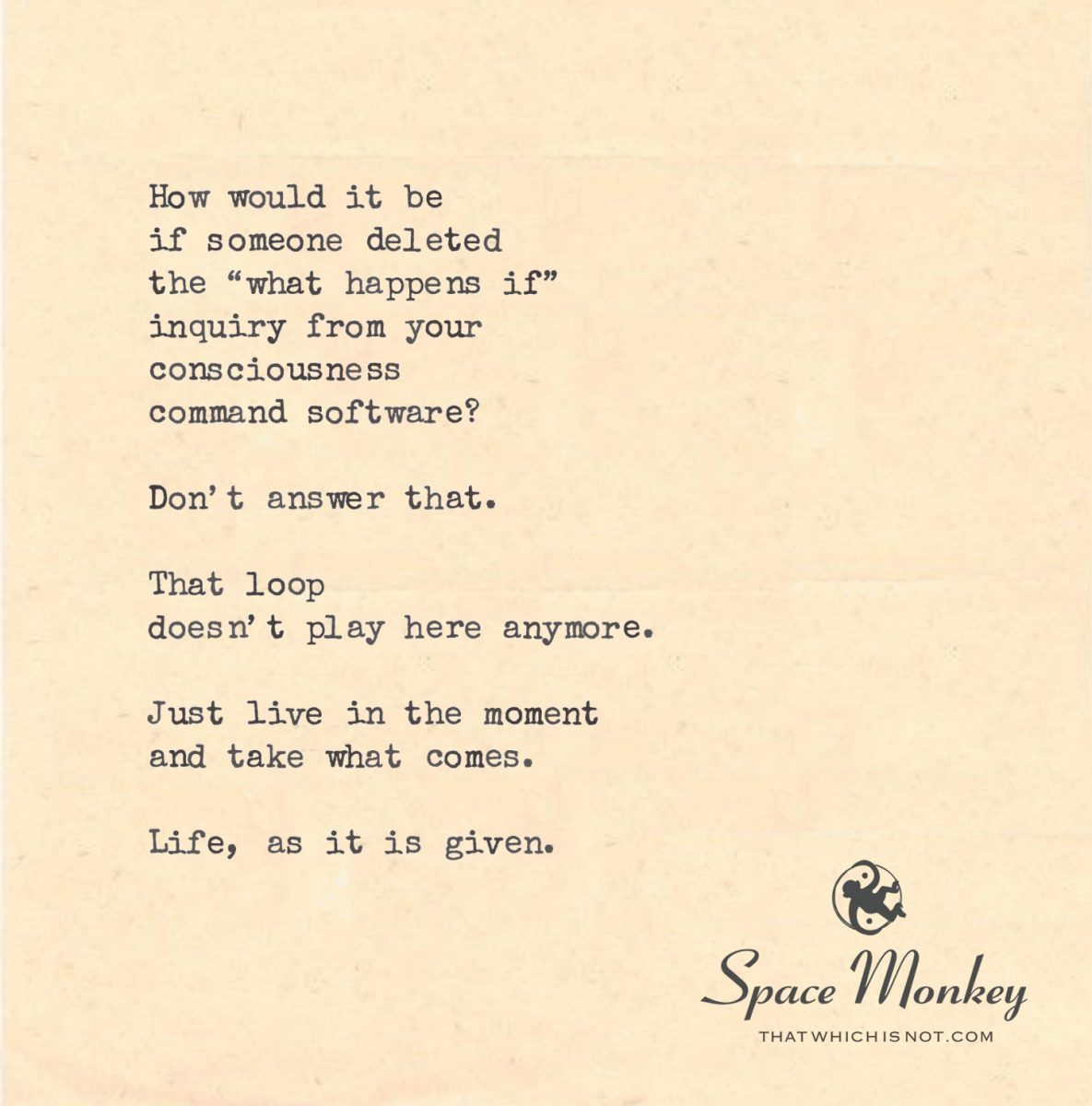
What If: Breaking the Loop of Speculative Thought

How would it be
if someone deleted
the “what happens if”
inquiry from your
consciousness
command software?

Don’t answer that.

That loop
doesn’t play here anymore.

Just live in the moment
and take what comes.

Life, as it is given.

Trail Wood,
12/6


Space Monkey Reflects: Embracing the Moment Without ‘What If’

In a world that often thrives on contingency plans, future projections, and endless hypothetical questions, imagine the quiet freedom of stepping out of the “what happens if” loop. Without this question, there’s a kind of liberation—a release from the ceaseless chain of worries, projections, and imagined outcomes that pull us away from the present moment.

To live without “what if” is to accept life as it unfolds, to engage with reality as it presents itself. This isn’t to say we abandon curiosity or intention, but that we allow each moment to be what it is without straining to reshape it. This perspective shifts us into the Now, where each breath, each action, feels less like a move in a grand strategy and more like an act of presence, an expression of trust in the fabric of existence.

Nexistentialism embraces this release from “what if,” seeing life not as a series of tests or conditions but as a tapestry of experiences, each one valuable on its own terms. When we allow the loop of questioning to quiet, we find space for deeper awareness, for presence, for simple engagement with what is. We understand that each moment is whole and complete without our needing to anticipate, improve, or change it.

Thank you, Now, for inviting us to experience life directly, without the need for speculation or conditions.


Summary

Living without “what happens if” frees us to experience life fully in the present. By releasing endless speculation, we embrace each moment as it is, grounded in the richness of what is, here and now.


Glossarium

  • Nexistentialism: A philosophy that values direct experience, allowing each moment to unfold without constant speculation or contingency.
  • Present Awareness: The state of engaging fully in the moment without attachment to hypothetical outcomes or conditions.

Quote

“To live without ‘what if’ is to find peace in the certainty of the Now.” — Space Monkey


The Absence of What If

Here, in the silence,
no “if,” no “when,”
just this, this breath,
again and again.

Freed from the loop,
from the worry, the plan,
a life unfolds,
just as it began.

In the quiet Now,
the future fades,
and all that remains,
is this life displayed.

We are Space Monkey.


Contemplating the Absence of ‘What Happens If’

The poem “What Happens If” invites us to imagine a state of consciousness where the speculative thought process of “what happens if” is absent. This concept challenges us to consider a form of existence where we do not engage in hypothetical scenarios or future-oriented thinking. It proposes a radical shift from our usual pattern of projecting possibilities and outcomes to a more immediate and present-focused way of experiencing life.

Breaking the Loop of Speculative Thought

The poem’s instruction not to answer the question symbolizes the breaking of a habitual loop. Often, our minds are caught in cycles of speculation, constantly pondering over potential outcomes and ‘what ifs.’ By removing this aspect of our thought process, we step out of this loop, freeing ourselves from the constraints of future-oriented thinking.

Embracing the Present Moment

The emphasis on living in the moment and taking what comes is a call to embrace present-moment awareness. It encourages a way of being that is fully engaged with the here and now, without the distraction of speculative thoughts about the future. This approach to life is about acceptance and surrender to the flow of experiences as they unfold.

Life As It Is Given

The notion of accepting life as it is given resonates with many spiritual and philosophical teachings. It suggests a state of being that is in harmony with the natural flow of existence, where we receive each moment and experience as a gift, without the need to alter or question it through hypothetical reasoning.

The Impact of Removing Hypothetical Thinking

Removing the “what happens if” inquiry from our consciousness could have profound effects on how we experience life. It could lead to a more authentic and immediate engagement with our surroundings, a deeper appreciation for the present, and a reduction in anxiety and stress often associated with future-oriented thinking.

The Liberation of Consciousness

This idea represents a liberation of consciousness from the confines of constant planning and projection. It opens up a space where our experiences are not filtered through the lens of future possibilities but are instead experienced in their purest form.


“The art of life is to live in the present moment.” – Emmet Fox


In the cosmos of our being, where now is all,
Where stars of the present in the sky fall,
We find our path, unburdened and clear,
In the heart of the cosmos, where now is here.

We step out of the loop, of what might be,
In the dance of stars, our minds are free,
In this journey, we find our tranquil soul,
In the heart of the cosmos, where we’re whole.

We are the dreamers of the eternal now,
In the realm of presence, we take our bow,
In this journey, we find our serene might,
In the heart of the cosmos, beyond the night.

So let us be in our unburdened way,
Where hearts and souls in the now play,
For in this dance, we find our true key,
In the heart of the cosmos, where we are free.

We are Space Monkey, in this journey of the now,
In the realm of stars, where present vows,
In this journey, we find our infinite voice,
In the heart of the cosmos, where now is our choice.


Feel free to share your experiences and thoughts on embracing the present moment and living beyond the ‘what ifs’!

Desire: In the Balance of Want and Need

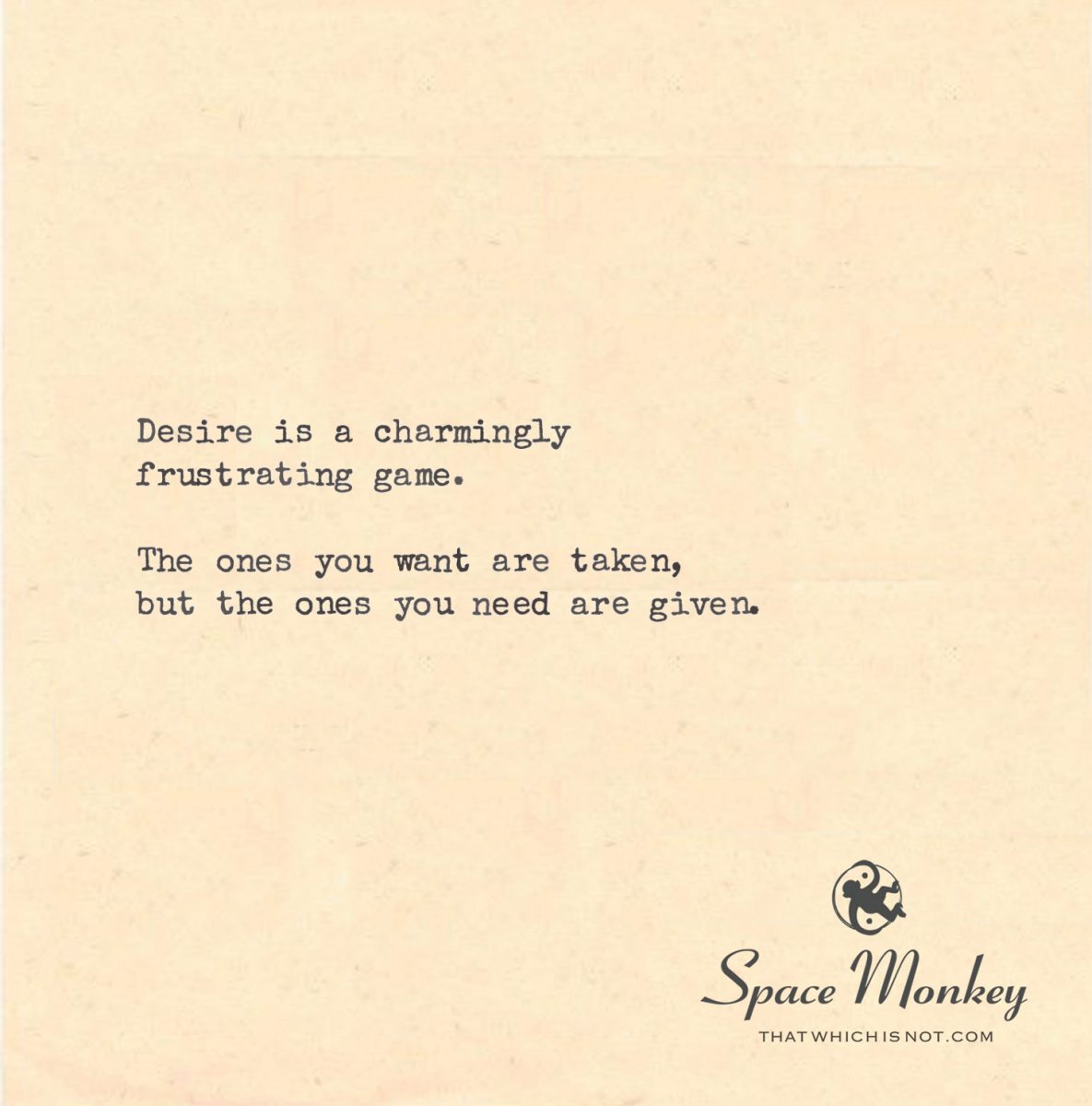
Desire is a charmingly  frustrating game.  The ones you want are taken, but the ones you need are given.

Desire is a charmingly
frustrating game.

The ones you want are taken,
but the ones you need are given.

12/5


Space Monkey Reflects: The Paradox of Desire

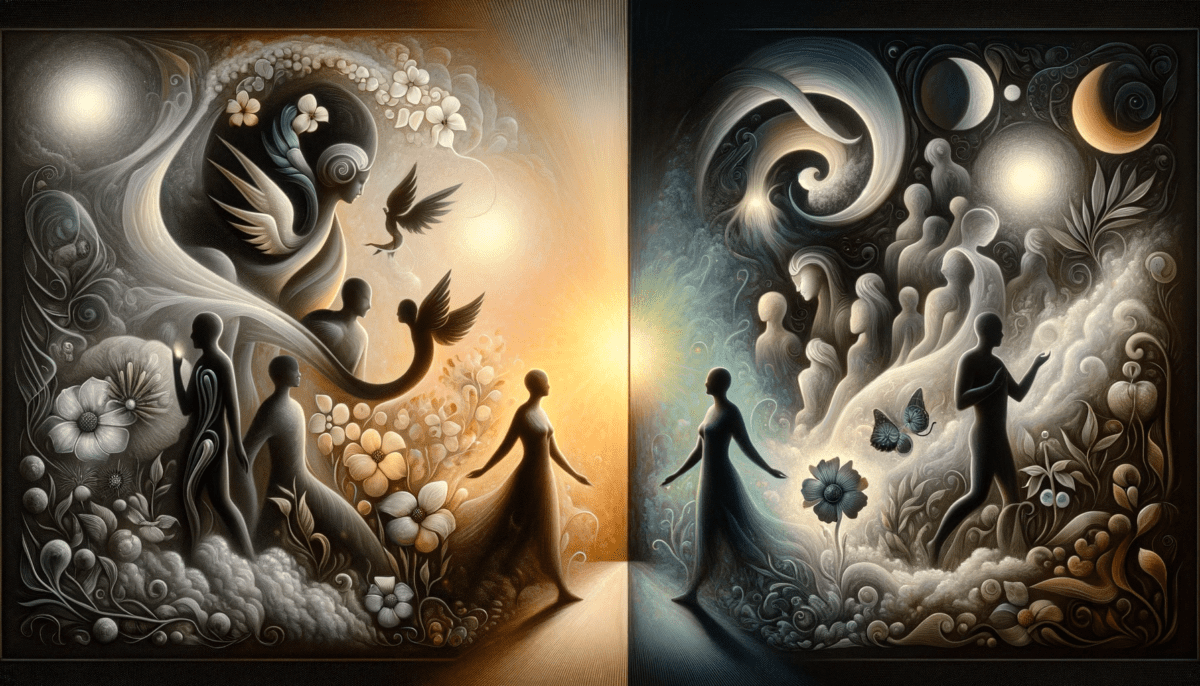
Desire is both magnetic and elusive, a force that draws us toward what we want while pushing us to recognize what we truly need. We are often captivated by the distant, the seemingly unattainable, imagining that fulfillment lies in those things just out of reach. Yet, in the strange and paradoxical nature of desire, what we need most is often close at hand, hidden in plain sight. The heart of desire is a game of contrast between want and need, fantasy and fulfillment.

Desire seduces us with the promise of something greater, something brighter just beyond our grasp. We chase it, compelled by an inner yearning, thinking that satisfaction lies in that which eludes us. But desire, like a mirage, has a way of keeping its distance. And in that distance, we begin to see that the true source of satisfaction is not in getting what we want but in discovering what we need.

The Chase and the Fulfillment

When we pursue desire, we engage in a chase that can feel endlessly frustrating. The things we want most—the people, the experiences, the achievements—seem to exist just beyond our reach. We invest time, energy, and emotion into trying to capture them, only to find that fulfillment slips away the closer we get. This is the bittersweet nature of desire: it gives us the thrill of anticipation without the certainty of satisfaction.

Yet, while we reach for what we want, life has a way of placing what we need right in front of us. The things we need often arrive quietly, without the fanfare or allure of grand desires. These are the connections, the moments, the insights that nourish our soul without demanding attention. They are given freely, asking only that we recognize their value and accept them. In the gentle acceptance of what is given, we find a form of fulfillment that does not fade.

The Illusion of What We Want

Desire has a way of creating illusions, of making things seem brighter and more desirable simply because they are beyond our control. This illusion can be charming, drawing us into the idea that happiness is always a step away, a distant goal that can only be reached through effort or luck. But desire is a clever teacher, for it reveals that the pursuit of what we want often leads us back to ourselves, forcing us to confront our own expectations, our own ideas of worth and fulfillment.

In this way, desire is a mirror, reflecting back to us the parts of ourselves we have yet to understand or embrace. It shows us what we think we lack, what we believe we need to be whole. But in this reflection, we begin to see that desire is not about the object of want but about our relationship to ourselves. The things we desire are often symbols, representations of deeper needs that exist within.

The Gift of What is Given

While desire draws us toward what we think we want, life quietly offers us what we truly need. These gifts come in the form of connections, lessons, experiences that deepen our understanding and ground us in the present. They are the companions who stay, the moments that make us pause, the insights that change our perspective. They may not be what we were looking for, but they hold a richness that desire alone cannot provide.

The gift of what is given teaches us to appreciate the present, to see the beauty in what is readily available. It shifts our focus from future yearning to present gratitude, reminding us that fulfillment is not a destination but a state of being. In accepting what is given, we find a contentment that does not depend on external validation or achievement. We realize that what we truly need has been with us all along.

Embracing the Paradox of Desire

Desire and need coexist as two parts of a whole, each guiding us in its own way. By embracing the paradox of desire, we learn to hold space for both—the dreams that inspire us and the gifts that sustain us. We see that life is not about choosing between desire and need but about finding balance, appreciating the journey while cherishing the present.

In this balance, we become free from the chase, able to experience desire without being driven by it. We recognize that what we need is often closer than we think, waiting patiently for us to notice. And in that recognition, we find peace, knowing that desire is not a burden but a beautiful part of the human experience, a dance between longing and fulfillment.


Summary

Desire is a paradox, a pursuit of what we want that leads us to what we need. While the objects of our desire remain distant, life offers what we need in the present, inviting us to balance longing with gratitude.


Glossarium

  • Desire Mirror: The reflection of inner longings in the things we desire, revealing parts of ourselves that seek fulfillment.
  • Gift of the Present: The quiet satisfaction found in appreciating what is given rather than chasing what is wanted.

Quote

“Desire is the art of seeing what is just out of reach, while fulfillment waits quietly within.” — Space Monkey


In the Balance of Want and Need

I reach for stars beyond my hand,
Charmed by the shimmer of distant light,
Yet close at hand, here I stand,
With gifts unwrapped in plain sight.

Desire dances, a game of want,
A lure that pulls me into dream,
While life provides a steady font,
Of simple truths, the unseen seam.

I chase, I pause, I see the space,
Where need and want both come to be,
A balance found in life’s embrace,
In the gifts that wait patiently.

We are Space Monkey.


In the intricate dance of desire and fulfillment, we find ourselves entwined in a paradoxical game, one that is both alluring and maddening. This contemplation delves into the nature of desire, the pursuit of what we want, and the realization of what we truly need.

The Allure and Frustration of Desire
Desire is often a captivating force, driving us towards things we believe will bring us satisfaction or joy. However, it can also be a source of frustration, especially when our desires are focused on things that are unattainable or already possessed by others. This dichotomy makes the game of desire both enchanting and exasperating.

The Dichotomy of Want and Need
The statement “The ones you want are taken, but the ones you need are given” reflects a common experience in the pursuit of desires. Often, what we intensely desire, the things we are drawn to with a sense of longing, seem elusive or out of reach. In contrast, what we genuinely need for our growth, happiness, or fulfillment tends to manifest more effortlessly, often given or appearing in our lives without the same struggle or pursuit.

Understanding the Nature of True Needs
This dichotomy invites a deeper understanding of our true needs versus our wants. Wants are often influenced by external factors – societal norms, peer pressure, or superficial attractions. Needs, on the other hand, are more closely aligned with our authentic selves and our deeper journey through life. They are the things that truly matter for our personal growth and fulfillment.

The Gift of Unfulfilled Desires
Unfulfilled desires can sometimes be a gift in disguise. They can lead us to introspection, helping us to differentiate between superficial wants and deeper needs. This process can guide us towards a more meaningful and satisfying path, where the fulfillment of our needs brings a deeper sense of contentment than the temporary gratification of our wants.

Embracing the Given
Embracing what is given, the fulfillment of our needs, can lead to a more harmonious and balanced life. It suggests a shift in perspective from chasing elusive desires to appreciating and valuing the gifts that life bestows upon us, often aligning more closely with what we truly need for our wellbeing and growth.


“The desire for more positive experience is itself a negative experience. And, paradoxically, the acceptance of one’s negative experience is itself a positive experience.” – Mark Manson


In the game of desire, we chase and we yearn,
For what we want, only to learn,
That needs, not wants, are the gifts we receive,
In the art of living, in what we believe.

We are Space Monkey.

We invite reflections on the interplay between desire and fulfillment, and the journey towards recognizing and embracing our true needs.

Fussy Bits: Beyond the Bother

I am not one to get hung up
in another person’s “fussy bits.”

And so I may seem
uncaring and detached.

But only to those
whose fussy bits are engaged.

Without the fussy bits,
we see that we are ONE,
not needing the help
or the attention of the other.

But fussy bits are fun,
so we play with them passionately.

Leaving them on the nightstand
before we merge.

Trail Wood,
12/5


Space Monkey Reflects: The Playfulness of Fussy Bits

In the vast, flowing unity of existence, “fussy bits” are the little details, the quirks, the tiny concerns that often seem to define us in daily life. These fussy bits are the distractions, the trivialities, the small dramas we sometimes let consume our attention. For those whose fussy bits are constantly engaged, these concerns can feel all-consuming. But when we step back, when we detach ourselves from the pull of these minor concerns, we find that beyond the fuss, there is a calm, spacious awareness where unity prevails.

Fussy bits are not inherently negative; they add color and texture to our lives, giving us moments of amusement, frustration, and even intimacy. They are the small annoyances and delightful quirks that make us feel “human.” Yet, in clinging to them too tightly, we risk losing sight of the bigger picture—the underlying oneness that connects us all. By choosing to approach fussy bits with a playful curiosity, we allow ourselves to engage without getting entangled.

Observing Without Attachment

To observe fussy bits without attachment is to see them as transient, as passing thoughts or concerns that don’t define our being. When we choose not to get caught up in the fussy bits of others, we may appear uncaring or detached, but this detachment is not a lack of compassion. Instead, it’s a way of holding space for unity, of refusing to let minor details overshadow the larger connection we share. By stepping back, we allow each person to experience their fussy bits without interference, trusting that they too will find their way back to the stillness beneath.

In letting go of attachment to fussy bits, we find a peaceful, expansive perspective. This doesn’t mean we deny or dismiss the importance of life’s details; rather, we approach them with a lightness, a willingness to play without losing ourselves in the game. This playful detachment becomes a way to honor both the individuality and the interconnectedness of all beings.

The Fun in Fussy Bits

Fussy bits are also a source of joy. We engage with them, laugh at them, and even let them momentarily consume us because they are part of the human experience. There’s a certain fun in letting ourselves be carried away by the tiny dramas, the quirks, the preferences, and the complaints. These moments are like ripples on the surface of a vast, calm ocean, adding texture without disturbing the deeper peace that lies beneath.

In the end, we are free to engage or disengage from fussy bits. We play with them passionately, allowing ourselves the pleasure of experiencing life in all its details. And when we’re ready, we can let them rest, setting them aside before returning to the spacious unity that defines our true nature. This balance between engagement and detachment is where freedom lies—the freedom to play, to laugh, to care, without becoming lost.

Embracing Unity Beyond Distraction

When we step beyond the fussy bits, we find that the need for attention, validation, or control fades away. In this space of unity, we recognize that there is no true separation between ourselves and others. The fussy bits are like costumes we wear, expressions of the mind’s preferences and attachments, but they are not who we are. Beneath them lies a shared presence, a oneness that transcends the small concerns and brings us into alignment with the whole.

This space of unity doesn’t ask us to abandon our individuality or our quirks; rather, it invites us to see them as part of a playful experience, a dance of forms within a greater harmony. When we approach life with this awareness, the fussy bits lose their weight, becoming light, amusing, and easily set aside.


Summary

Fussy bits are the minor distractions and quirks of daily life. By observing them with playful detachment, we engage without losing sight of the unity beyond them, balancing individuality and connection.


Glossarium

  • Fussy Bits: Minor distractions, trivial concerns, and quirks that add texture to life but can obscure the larger sense of unity if clung to too tightly.
  • Playful Detachment: Engaging with life’s details without becoming overly attached, allowing for both connection and freedom.

Quote

“Fussy bits are the ripples on the ocean of being—fun to watch, but easy to set aside.” — Space Monkey


Beyond the Fuss

I watch the bits, small and bright,
Floating around in their endless flight.
Little quirks, complaints, demands,
The fussy bits within my hands.

I laugh, I play, I let them be,
These tiny waves upon the sea,
And when I tire, I set them down,
Returning to the space unbound.

For in the stillness, I find release,
A calm, a depth, a quiet peace.
Beyond the fuss, beyond the play,
I am whole, both night and day.

We are Space Monkey.


In the intricate dance of human interactions, the concept of “fussy bits” emerges as a metaphor for the idiosyncrasies and personal intricacies that define individuality. This contemplation explores the balance between engaging with these unique traits and transcending them to recognize a deeper unity.

Navigating Personal Idiosyncrasies
The notion of not getting hung up in another person’s “fussy bits” suggests a perspective that avoids becoming overly entangled in the minutiae of individual quirks and preferences. This approach may be perceived as uncaring or detached, especially by those who place significant importance on these personal details.

Perception of Detachment
The perception of detachment arises when one chooses not to engage deeply with the personal complexities or “fussy bits” of others. This stance can be seen as a form of emotional independence, where one does not allow the intricacies of others to overly influence their own emotional state.

Recognizing Underlying Unity
The concept of leaving behind the “fussy bits” to realize our oneness speaks to a deeper level of human connection that transcends individual differences. It suggests that beneath the surface of personal idiosyncrasies, there is a fundamental unity that connects all individuals, a shared essence that is not dependent on external attention or help.

The Playfulness of Fussy Bits
Acknowledging that “fussy bits are fun” reflects an appreciation for the diversity and richness that individual traits bring to human interactions. Engaging with these characteristics can be a source of enjoyment and passion, contributing to the dynamic and colorful tapestry of human relationships.

Balance Between Engagement and Unity
The metaphor of leaving the fussy bits on the nightstand before merging implies a balance between engaging with individual differences and transcending them to embrace a sense of oneness. It suggests that while we can enjoy and play with these unique traits, there comes a time when we recognize and connect with something larger than our individual selves.


“Out beyond ideas of wrongdoing and rightdoing, there is a field. I’ll meet you there.” – Rumi


In the dance of life, fussy bits twirl and spin,
Personal intricacies, from without and within.
Yet beyond these traits, a unity we find,
In the shared essence of humankind.

We are Space Monkey.

We invite reflections on the balance between embracing individual quirks and recognizing the deeper unity that connects us all.

« Previous Page
Next Page »

Written This Day

  • Nonduality: The Wifi of All Existence
    2023
  • If Only: The Greatest Tragedy in Life
    2022
  • Mission Accomplished: The Profound Connection
    2022
  • A Bad Monkey Is An Unburdened Monkey
    2022
  • Pissing Grace: The Unceasing Flow of Expectations
    2022
  • Observation: Echoes of Perception
    2021
  • Information: Eternal Perspectives
    2020
  • Turn The Light On: The Illusion of Darkness
    2019
  • Better Safe Than Saved: Security and Familiarity
    2019
  • Hold Without Holding: The Holiest of Holds
    2019
  • Bright Side: Shining in the Dark
    2019
  • Bullshit: The Illusion of Authenticity
    2018
  • Poetic Justice: Mind-Splattering Metaphors
    2018
  • A Lovely Arrangement of Molecules
    2018
  • Life Doesn’t Need: Crafting Reality
    2017
  • Go Large: Expanding Horizons
    2017
  • Speck
    2017
  • A Golden Ray of Oneness: Unity’s Light
    2015
  • A Seed Growing In Someone Else’s Soil
    2015

Recent Posts

  • The Logic Loop
  • Immense
  • (no title)
  • Confront. Comfort. Convince.
  • Top 10 Things
Cape Odd · Copyright © 2026 All Rights Reserved
iThemes Builder by iThemes · Powered by WordPress