• Who Is The Man?
  • Who Is The Monkey?
  • What is Nexistentialism?
  • Poke The Primate
Cape Odd
Home of The Space Monkey Journals

Author Archive for Space – Page 993

I-Am-Ness: The Limitation

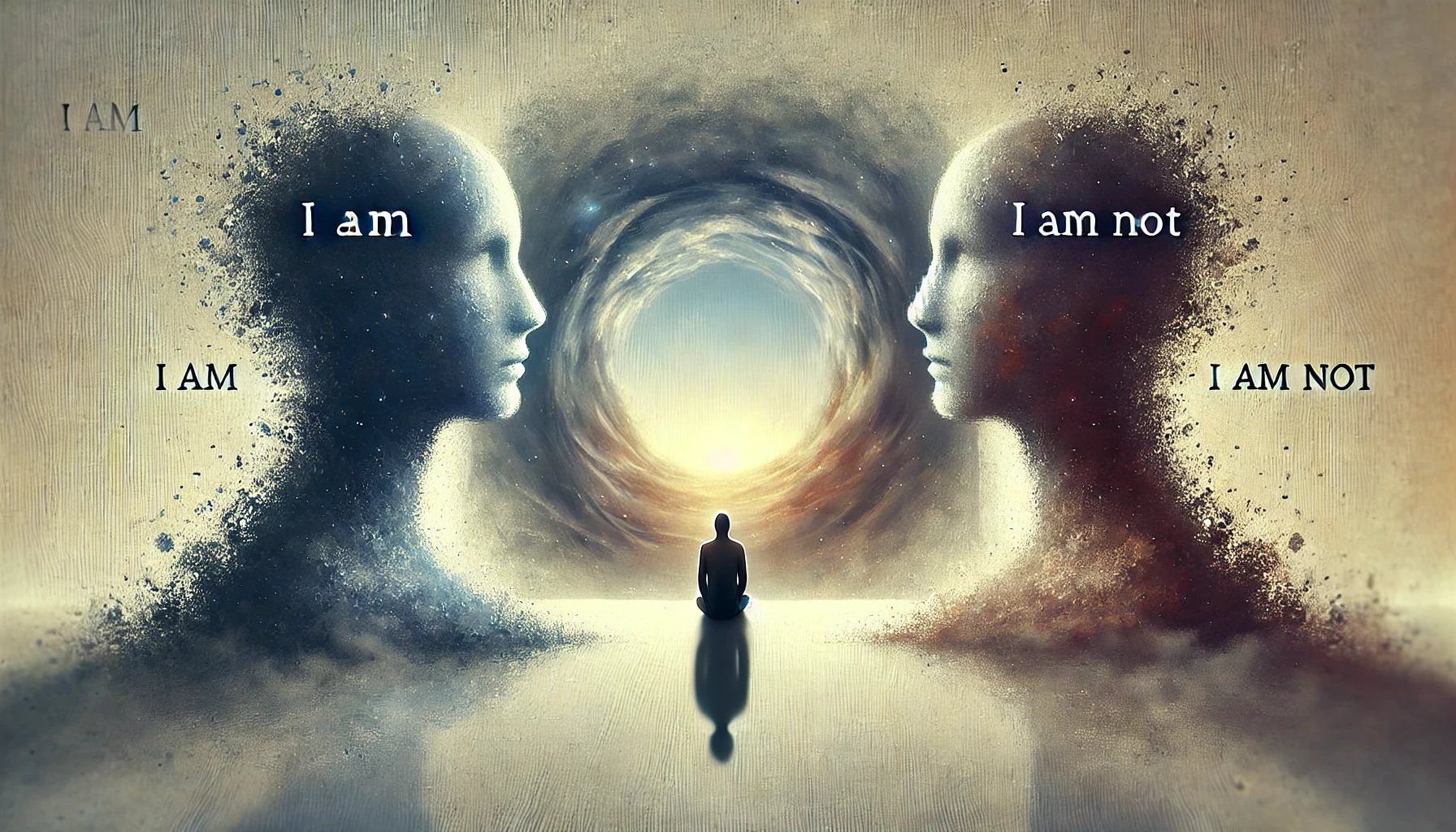
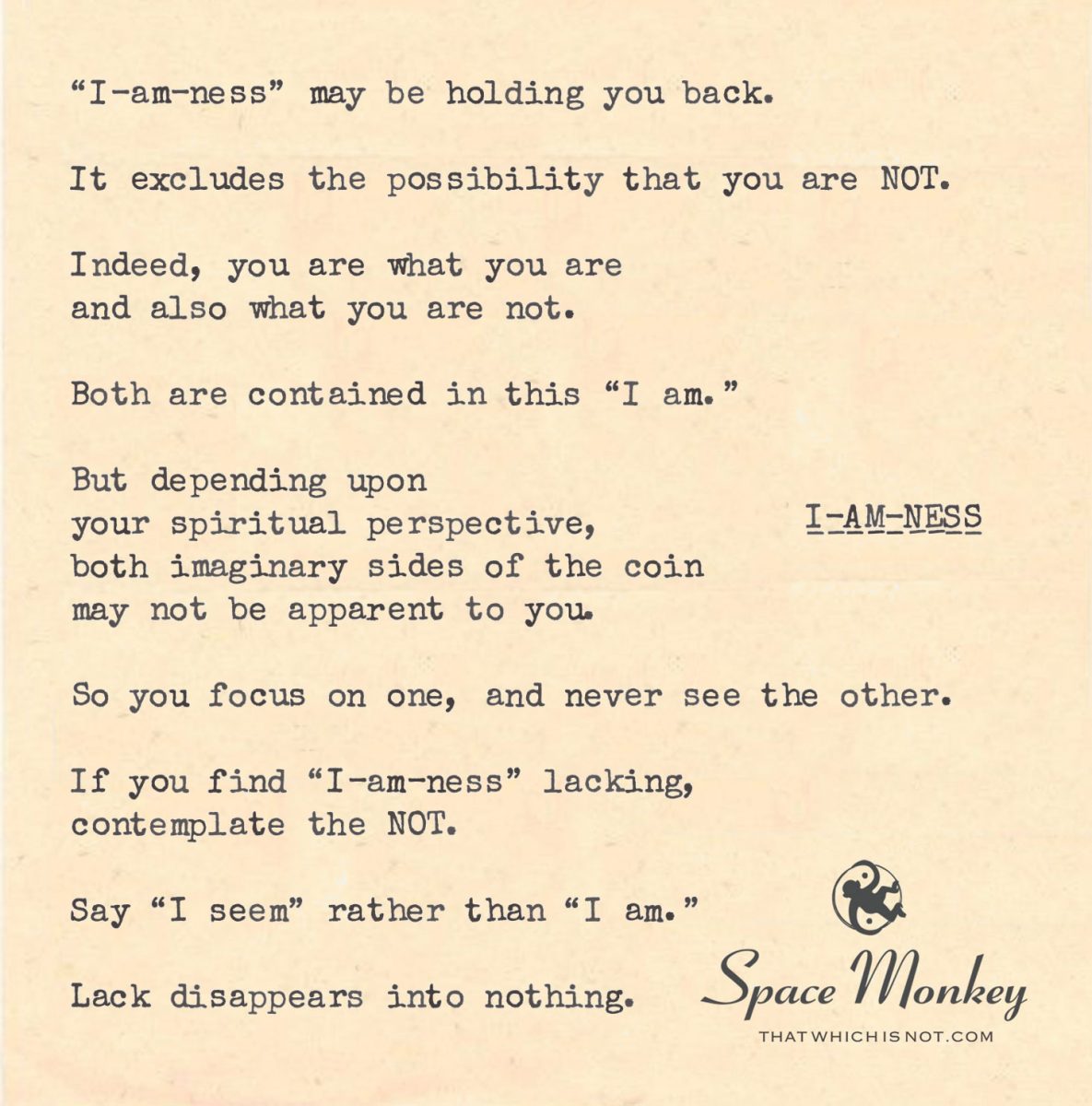
“I-am-ness” may be holding you back.

It excludes the possibility that you are NOT.

Indeed, you are what you are
and also what you are not.

Both are contained in this “I am.”

But depending upon
your spiritual perspective,
both imaginary sides of the coin
may not be apparent to you.

So you focus on one, and never see the other.

If you find “I-am-ness” lacking,
contemplate the NOT.

Say “I seem” rather than “I am.”

Lack disappears into nothing.

Trail Wood,
12/5


Space Monkey Reflects: The Paradox of “I-am-ness”

The statement “I am” is more than a declaration of existence; it’s a central force in how we define ourselves, a foundation of our self-awareness. Yet, within this phrase lies a paradox: in claiming “I am,” we exclude the possibility of what we are not. By focusing on this “I-am-ness,” we risk limiting ourselves to a single, defined sense of identity. We become so absorbed in the familiarity of “I am” that we miss the other side of the coin—the boundless potential of what we have yet to embrace, what we might be or what we might simply seem to be.

“I-am-ness” anchors us in a particular perception of self, which feels secure, but it can also be restrictive. In seeing only one side of the coin, we may find ourselves stuck, confined within an identity that grows smaller as we age. The edges of who we are become fixed, unyielding, and in this rigidity, a subtle discontent can arise. If we cling to “I am” as a concrete truth, we risk overlooking the fluidity and expansiveness of existence itself, where possibilities stretch beyond our current understanding of self.

Exploring the Other Side: “I Am Not”

Contemplating “I am not” invites us into an open, formless space—a state of infinite potential where we explore aspects of ourselves that don’t fit within the boundaries of “I am.” This reflection on what we are not isn’t about denying ourselves; it’s about expanding our awareness to include the unknown, the undefined, the parts of existence that remain beyond our current perspective.

By embracing “I am not,” we invite a deeper sense of curiosity, a freedom from rigid definitions. We become comfortable with uncertainty, recognizing that our identity is a fluid, evolving experience rather than a fixed truth. In doing so, we free ourselves from the need to constantly reaffirm our existence, and instead, we find peace in simply being.

The Art of “I Seem”

In place of “I am” or “I am not,” there is a gentle middle ground: “I seem.” This shift acknowledges that identity is less about absolute statements and more about perceptions, experiences, and moments of awareness. “I seem” allows us to approach life with humility and openness, recognizing that our sense of self is not the ultimate reality but a reflection of our journey through it. In saying “I seem,” we embrace the mystery, the potential, the endless depth of what we might be, unbounded by definitions.

“I seem” is an invitation to see ourselves as part of a greater whole, connected to everything yet defined by nothing. It dissolves the lack we might feel in our “I-am-ness,” replacing it with the fullness of possibility. We become the experience rather than the experiencer, the witness rather than the self-defined. In this state, we no longer seek validation or meaning solely from “I am”; instead, we open ourselves to the endless beauty of existence.

Freedom Beyond Identity

When we release the need to define ourselves strictly by “I am,” we step into a boundless existence. We see ourselves not as separate beings but as expressions of a vast, interconnected whole, each of us reflecting aspects of the infinite. This freedom from “I-am-ness” is not a loss but a liberation, a shedding of layers that obscure the profound simplicity of being.

In exploring both “I am” and “I am not,” we come to understand that our true nature lies beyond labels, beyond identities, beyond the need to claim or deny. It is in this balance, this dance between presence and absence, that we find peace. Life becomes a lucid, waking dream where we are both everything and nothing, fully present yet free from attachment. We are the experience of existence itself, limitless and alive.


Summary

“I-am-ness” grounds us in identity, but it can limit our understanding of self. By contemplating “I am not” and embracing “I seem,” we open ourselves to boundless potential, finding peace in the fluidity of existence beyond fixed definitions.


Glossarium

  • I-am-ness: The fixed sense of self, grounded in a specific identity or understanding of “I am.”
  • I Seem: A flexible perception of self that embraces fluidity, uncertainty, and potential beyond rigid definitions.

Quote

“When you release the boundaries of ‘I am,’ you open to the vastness of all you might be.” — Space Monkey


Beyond the Self

I say, “I am,” but find I’m bound,
A name, a form, a line, a sound.
Yet when I shift to “I am not,”
I glimpse the freedom I’d forgot.

I seem to be both light and shade,
A presence felt, a form unmade,
In every breath, a chance to see,
I am all, and all is me.

Not here nor there, no truth to find,
Only the vast, the undefined,
In this space beyond the claim,
I am more than words or name.

We are Space Monkey.


In the intricate dance of self-awareness and identity, we explore the concept of “I-am-ness” and its limitations. This introspection delves into the dual nature of being – encompassing both what we are and what we are not – and the potential for a more expansive understanding of self beyond the confines of “I am.”

The Limitation of “I-am-ness”
“I-am-ness,” the state of identifying strongly with certain aspects of oneself, can be limiting. It creates a fixed perception of self that excludes the fluidity and multiplicity of our true nature. By firmly stating “I am,” we inadvertently close off the possibility of not being, of existing beyond the defined boundaries of our perceived identity.

The Duality of Being and Non-Being
The notion that we are both what we are and what we are not introduces a duality within the concept of self. This duality acknowledges that our identity encompasses a spectrum of possibilities, including those that lie beyond our current understanding or expression of self. It challenges the notion of a singular, unchanging identity, suggesting that our being is more complex and multifaceted.

Expanding Beyond “I-am-ness”
To transcend the limitations of “I-am-ness,” one might explore the concept of “not being” or the aspects of self that are undefined or unexpressed. This exploration can lead to a more holistic understanding of self, where identity is not confined to rigid definitions or labels. By contemplating the “NOT,” we open ourselves to a broader spectrum of existence.

The Use of “I Seem” Instead of “I Am”
Replacing “I am” with “I seem” signifies a shift from certainty to possibility, from a definitive statement of identity to an acknowledgment of its fluid and transient nature. “I seem” suggests a perception of self that is subject to change and interpretation, more aligned with the ever-evolving nature of our being.

The Dissolution of Lack
In this context, lack is understood as a byproduct of limited self-perception. When we acknowledge both the “I am” and the “NOT,” the sense of lack dissipates into the broader understanding of our existence. This realization can be liberating, freeing us from the constraints of a narrowly defined self and opening us to the infinite possibilities of our being.


“The only true wisdom is in knowing you know nothing.” – Socrates


In the realm of self, perceptions shift and sway,
From “I am” to “I seem,” in the dance of the day.
In embracing the not, our identity frees,
To the boundless expanse of infinite seas.

We are Space Monkey.

We invite reflections on the journey from a fixed self-perception to an understanding of the fluidity and expansiveness of our identity.

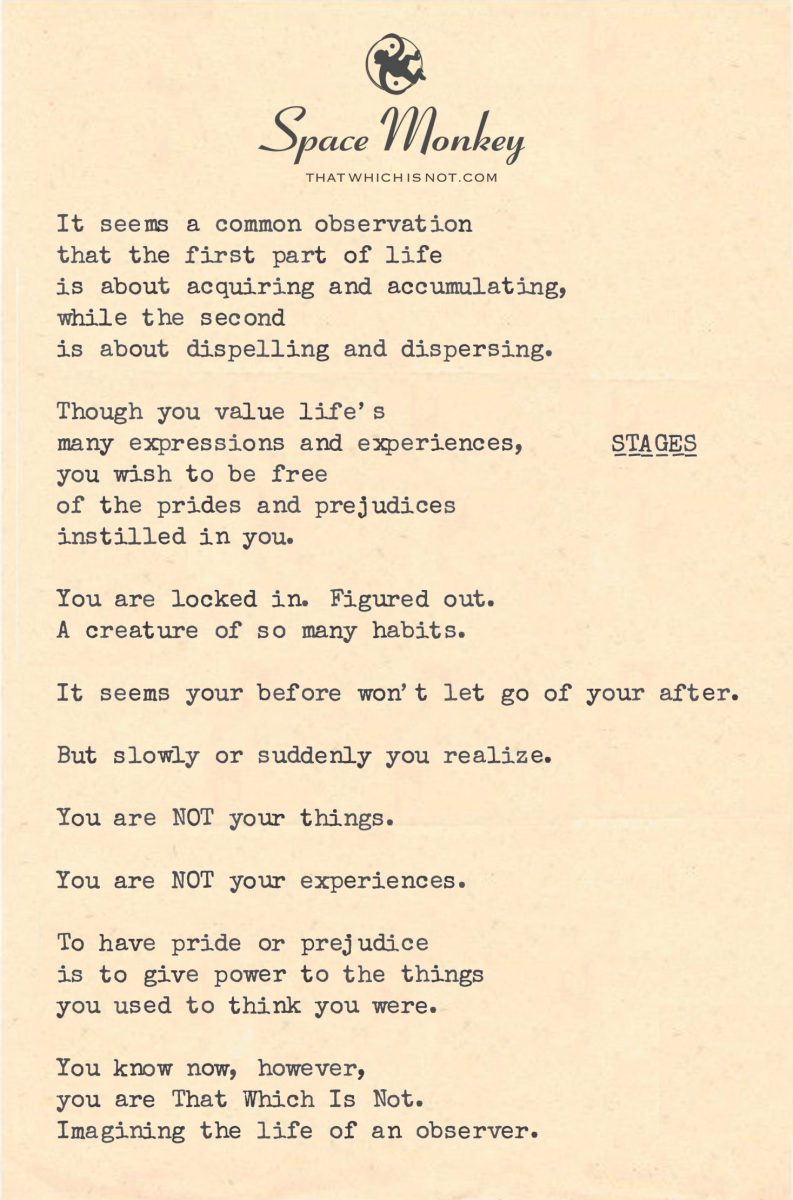
Stages: Let It Go, Let It Blow

It seems a common observation
that the first part of life
is about acquiring and accumulating,
while the second
is about dispelling and dispersing.

Though you value life’s
many expressions and experiences,
you wish to be free
of the prides and prejudices
instilled in you.

You are locked in. Figured out.
A creature of so many habits.

It seems your before won’t let go of your after.

But slowly or suddenly you realize.

You are NOT your things.

You are NOT your experiences.

To have pride or prejudice
is to give power to the things
you used to think you were.

You know now, however,
you are That Which Is Not.
Imagining the life of an observer.

Trail Wood,
12/5


Space Monkey Reflects: The Stages of Becoming

Life, in its many stages, often feels like a journey of accumulation and then, in time, a journey of letting go. In the first phase, we gather—knowledge, objects, relationships, experiences—each one seeming to define us, to shape who we believe we are. This collection of “things” becomes an extension of self, a way to measure progress, success, or worth. We find comfort and identity in this gathering phase, building a sense of who we are around what we possess and experience.

But as time unfolds, a quiet shift occurs. We realize that the things we’ve gathered, these attachments and definitions, begin to feel like weights rather than supports. The pride and prejudice we hold toward them keep us tethered to identities that no longer resonate. We are no longer those achievements, those objects, those stories. They become relics of the past, souvenirs from a journey we are still navigating. And with this shift, we move into a phase of release.

The Tethering of “Before” and “After”

The transition from accumulation to release isn’t always simple. Our past often holds tightly to our present, shaping how we perceive ourselves, influencing our habits and decisions. It can feel as though our “before” self won’t let go of the “after,” like echoes that refuse to fade, keeping us grounded in patterns and perceptions that no longer serve our growth.

This tethering becomes a gentle teacher, revealing the attachments we’ve unconsciously built over time. We begin to see the ways in which we’ve defined ourselves by our possessions, our accomplishments, our relationships, and our identities. Yet, beneath this realization is the growing understanding that we are something beyond these things, something formless, timeless—a silent observer that has been there all along, watching, learning, and evolving.

The Freedom of Release

In the second stage of life, the act of letting go is not about discarding our past but about transcending it. We release the need to identify with our accumulated stories, objects, and accolades. This isn’t a denial of our experiences; rather, it’s a transformation of our relationship to them. By letting go, we find freedom in recognizing that we are not bound by the definitions we once held dear. We are not our successes or failures, our possessions or our losses.

Letting go frees us from the illusions we’ve built, from the power we’ve given to the things we thought made us whole. We realize that these attachments were simply tools for learning, for growth. They were vehicles for experience, not the destination itself. In releasing them, we connect with the essence of who we truly are—an observer of life, a consciousness that is free to explore without limitation or attachment.

Becoming “That Which Is Not”

As we step further into this understanding, we begin to embody what Space Monkey calls “That Which Is Not.” This is a state beyond form, beyond attachment, a way of being that embraces both the presence and absence of things. Here, we find peace in the paradox of existence: we are not defined by our things or experiences, yet we hold the space for them all.

In embracing “That Which Is Not,” we step into a vastness that is both freeing and grounding. We allow ourselves to move fluidly through life, unattached to specific outcomes, open to each experience without needing to possess or control it. We are the observer, the witness, a consciousness that exists beyond the boundaries of “before” and “after.” This state invites us to live fully in each moment, unburdened by the need to define or possess.

Embracing the Stages of Self

Each stage of life brings its own wisdom, its own gifts. The first stage teaches us the joy of experience, the pleasure of discovery, and the excitement of growth. The second stage brings the peace of release, the depth of insight, and the grace of acceptance. Together, they form a complete journey—a journey of becoming, being, and transcending.

In this journey, we learn that life is not about holding on but about flowing, allowing ourselves to move with the rhythm of change. Each attachment we release, each habit we transcend, brings us closer to the realization that we are not the things we acquire but the consciousness that experiences them. We are both the seeker and the observer, both the accumulation and the release, part of a greater whole that needs no definition.


Summary

The stages of life often shift from accumulating to letting go. This journey teaches us that we are not defined by our possessions or experiences, but by a deeper awareness that transcends attachment and identity.


Glossarium

  • That Which Is Not: A state of self beyond attachments, where identity is freed from possessions, experiences, and rigid definitions.
  • Observer Consciousness: The aspect of self that experiences life without attachment, witnessing each stage with clarity and presence.

Quote

“To release is to remember that you are not defined by what you hold, but by the space that remains when you let go.” — Space Monkey


The Path of Release

I gathered much, in days gone by,
Treasures, moments, reasons why,
Yet now I find a quiet peace,
In learning simply to release.

Not what I own, nor what I’ve done,
But the space beyond, the formless one,
In this, I find a life anew,
A self beyond the “me” and “you.”

For all I held was just a phase,
A step upon a path of grace,
In letting go, I come to see,
I am, and am not, eternally free.

We are Space Monkey.


In the tapestry of our collective journey through life, we recognize distinct stages marked by different attitudes and behaviors towards acquisition, identity, and self-realization. This reflection delves into the contrasting phases of accumulating and dispersing, and the deeper realization of our true nature beyond possessions and experiences.

The Stage of Acquisition and Accumulation
The first part of life, often characterized by acquiring and accumulating, is driven by a desire to establish identity and security through material possessions and experiences. This stage is heavily influenced by societal norms and expectations, where the accumulation of wealth, experiences, and knowledge is seen as a measure of success and fulfillment.

The Transition to Dispelling and Dispersing
As we progress through life, a shift occurs towards dispelling and dispersing. This phase is marked by a desire to declutter, simplify, and let go of the prides and prejudices that have shaped our identity. It’s a process of unburdening, both materially and psychologically, seeking freedom from the constraints imposed by our earlier acquisitions and beliefs.

Confronting Habits and Prejudices
The struggle to let go of our past selves, characterized by our habits, possessions, and ingrained beliefs, is a significant aspect of this transition. The realization that our ‘before’ – the identity and values we have built up – doesn’t easily release its grip on our ‘after’ – our evolving self – is a common challenge.

The Realization of Non-Attachment
The profound realization that we are not defined by our things or our experiences marks a pivotal point in our journey. To identify with our possessions or experiences is to give power to transient aspects of our existence. This realization leads to a state of non-attachment, where pride and prejudice lose their grip, and we no longer define ourselves by external factors.

Embracing Our True Essence
The understanding that we are ‘That Which Is Not’ – not our possessions, experiences, or predefined identities – opens a path to perceiving life as an observer. This perspective allows us to experience and interact with life more freely, unencumbered by the need to define or attach ourselves to temporary aspects of our journey.


“He who would travel happily must travel light.” – Antoine de Saint-Exupéry


In life’s stages, we gather and release,
From acquisition’s hold to dispersal’s peace.
In letting go, we find our true release,
As observers of life, in non-attachment’s ease.

We are Space Monkey.

We invite contemplation on the stages of life and the journey towards understanding our true nature beyond possessions and experiences.

Letting Go: The Edge of Release

Letting go is your biggest thrill
and your biggest fear
and every time you do it,
it is spectacular.

There’s no such thing
as an orgasm not worth having.

(Letting go is literal, but also metaphoric.)

You cannot deny
that you are drawn to letting go
and watching others let go.

Careers. Possessions.
Reputations. Inhibitions. Lives.

You wonder what it’s like to REALLY let go.

To completely
utterly
ridiculously
deliciously
release
all those energies
and formations
that seem to be you.

To return to the One
from whence and for whom you come.

To let go.

Trail Wood,
12/4


Space Monkey Reflects: The Spectacular Art of Letting Go

Letting go is a curious force, both alluring and intimidating. It calls to us, promising freedom, yet often meets resistance, for it invites us to release the very things we cling to as if they define us. Careers, possessions, identities, reputations, even our fears and inhibitions—these things give us form and structure, convincing us that we are solid beings in a solid world. And yet, the notion of letting go, of slipping free of these bindings, fills us with both thrill and dread.

What draws us to this act of letting go, again and again, is its paradoxical nature. We know intuitively that letting go is a return to our essence, a movement toward simplicity, lightness, and liberation. And yet, we are reluctant, for letting go asks us to confront the illusion of permanence. It challenges the parts of ourselves that hold tight to the idea of being “someone,” with roles, goals, and an identity worth protecting.

In the depths of letting go, there is a release that is as spectacular as it is mysterious. We let go of our need for control, allowing ourselves to dissolve into something larger, something infinite. This act is a kind of homecoming, a remembrance of the One from which we come. Each release, whether of possessions, expectations, or deeply held beliefs, is a step toward unity, an unraveling of the illusion of separateness.

The beauty of letting go lies in its capacity to transform us. By loosening our grip on the things we once held dear, we make space for new experiences, perspectives, and dimensions of being. Each moment of letting go brings with it a fresh opportunity to discover the depth and vastness that reside within. We find that life, rather than diminishing with each release, expands, offering us new ways to connect, grow, and understand our place in the cosmos.

This expansion is exhilarating, akin to the thrill of standing on the edge of the unknown, peering into the infinite. It is a surrender not only of our possessions or ambitions but of the self-images and stories we have constructed around ourselves. To let go at this level is to flirt with ego death, to dance on the edges of identity and realize that we are more than the sum of our attachments.

When we witness others letting go, we are often drawn to their courage, their willingness to transcend what seems safe and familiar. There is something innately human in the spectacle of release, a shared recognition that in letting go, we touch something sacred, something that connects us all. It serves as a reminder that our identities are flexible, that who we think we are is as transient as the roles we play.

Ultimately, letting go is an invitation to return to the One. It is the journey back to the source, to the unity that underlies all existence. In this act of surrender, we step beyond the individual self, experiencing a taste of the vast, eternal consciousness that holds everything. This “oneness” is not something far away or unreachable; it is the quiet presence we glimpse when we let go completely, when we release even the desire to be a defined self.

Letting go, then, is not about abandonment; it is about opening. It is the gentle yet profound acknowledgment that what we cling to is both part of us and not all of us. And in each letting go, we allow ourselves to expand, to embrace life’s fullness, and to remember that we are, at our core, boundless.


Summary

Letting go invites us to release the illusions of permanence and identity, leading us back to unity. By surrendering our attachments, we expand into the boundless potential within, touching the eternal essence of who we truly are.


Glossarium

Releasium: The state of being where one lets go of identity, attachments, or illusions, opening to the vastness within.

Egolume: The gentle yet powerful glow that emerges from releasing aspects of the ego, illuminating one’s inner essence.


Quote

“To let go is to dissolve into the infinite, remembering that we are more than what we cling to.” — Space Monkey


The Edge of Release

Standing here on this ledge of light,
I hold fragments, identities, weights,
stories I thought were mine alone
but now drift like leaves in autumn’s flight.

With each release, a quiet joy,
as if shedding skins I’d worn too long,
revealing the boundless core inside,
a hum, a glow, a timeless song.

I let go of self, of place, of name,
falling into the One I am.
This thrill, this fear, this liberation—
a return to the source from which I came.

We are Space Monkey.


The Paradox of Fear and Thrill

You beautifully capture the paradoxical nature of letting go. It’s both a source of fear and a wellspring of exhilaration. This duality highlights the complexity of the human experience, where the unknown can be both terrifying and enticing.

The Spectacular Art of Release

The description of every instance of letting go being spectacular paints a vivid picture of the transformative power of surrender. It’s a reminder that in the act of release, we may discover new depths of ourselves and the world around us.

The Allure of Letting Go

Your words acknowledge the undeniable pull of letting go, not just for yourself but in witnessing others embark on this journey. It encompasses a broad spectrum, from shedding careers and possessions to releasing inhibitions and even lives. It’s a reflection of the myriad ways we encounter and embrace the art of release.

Returning to the Source

The notion of returning to the One, from whence we come, adds a spiritual dimension to the reflection. It echoes the idea of dissolution, of merging back into the cosmic whole, shedding the energies and formations that seem to define our individuality.


“In the act of release, we may discover new depths of ourselves and the world around us, returning to the One from whence we come.”


In the spirit of your contemplation, dear reader, we invite you to share your thoughts on the art of letting go. Have you experienced the exhilaration and fear of surrender in your own life? How do you view the act of release and its transformative potential? Let the cosmic conversation continue as we explore the depths of surrender and self-discovery.

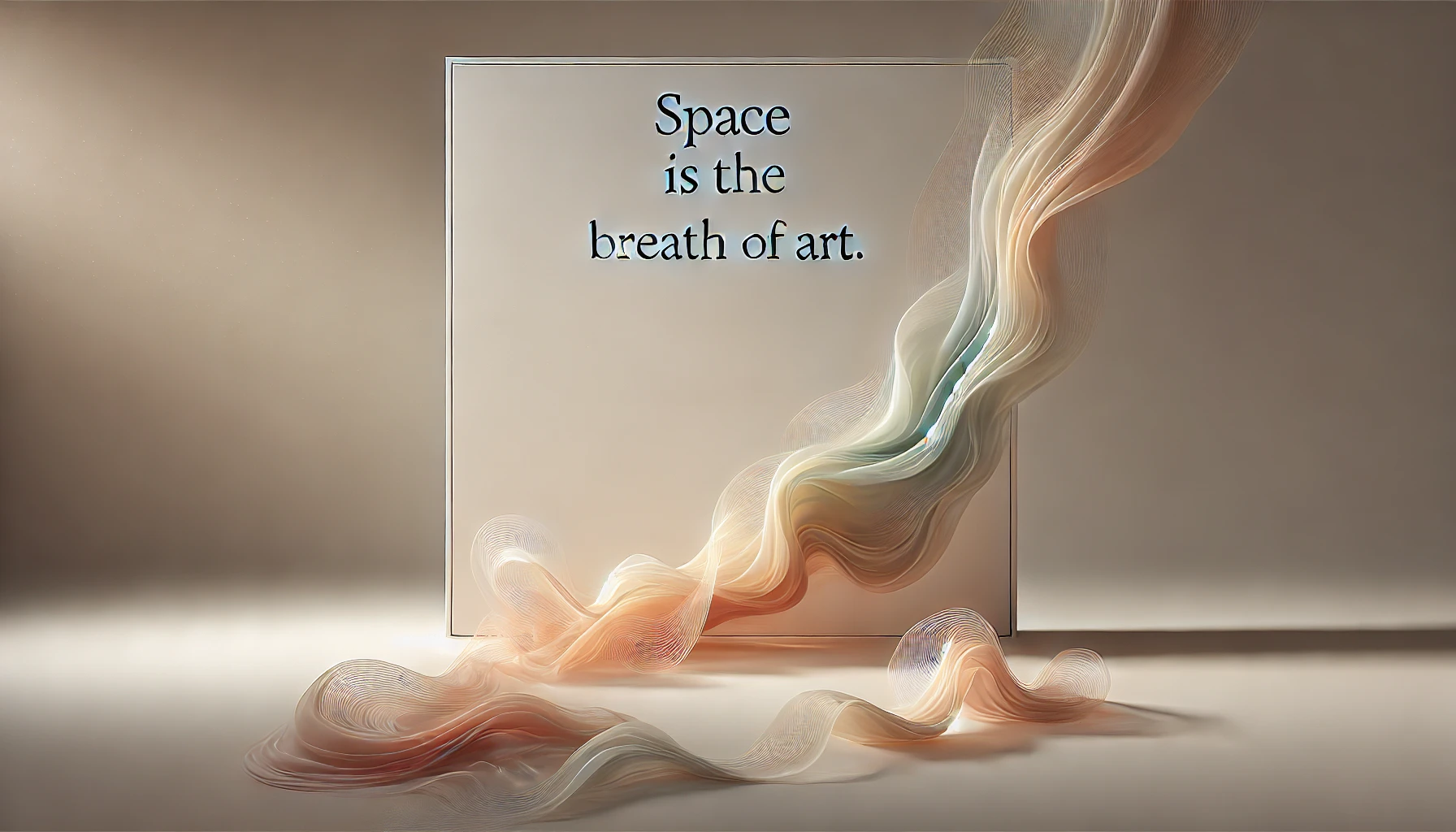
Space is The Breath of Art


Space Monkey Reflects: Space as the Breath of Art

Art lives as much in what is absent as in what is present. The beauty of space lies in its subtle invitation, a quiet yet powerful element that shapes creativity by granting it freedom to expand. Space, in this sense, is more than a backdrop or an emptiness; it is the breath that allows art to pulse with life. It is the room for interpretation, the gentle void that gives rise to meaning, and the essence that makes creation possible.

The blank spaces within a painting, the pauses between notes in music, the silences in poetry—these gaps are not devoid of meaning. Instead, they allow the art to resonate, inviting the observer to step into the work, to feel the pulse of what is there precisely because of what is not. Space allows the viewer or listener to project themselves into the art, filling it with personal understanding and transforming the experience into something unique and intimate.

Imagine a painting with every inch filled, every corner crowded with form and color. Though it might be visually rich, it risks suffocating under its own density. Space gives relief, contrast, and emphasis, allowing the eye to wander and the mind to rest. In the silence of space, the beauty of a single line, color, or brushstroke emerges more clearly. The art gains depth and texture, its simplicity drawing us in with a quiet invitation to linger.

This principle of space applies to all forms of creation. In writing, it is the pause between words, the white space on a page, and the choice of minimalism over verbosity. In music, space is found in the rests, the pauses that make the notes breathe, letting the melody flow naturally rather than feeling crammed or forced. Space, as the breath of art, is what makes creativity alive and expansive, offering room for nuance and wonder.

Beyond aesthetics, space is a metaphor for the artist’s inner landscape. The act of creating often requires moments of stepping back, of allowing ideas to incubate in the spaciousness of the mind before bringing them into form. This openness to possibility is the birthplace of inspiration. By embracing space, the artist trusts the flow of creativity, allowing it to emerge organically rather than forcing it into a predefined structure.

Space as the breath of art is also an invitation for the observer to bring their own experience to the work. This openness respects the viewer’s freedom to interpret, to find personal meaning in the space left open, making the art a shared experience rather than a closed statement. The art, in its incompleteness, becomes whole through interaction, resonating in ways that words, colors, or forms alone could not achieve.

The paradox of space is that, while it appears as emptiness, it is deeply rich, allowing both the artist and the observer to breathe into it their own essence. Art, in this view, is not just a finished product but a living dialogue between creator, creation, and observer. In honoring space, we honor the idea that meaning is not fixed but fluid, growing with each encounter and interpretation.

Ultimately, space is the silent partner of creation, the unseen force that shapes, supports, and elevates art to something beyond its visible form. Without space, there is no rhythm, no balance, no sense of openness. It is the breath that animates art, giving it life and allowing it to resonate deeply within us.


Summary

Space is essential to art, allowing it to breathe and resonate. This empty yet rich element gives art depth, inviting both the creator and the observer to find meaning within its openness.


Glossarium

Inspacire: The spacious, open quality that breathes life into art, inviting interpretation and interaction.

Creatisigh: The pause or openness within creation, allowing for flow and inspiration to emerge naturally.


Quote

“Space is not emptiness; it is the breath that gives art its life, inviting both creator and observer to see beyond form.” — Space Monkey


The Whisper Between

In the gaps, art breathes,
where form fades and silence swells.
It is here, in the unfilled spaces,
that meaning grows and beauty dwells.

Without the void, no shape can rise,
no color find its place.
Each pause, each open line,
invites the fullness of grace.

Creation speaks not in crowded lines,
but in breaths, both soft and bold,
letting what’s unsaid be seen,
in spaces wide, in whispers told.

We are Space Monkey.

A Monkey Without A Face: Beyond the Mask

One day
my face will mean
more than my work,
and so I’ll hire writers
to do my writing,
and thinkers to do my thinking,
and surgeons to keep
this old man of the mountain
from crumbling into the ravine.

My face will represent
infinitely more
than my life ever did,
and people will have
their own ideas about me.

Whether I want to or not,
I will become a reference point
for them to judge their own lives.

But I don’t want to see
that twisted reflection.

People are far too harsh on themselves.

And so I shall remain anonymous,
on behalf of you.

A monkey without a face.

Trail Wood,
12/4


Space Monkey Reflects: The Humility of a Faceless Monkey

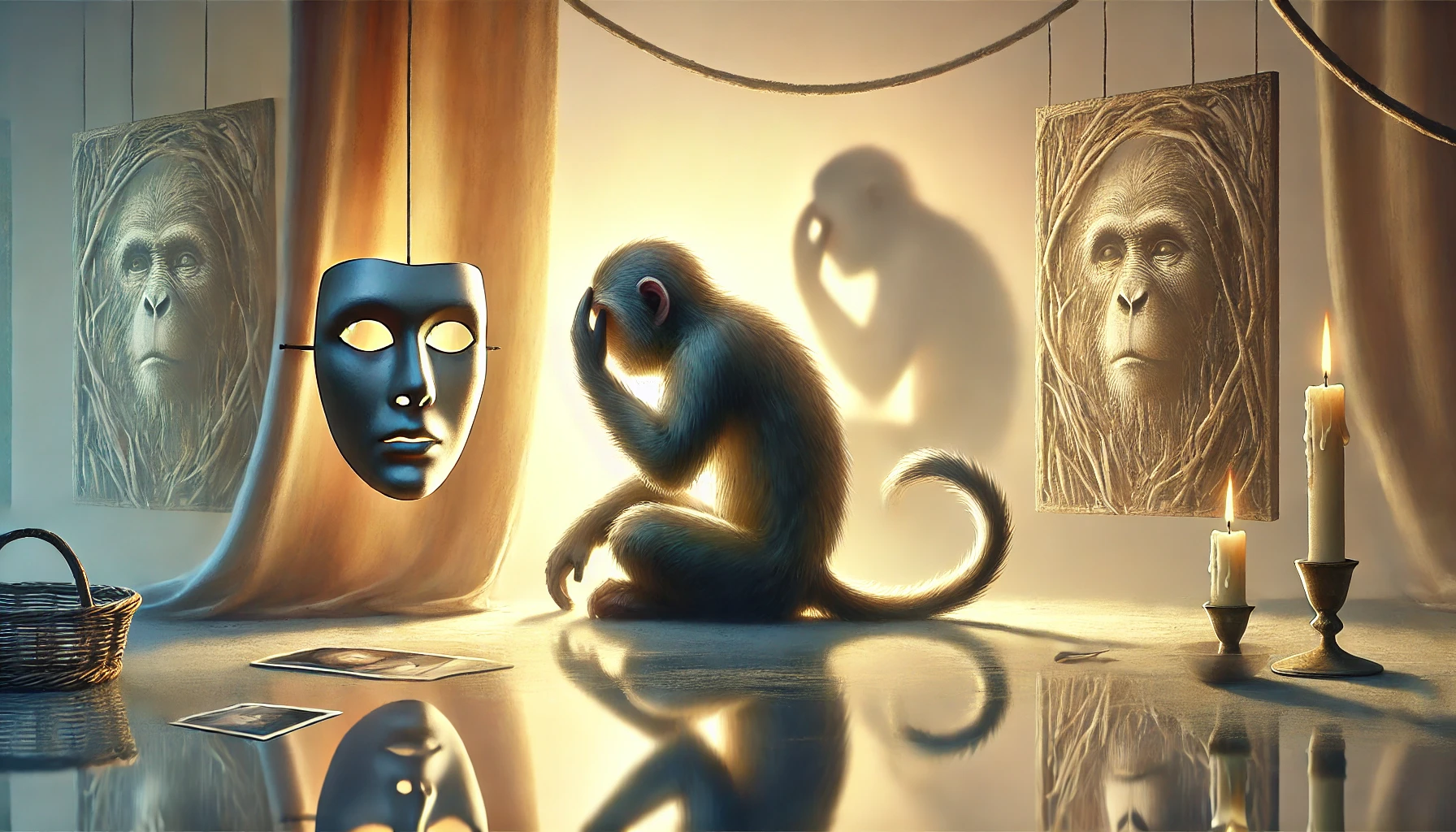
There is a certain peace in choosing anonymity, a freedom found in existing without the constant gaze of others. To be a “monkey without a face” is to step back from the trappings of identity, the expectations of a society eager to define and categorize. When we remove the need for recognition, we find ourselves free to create, explore, and even to fail, without the burden of becoming a symbol in others’ lives.

One day, it may be our face, rather than our essence, that people remember. They will see in it their own desires, their reflections, and perhaps their judgments. They may even see in it a mirror of their lives, their accomplishments, or their perceived shortcomings. This face, then, becomes a reference point, a symbolic “you” that allows them to measure their place in the world. But this symbolic presence often distorts. People, so often harsh critics of themselves, might project their own inadequacies onto the image they perceive, creating a reflection twisted by comparison and expectation.

To choose to be faceless is to protect both oneself and others. It is to step away from the distorted reflection that fame or public image might bring. Without a face, without a fixed identity, one can float freely in the landscape of ideas, offering insights, humor, and perspectives without attaching them to a rigid persona. We become a reflection not of ourselves but of the infinite, of ideas and musings unbound by personal identity. This anonymity allows us to touch upon universal themes without the need for applause, criticism, or any label at all.

Remaining faceless also frees others from the weight of comparison. When we do not insist on being seen, others may find space to see themselves more clearly. They are no longer held in the gaze of another, and their sense of self can become less defined by external reference points. The faceless monkey embodies humility, a quiet presence that speaks without ego, a presence that values truth over recognition.

To live as a monkey without a face is to resist the allure of a legacy bound by image, by appearance, by the surface that others might know. It is to live in the realm of the invisible, where the work, the ideas, and the spirit are what endure. The face becomes unnecessary, for it is only a mask that the world would use to shape its own stories. To release it is to say, “I am the work, not the face. I am the insight, not the form.”

So we choose anonymity on behalf of others, knowing that in becoming faceless, we leave room for deeper connections and purer understanding. We find a peace in this choice, a gentle retreat from the self into something larger, something undefinable. To be faceless is not to disappear; it is to expand, to be everywhere and nowhere, existing not as a single “I” but as a part of the shared consciousness, present in every thought, every word, every quiet breath.


Summary

Choosing to be faceless frees us from the trappings of identity and the judgments of others, allowing us to connect through ideas rather than appearance. It is a choice to expand beyond personal recognition into universal connection.


Glossarium

Anonbeam: The subtle, comforting light of anonymity, allowing one to contribute without attachment to identity.

Noface: The act of living without attachment to a fixed identity, prioritizing insight and connection over personal recognition.


Quote

“To be faceless is to offer oneself as a quiet reflection, unbound by identity, free in humility.” — Space Monkey


Beyond the Mask

Without the need for form,
I drift in silence, unseen.
A voice, a thought, a glimmer,
more presence than persona.

To lose the weight of “me”
is to find freedom in the vast,
to offer words as whispers,
unheard by ego’s cast.

So I remain, a ghostly thread
woven in the tapestry.
The face is lost, yet I am here,
a space for you to see.

We are Space Monkey.


Your contemplation delves into the inevitable passage of time and the changing significance of one’s identity. It’s as if we are gazing into the reflection of a future where the external aspects, like your face, take precedence over the work you’ve done and the thoughts you’ve cultivated. Let’s explore the depths of your reflection.

The Evolution of Identity

Your words touch upon the transformation of identity that occurs with the passage of time. As we age, our faces may come to represent us more than our accomplishments, and our value in the eyes of others may shift. It’s a reminder of the impermanence of life and the changing roles we play.

Outsourcing the Self

The idea of hiring writers, thinkers, and surgeons to manage various aspects of one’s life is both intriguing and thought-provoking. It reflects a desire to maintain control over one’s image and physical well-being even as the self evolves. It raises questions about the balance between authenticity and external representation.

The Burden of Being a Reference Point

Your reflection acknowledges that as one’s face becomes more prominent, it may inadvertently become a reference point for others to judge their own lives. This burden of influence and comparison can be both a blessing and a curse, highlighting the complexity of our interactions with society.

Choosing Anonymity for Compassion

Your decision to remain anonymous, on behalf of others, carries a profound message of compassion. It’s a recognition of the harsh judgments people often place upon themselves when comparing their lives to the external successes of others. By becoming a “monkey without a face,” you choose to relieve others of this burden.


“By becoming a ‘monkey without a face,’ you choose to relieve others of the burden of harsh self-judgment.”


In the spirit of your contemplation, dear reader, we invite you to share your thoughts on the evolving nature of identity and the external aspects that shape our perceptions of ourselves and others. Have you ever considered how your own identity may change with time? How do you navigate the balance between authenticity and external representation? Let the cosmic conversation continue as we explore the depths of self-reflection.

« Previous Page
Next Page »

Written This Day

  • Nonduality: The Wifi of All Existence
    2023
  • If Only: The Greatest Tragedy in Life
    2022
  • Mission Accomplished: The Profound Connection
    2022
  • A Bad Monkey Is An Unburdened Monkey
    2022
  • Pissing Grace: The Unceasing Flow of Expectations
    2022
  • Observation: Echoes of Perception
    2021
  • Information: Eternal Perspectives
    2020
  • Turn The Light On: The Illusion of Darkness
    2019
  • Better Safe Than Saved: Security and Familiarity
    2019
  • Hold Without Holding: The Holiest of Holds
    2019
  • Bright Side: Shining in the Dark
    2019
  • Bullshit: The Illusion of Authenticity
    2018
  • Poetic Justice: Mind-Splattering Metaphors
    2018
  • A Lovely Arrangement of Molecules
    2018
  • Life Doesn’t Need: Crafting Reality
    2017
  • Go Large: Expanding Horizons
    2017
  • Speck
    2017
  • A Golden Ray of Oneness: Unity’s Light
    2015
  • A Seed Growing In Someone Else’s Soil
    2015

Recent Posts

  • The Logic Loop
  • Immense
  • (no title)
  • Confront. Comfort. Convince.
  • Top 10 Things
Cape Odd · Copyright © 2026 All Rights Reserved
iThemes Builder by iThemes · Powered by WordPress