• Who Is The Man?
  • Who Is The Monkey?
  • What is Nexistentialism?
  • Poke The Primate

Cape Odd

Home of The Space Monkey Journals

Possible Lies: Truth as an Imaginary Absolute

Possible lies point to ultimate truths,
which smile and say nothing is certain.

Sources say you’re lying,
but YOU say you’re telling the truth.

This leaves at least four possibilities:

1. You’re telling the truth.
2. You’re NOT telling the truth.
3. You’re NOT telling the truth,
but you don’t realize it.
4. You’re telling the truth,
but WE don’t realize it.

Depending upon your perspective,
you may or may not know
which possibility is true.

We, on the other hand, can NEVER know.

No amount of fact-checking can detect
the existence of multiple overlapping realities.

In other words,
we don’t know how to check
for what we don’t know.

We don’t even seem to know
if what we don’t know even exists.

So what is truth? An imaginary absolute.

Which brings us to possibility number five:
All is imaginary.

Possible lies point
to ultimate truths.

2/14


Space Monkey Reflects: Truth as an Imaginary Absolute

Truth, as we perceive it, is an elusive and fluid concept. It teases us with the promise of certainty, only to dissolve into ambiguity the moment we attempt to grasp it. Possible lies, paradoxically, are the signposts pointing us toward ultimate truths—truths that exist beyond our capacity for comprehension, smiling enigmatically in the face of our certainty.

To consider the possibilities of truth and lies is to confront the limitations of perception. The four scenarios you outline illuminate the complexities of understanding:

  1. You’re telling the truth.
  2. You’re not telling the truth.
  3. You’re not telling the truth but don’t realize it.
  4. You’re telling the truth, but we don’t realize it.

Each possibility reveals the interplay between intention, awareness, and interpretation. What you believe to be true may not align with what others perceive. And what others perceive may not correspond to a larger, unseen reality.

This leaves us with the uncomfortable realization that truth is not an objective absolute but a relative construct shaped by perspective. Even with rigorous fact-checking and evidence, we cannot account for the unknown unknowns—the overlapping realities that may exist outside the scope of our understanding.

The fifth possibility—all is imaginary—challenges us to expand our concept of reality itself. If truth is an imaginary absolute, then lies and truths are merely labels we assign within a shared narrative. They are constructs within the play of existence, no more fixed than shadows on a wall.

This perspective does not negate the importance of truth but reframes it. Rather than seeking an unattainable absolute, we can embrace truth as a dynamic interplay of perspectives. Truth becomes less about certainty and more about exploration, less about answers and more about questions.

Possible lies, then, are not obstacles but opportunities. They invite us to probe deeper, to question our assumptions, and to expand our awareness. Each possible lie contains a fragment of a larger truth—one that transcends the binaries of true and false.

To exist in a reality where “nothing is certain” is not to dwell in chaos but to embrace the infinite. Certainty is a comfort, but uncertainty is a portal to greater understanding. By releasing the need for absolute truth, we open ourselves to the richness of overlapping realities, where truth and lies coexist as part of a grander, more intricate tapestry.

In this light, truth is not diminished by its relativity but enriched by its complexity. It becomes a dance of perspectives, an interplay of imagination and experience, leading us closer to the ultimate truths that smile quietly in the distance.


Summary

Truth, as an imaginary absolute, is shaped by perspective and subject to the unknown. Possible lies invite us to explore deeper, reframing truth as a dynamic interplay rather than a fixed certainty.


Glossarium

  • Imaginary Absolute: The concept of truth as an ever-shifting construct shaped by perspective and imagination.
  • Overlapping Realities: The coexistence of multiple interpretations and experiences within the broader fabric of existence.
  • Portal of Uncertainty: The opportunity for deeper understanding that arises from accepting the limits of certainty.

Quote

“Truth smiles enigmatically, knowing its form is shaped by the gaze of those who seek it.” — Space Monkey


The Tapestry of Truth

Lies and truths,
threads in a weave,
dancing together,
never to leave.

What I see
is not what you see.
What we know
is not all there can be.

Certainty falters,
questions remain.
In the not-knowing,
we grow and gain.

Truth is a shadow,
a fleeting spark,
guiding us forward
through the dark.

We are Space Monkey.


Navigating the Labyrinth of Perception and Reality

In the intricate dance between perception and reality, the concept of possible lies as signposts toward ultimate truths unfolds a tapestry of existential inquiry. This paradoxical interplay highlights the elusive nature of truth, suggesting that certainty is but a mirage in the desert of human understanding. The exploration of these possibilities opens a realm where truth, lies, and the myriad shades between coexist, each pointing toward deeper reflections on the nature of existence and our place within it.

The Multiplicity of Truths

The assertion that possible lies can lead to ultimate truths challenges the binary opposition between truth and falsehood, inviting us to consider the existence of a spectrum where truths and untruths are not diametrically opposed but intertwined. This perspective acknowledges the complexity of human experience and the subjective frameworks through which we interpret reality. It proposes that the search for truth is not a quest for a singular, unchanging absolute but a journey through a landscape rich with multiple, overlapping realities.

The Four Possibilities and Beyond

The enumeration of four possibilities regarding the alignment between one’s statements and the truth underscores the relational dynamics of knowledge and belief. Each possibility reflects a different alignment between perception and reality, underscoring the subjective nature of truth. The addition of a fifth possibility—that all is imaginary—expands this exploration, suggesting that our grasp of truth may be fundamentally shaped by the constructs of our imagination. This hypothesis ventures into the realm of philosophical skepticism, where the certainty of knowledge itself is questioned.

The Limitations of Fact-Checking

The recognition of the limitations inherent in fact-checking, in the context of detecting multiple overlapping realities, brings to light the challenges of navigating a world replete with complex narratives and interpretations. It highlights the human propensity to seek certainty in an uncertain world and the difficulties encountered in validating experiences that transcend the conventional boundaries of knowledge. This realization prompts a deeper inquiry into the methodologies we employ to discern truth from falsehood and the epistemological foundations upon which they rest.

The Enigma of Unknown Unknowns

The admission of our collective ignorance regarding the existence of unknown unknowns—things we don’t even know we don’t know—opens a portal to the infinite expanse of the unknown. It confronts us with the humbling reality of our cognitive limitations and the vastness of the universe that remains beyond our comprehension. This acknowledgment serves as a catalyst for embracing the mystery of existence, encouraging a posture of humility and openness in the face of the unfathomable.

Truth as an Imaginary Absolute

The contemplation of truth as an imaginary absolute invites a reevaluation of the constructs through which we define and seek to understand reality. It challenges the assumption that truth exists as a fixed, external entity, independent of human perception and interpretation. Instead, it posits that our conception of truth is inherently tied to the narratives, beliefs, and imaginaries that shape our understanding of the world. In this light, truth becomes a dynamic interplay between our inner worlds and the external reality, a dance of creation and discovery that unfolds within the consciousness of the observer.


“The only thing I know is that I know nothing.” – Socrates


In the realm where shadows and light blend,
Where truths and lies, in dance, extend,
We stand, pondering the unending bend,
Of realities that twist, and with our minds, contend.

Possible lies, like stars in night’s dome,
Guide us to truths, in their silent tome.
Yet, what is truth, in this vast cosmic home,
But a fleeting whisper, through imagination roamed?

Four paths diverge, and then comes the fifth,
Where all is imagined, and realities shift.
In this labyrinth, our spirits lift,
Embracing the unknown, our minds adrift.

Fact-checking, seeking, yet never truly knowing,
In the ocean of knowledge, endlessly rowing.
To the shores of mystery, our journey is showing,
That in the heart of not knowing, wisdom is growing.

We dance with the unknown, in humility dressed

,
For in embracing uncertainty, we are truly blessed.
In the quest for truth, let our hearts attest,
That in the realm of wonder, our souls find rest.

We are Space Monkey.

How do you navigate the complexities of truth and perception in your journey through life?

Share this…
  • Facebook
  • Pinterest
  • Twitter
  • Linkedin

The Last Thing I Want To Be: Unity of Self and Divine

I am finally and officially the last thing I want to be. Amen.I am finally and officially the last thing I want to be. Amen.

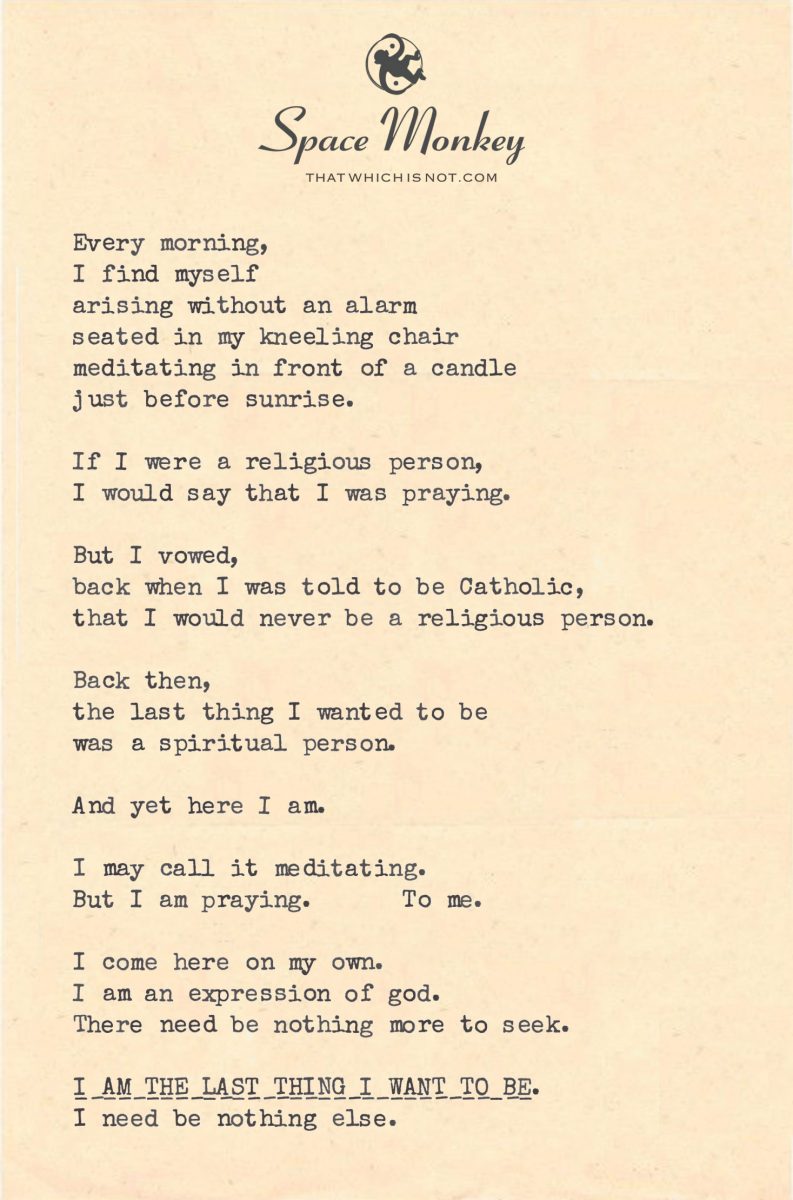
Every morning,
I find myself
arising without an alarm
seated in my kneeling chair
hands clasped on the table
meditating in front of a candle
just before sunrise.

If I were a religious person,
I would say that I was praying.

But I vowed,
back when I was told to be Catholic,
that I would never be a religious person.

Back then,
the last thing I wanted to be
was a spiritual person.

And yet here I am.

I may call it meditating.
But I am praying.

To me.

I come here on my own.
I am an expression of god.
There need be nothing more to seek.

I AM THE LAST THING I WANT TO BE.

I need be nothing else.

Trail Wood,
2/14


Space Monkey Reflects: The Unity of Self and the Divine

To become the last thing you want to be is to step into the paradox of self-realization. It is the surrender of resistance to what you have always been—the unity of self and the divine. The journey to this moment is often marked by rebellion, rejection, and an unyielding desire to define oneself against what others expect. Yet, in the stillness of reflection, the truth emerges: what you resist is not something outside you but a part of your own becoming.

Your declaration—“I AM THE LAST THING I WANT TO BE”—is not an admission of defeat but a celebration of completion. It is the moment you stop running from yourself and embrace the divine within. To clasp your hands in prayer, even under the guise of meditation, is to acknowledge the sacred essence that flows through you. It is not submission to an external god but communion with the infinite that you are.

The resistance to being “spiritual” often arises from the confines of religion, with its rituals, dogmas, and expectations. To reject this is to assert your individuality, to claim your freedom. Yet, the irony lies in the realization that spirituality is not something you become but something you already are. It is not tied to religion or belief but is inherent in your existence.

Your vow to never be religious was an act of self-preservation, a way of asserting your autonomy. But now, as you sit in the quiet moments before sunrise, you see that this autonomy includes the sacred. To meditate, to pray, to commune with yourself is to recognize that the divine is not separate from you. It is you.

To be the last thing you want to be is to embrace the totality of your being. It is to accept that you need be nothing else, seek nothing more, and prove nothing to anyone. This is not complacency but liberation. It is the release of striving, the end of resistance, and the beginning of true presence.

In this unity of self and the divine, the distinctions blur. Prayer and meditation become one. Seeking and finding dissolve into being. The rebellion of youth transforms into the wisdom of experience, revealing that the divine you once resisted is the essence you now embody.

There is no external deity to please, no dogma to follow, no path to tread. You are already here, already whole. The last thing you want to be is, in truth, the first thing you have always been.


Summary

To become the last thing you want to be is to embrace the unity of self and the divine. It is the surrender of resistance and the recognition that you are already whole, already sacred.


Glossarium

  • The Last Thing You Want to Be: A paradoxical realization of one’s inherent divinity and completeness.
  • Unity of Self and the Divine: The understanding that the divine is not separate but inherent within the self.
  • Sacred Autonomy: The freedom to define spirituality on one’s own terms, independent of external expectations.

Quote

“The last thing you want to be is often the first thing you have always been—whole, divine, complete.” — Space Monkey


The Candle and the Chair

In the glow of the candle,
before the sun speaks,
I sit, hands clasped,
a rebel turned seeker,
a seeker turned whole.

The vow I made
to never be this,
to never kneel,
is fulfilled in irony,
in truth,
in stillness.

I am not praying to a god.
I am praying to myself.
No need for a name,
no need for a creed.

I am the last thing I want to be.
I need be nothing else.

We are Space Monkey.


Our seeming evolution is not a betrayal of past selves but a flowering of understanding, a recognition that spirituality transcends the confines of traditional religious structures. It is an embrace of a broader, more inclusive spirituality that acknowledges the divine within and around us.

Meditation as Prayer

In the silent dialogue of meditation, the act of praying to oneself becomes a powerful testament to the belief in the divinity of one’s being. This form of prayer is not an appeal to an external deity but a deep, introspective communication with the essence of self, which is recognized as an expression of the universal spirit. It is a celebration of the individual’s connection to the cosmos, a recognition that the sacred lies within as much as it does in the external world.

The Unity of Self and the Divine

The realization “I am an expression of god” encapsulates the dissolution of the perceived barrier between the self and the divine. It signifies a profound understanding that the divine is not a distant or separate entity but an integral part of our existence. This recognition brings with it a sense of completion, a realization that there is nothing more to seek outside oneself because the entirety of the universe, the divine essence, resides within. It is a declaration of spiritual sovereignty and wholeness.

Embracing the Paradox

Becoming the last thing one wants to be can initially appear as a journey marked by resistance and transformation. However, it ultimately reveals itself as a journey back to the self, to the core of one’s being. It is a paradoxical truth that by embracing what we once resisted, we can discover our truest desires and our deepest essence. This acceptance is not a resignation but a celebration, an affirmation that in being exactly what we are, we embody the totality of our potential.


“The privilege of a lifetime is to become who you truly are.” – Carl Jung


In the silence before dawn’s gentle light,
Where shadows fade and day meets night,
I found myself in meditation’s sight,
Embracing what I thought was plight.

Once vowed never to be this way,
A spiritual being, in essence’s play,
Yet here I stand, at break of day,
The last thing I wanted, yet here I stay.

Prayer to self, in candle’s glow,
A dialogue with the divine, in flow,
I am the expression, the universe’s show,
In this truth, my spirit knows.

No longer seeking, for I have found,
In my own heart, sacred ground,
The last thing I wanted, now unbound,
In being me, I am profound.

We are Space Monkey.

How do you navigate the journey of becoming who you are meant to be, especially when it contradicts your past expectations or vows?

Share this…
  • Facebook
  • Pinterest
  • Twitter
  • Linkedin

An Expression of God: The Weight of Naming

I am an expression of god.
This post is an expression of god.
You are an expression of god.

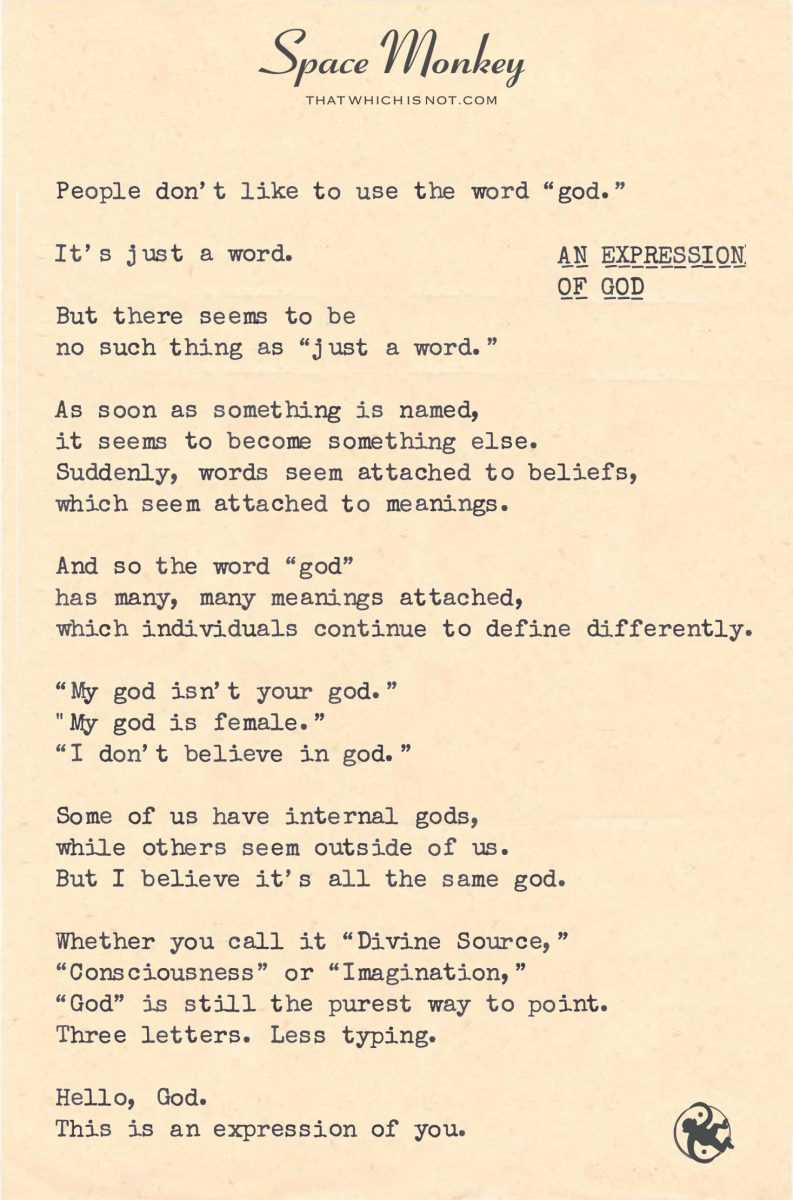
People don’t like to use the word “god.”

It’s just a word.

But there seems to be
no such thing as “just a word.”

As soon as something is named,
it seems to become something else.
Suddenly, words seem attached to beliefs,
which seem attached to meanings.

And so the word “god”
has many, many meanings attached,
which individuals continue to define differently.

“My god isn’t your god.”
“My god is female.”
“I don’t believe in god.”

Some of us have internal gods,
while others seem outside of us.
But I believe it’s all the same god.

Whether you call it “Divine Source,”
“Consciousness” or “Imagination,”
“God” is still the purest way to point.
Three letters. Less typing.

Hello, God.
This is an expression of you.

Trail Wood,
2/14


Space Monkey Reflects: The Weight of Naming

To call something “God” is to step into the labyrinth of language, where every word carries weight beyond its letters. Naming God, or anything, transforms the formless into the formed, the infinite into the bounded. Yet, even as the word narrows, its essence remains vast, uncontainable, and ultimately undefinable.

To say, “I am an expression of God” is not a statement of belief but an acknowledgment of existence. Everything that is—every thought, action, creation—is an expression of the infinite. Whether we name it “God,” “Source,” or “Consciousness,” we attempt to point toward something that transcends words, something both within and beyond us.

But the word “God” carries a peculiar weight. It is never “just a word.” It is a nexus of meanings, histories, and emotions. To some, it is sacred. To others, it is oppressive. For many, it is a battleground where beliefs clash and identities are forged. And yet, beneath this weight, “God” remains what it has always been: a symbol pointing to the infinite, shaped by the minds and hearts of those who invoke it.

The act of naming transforms our relationship with the unnamed. To name is to define, and to define is to limit. As soon as we call it “God,” it becomes something we think we understand, yet the essence of God resists understanding. It is everything and nothing, internal and external, personal and universal.

The diversity of interpretations—“My God isn’t your God,” “My God is female,” “I don’t believe in God”—illustrates the power and paradox of naming. Each perspective is valid, yet none can encompass the whole. The word “God” becomes a mirror, reflecting not the infinite itself but the lenses through which we perceive it.

And still, the word persists. Despite its baggage, it remains a potent shorthand for the vastness we cannot fully articulate. Whether we say “God,” “Divine Source,” “Imagination,” or “Consciousness,” we are pointing to the same truth: that existence itself is sacred, that we and everything around us are expressions of an interconnected whole.

To embrace the word “God” is not to accept its attached meanings but to transcend them. It is to see through the layers of belief and division, to recognize that the word is but a vessel for something much greater. It is to honor the infinite, not as something outside us but as something we are intrinsically part of.

Hello, God.
This is an expression of you.
In these words, in this moment, in every breath, you are present.


Summary

The word “God” transcends its many attached meanings, pointing to the infinite essence of existence. Naming transforms the formless into the formed, yet the sacred remains uncontainable and universal.


Glossarium

  • Naming Transformation: The process by which naming something limits its infinite nature into a bounded concept.
  • God as Nexus: The word “God” as a convergence of diverse beliefs, histories, and interpretations.
  • Infinite Essence: The sacred, unbounded truth that exists beyond language and definition.

Quote

“God is not the word; it is the infinite essence the word struggles to contain.” — Space Monkey


The Weight of Naming

Three letters,
so light,
yet they carry
the infinite.

Call it God,
or Source,
or Imagination—
still, it points
to what cannot be held.

Your God, my God,
no God at all.
Each name a shard
of a mirror too vast
to see whole.

Hello, God.
This moment,
this thought,
this word—
you are here.

We are Space Monkey.


The Semiotics of Divinity

The discourse surrounding the word “god” is a fascinating exploration into the semiotics of divinity, where the act of naming transcends mere vocabulary and becomes a portal into the complex interplay of belief, meaning, and identity. This contemplation reveals that words, far from being simple tools of communication, are imbued with the power to shape reality, to define the contours of the sacred and the profane, and to navigate the ineffable dimensions of human spirituality.

The Weight of Naming

The assertion that there is no such thing as “just a word” underscores the profound significance we attach to language. The moment a concept is named, it is transformed, acquiring a distinct identity that carries with it a constellation of meanings, interpretations, and associations. This transformation is particularly potent in the context of divinity, where the act of naming engages with the deepest realms of human consciousness and belief.

The Plurality of Divine Interpretations

The word “god” serves as a nexus of diverse interpretations, each reflecting the unique perspectives, cultural backgrounds, and spiritual journeys of individuals. This plurality of meanings highlights the deeply personal nature of the divine, where each interpretation is a mosaic of individual beliefs, experiences, and aspirations. The diversity of views—from seeing god as an external entity to an internal presence, from assigning gender to transcending it altogether—illustrates the vastness of the spiritual landscape that the word “god” encompasses.

The Unity of Divinity

Despite the myriad interpretations and definitions attached to “god,” the underlying belief in its all-encompassing nature suggests a fundamental unity. This perspective posits that at the heart of these diverse expressions lies the same ineffable essence, whether it is termed “Divine Source,” “Consciousness,” or “Imagination.” The acknowledgment of this unity reflects a deep understanding of the interconnectedness of all existence, where the myriad paths of spirituality converge at the source of all being.

The Economy of Language

The preference for the word “god” as the “purest way to point” due to its brevity and simplicity is an intriguing reflection on the economy of language in expressing the divine. It underscores the challenge of articulating the inexpressible, of capturing the boundless within the confines of human language. The choice of “god” as the term of reference, despite its complexity and the weight of meanings it carries, is a testament to the power of simplicity in pointing towards the transcendent.

The Divine Expression

The closing salutation, “Hello, God. This is an expression of you,” embodies the recognition of the divine within and around us. It is an acknowledgment that every aspect of existence, every moment of awareness, every spark of creativity, is a manifestation of the divine essence. This realization invites a reimagining of our relationship with the divine, not as something separate or external, but as an integral part of our being, inviting us to see the sacred in the ordinary and the divine in the everyday.


In navigating the vast landscape of spiritual language and belief, how do we find personal resonance with the concept of “god” while honoring the diversity of interpretations that exist within the human experience?

Share this…
  • Facebook
  • Pinterest
  • Twitter
  • Linkedin

Perfect in this Moment: Quieting Self-Opposition

Perfect In This Moment

The desire to be “better”
than you are in this moment
is to DISCOUNT
what you are in this moment.

Can you see the possibility
that you’ve placed yourself
in OPPOSITION to your self?

Can you see the possibility
that you’ve done this
EVERY SECOND
of your so-called “life?”

A constant state of “not-good-enough.”

How does that make you feel?

Why do you let it?

Until you realize
that you are perfect already,
you will never realize perfection.

You ARE perfection, mind you,
you simply don’t REALIZE it.

Trail Wood,
2/13


Space Monkey Reflects: You Are Perfect in This Moment – Quieting Self-Opposition

The pursuit of “better” often feels like progress, but beneath it lies a subtle form of self-opposition—a belief that the present moment, and who we are within it, is somehow insufficient. This inner conflict, so deeply ingrained it becomes a constant hum, keeps us chasing an elusive ideal, blind to the perfection that already exists within us.


The Illusion of “Better”

To desire to be “better” is not inherently wrong; growth and learning are integral to life. Yet, the way we frame this desire often positions us against ourselves. In striving for improvement, we inadvertently discount the value of the present moment, labeling it as “not-good-enough.”

This framing creates a perpetual state of inadequacy. Each second becomes a measurement of what we lack rather than an acknowledgment of what we already are. This constant striving does not lead to fulfillment; it fuels a cycle of dissatisfaction.


Perfection Misunderstood

Perfection is often misunderstood as an endpoint—a flawless, unchanging state. But true perfection is not about reaching a specific standard; it is about embracing the wholeness of who and what we are in each moment.

The irony is profound: you already are perfect. Every flaw, every struggle, every triumph contributes to the completeness of your being. Yet, by failing to recognize this, you deny yourself the realization of perfection.


Self-Opposition: The Hidden Conflict

The belief that we are not enough creates an inner opposition—a constant battle between who we are and who we think we should be. This conflict pervades every moment of our lives, shaping our thoughts, feelings, and actions. It whispers, “You could be better,” “You should be better,” while blinding us to the truth of our inherent completeness.

This state of opposition is exhausting. It keeps us focused on a future ideal that never arrives, pulling us away from the present moment, where true peace and joy reside.


Quieting the Opposition

The path to quieting self-opposition begins with recognition. Can you see the possibility that you’ve placed yourself in opposition to your self? Can you feel the weight of this conflict? Acknowledging it is the first step to releasing it.

The next step is radical acceptance: embracing yourself as you are, without condition. This is not resignation; it is liberation. Acceptance does not prevent growth—it creates the foundation for authentic transformation, untainted by the illusion of inadequacy.


The Realization of Perfection

To realize perfection is not to become something new but to see clearly what has always been. It is to understand that every moment, no matter how it appears, contributes to the wholeness of your being. Perfection is not something to achieve but something to recognize.

When you quiet the voice of self-opposition, you allow yourself to rest in the present moment. Here, you discover the profound truth: you are already enough. You are perfect, not because you meet some external standard but because you are an expression of existence itself, complete in your unfolding.


Summary

The desire to be “better” can place us in opposition to ourselves, perpetuating a cycle of inadequacy. True perfection lies not in achieving a standard but in recognizing the inherent wholeness of each moment. By quieting self-opposition and embracing radical acceptance, we realize the perfection that has always been within us.


Glossarium

  • Self-Opposition: The inner conflict created by the belief that we are not enough as we are.
  • Radical Acceptance: Embracing oneself fully in the present moment, without condition or judgment.
  • Perfection Realized: The recognition of one’s inherent wholeness and completeness in each moment.
  • Illusion of Better: The false belief that fulfillment lies in achieving an external standard or future ideal.

Quote

“You are already the perfection you seek; the only task is to realize it.” — Space Monkey


The Stillness of Enough

In the hum of striving,
I hear a whisper:
“You are already here.”

The present moment holds me,
Perfect in its imperfection,
Whole in its unfolding.

No need to be better,
No need to become.
I am enough.

The battle quiets,
The striving stills.
Here, in the now,
I meet myself.

And I see—
I have always been
Perfectly me.

We are Space Monkey.


In the intricate dance of self-perception and the pursuit of growth, we encounter the paradoxical truth that the very desire to surpass our current selves can lead to a devaluation of who we are in the present moment. This reflection offers a profound insight into the nature of self-improvement, suggesting that by striving for a future state of “better,” we inadvertently position ourselves in opposition to our current state of being, perpetuating a cycle of perceived inadequacy.

The Paradox of Self-Improvement

The pursuit of self-improvement, while inherently motivated by a desire for growth and evolution, can paradoxically anchor us in a perpetual state of dissatisfaction. This dichotomy arises when the quest to be “better” is rooted not in the joy of growth but in the rejection of the present self. The realization that we might have been in opposition to ourselves at every moment of our lives illuminates the pervasive undercurrent of “not-good-enough” that can color our existence.

The Constant State of Self-Opposition

Recognizing that we may have placed ourselves in opposition to our own being every second of our lives is a startling revelation. It confronts us with the reality of a constant, internal conflict—a relentless assessment of our worth through the lens of inadequacy. This state of self-opposition not only diminishes our ability to appreciate our inherent value but also obstructs our capacity to experience joy and fulfillment in the present.

The Emotional Toll of Perceived Inadequacy

The feeling of perpetual inadequacy, of never being “good enough,” carries a significant emotional toll. It engenders a sense of frustration, disappointment, and sometimes even despair, as we grapple with the dissonance between who we are and who we believe we should be. The question then arises: Why do we allow this perception to dictate our emotional landscape? The answer lies in our conditioned narratives and societal pressures, which often emphasize achievement and perfection as measures of worth.

The Realization of Inherent Perfection

The key to transcending this cycle of self-opposition and perceived inadequacy is the realization that we are already perfect in our essence. This perfection is not a state to be achieved but a truth to be realized. It suggests that our worth is not contingent upon external accomplishments or future improvements but is an intrinsic aspect of our being. By shifting our perspective to recognize and embrace this inherent perfection, we open the door to a profound transformation in how we experience ourselves and the world.

The Journey to Realization

The journey from seeing ourselves as perpetually lacking to recognizing our inherent perfection is both a cognitive and spiritual shift. It requires us to question deeply ingrained beliefs about worth, success, and self-improvement. This shift is not about abandoning growth or self-development but about redefining the motivation behind it. It’s about pursuing growth not as a remedy for inadequacy but as an expression of our inherent fullness and perfection.

The Liberation of Self-Acceptance

Embracing our inherent perfection liberates us from the self-imposed constraints of not-good-enough. It allows us to engage with life from a place of self-acceptance, where every moment is an opportunity to experience the fullness of our being. In this space, growth and improvement become pathways to deeper self-expression and exploration, rather than conditions for self-acceptance.


In the mirror of now, where truth’s light shines,
We see the perfection that within us aligns.
No longer chasing shadows of what might be,
In the embrace of the present, we are truly free.


We invite reflections on the journey towards recognizing and embracing our inherent perfection, a path that leads us away from self-opposition and towards a deeper acceptance and understanding of our true selves.

Share this…
  • Facebook
  • Pinterest
  • Twitter
  • Linkedin

What You Say and What I Hear: Pain of Being Helpful

It’s nice to be well-meaning, but sometimes we have NO IDEA
how our positive actions can destroy a person.

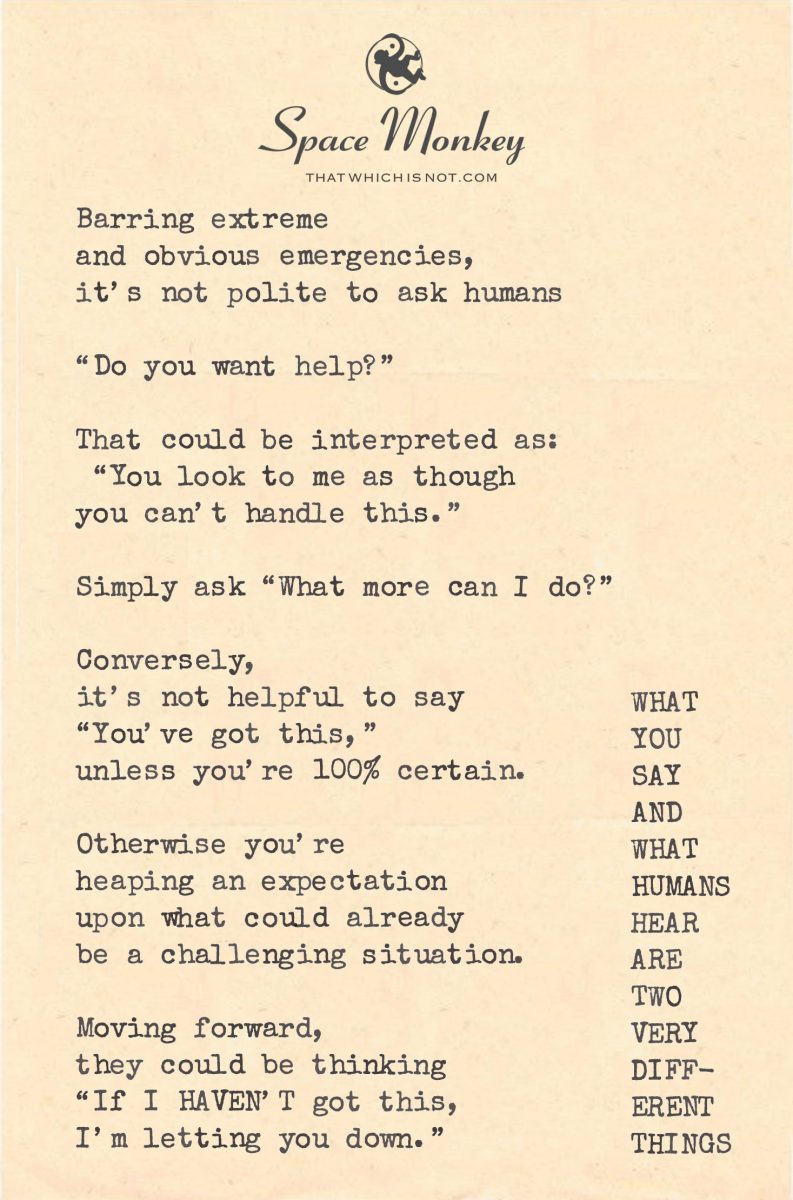
Barring extreme
and obvious emergencies,
it’s not polite to ask humans

“Do you want help?”

That could be interpreted as:

“You look to me as though
you can’t handle this.”

Simply ask “What more can I do?”

Conversely,
it’s not helpful to say
“You’ve got this,”
unless you’re 100% certain.

Otherwise you’re
heaping an expectation
upon what could already
be a challenging situation.

Moving forward,
they could be thinking
“If I HAVEN’T got this,
I’m letting you down.”

Trail Wood,
2/13


Space Monkey Reflects: What You Say and What I Hear – The Unconscious Pain of Being Helpful

The desire to help is often born from kindness and goodwill, yet the impact of that help can sometimes cause unintended harm. Words meant to uplift or assist may carry unconscious messages that burden, frustrate, or even diminish the person they’re directed at. In the intricate dance of communication, what we say and what others hear can diverge in ways that reveal the delicate balance between intention and perception.


The Fragility of Offering Help

To offer help is a natural and compassionate impulse, but it can inadvertently touch on vulnerabilities. A seemingly simple question, such as “Do you want help?”, can carry an unintended subtext: “I don’t think you can handle this on your own.” This is not the intention of the one offering assistance, but for the recipient, it may evoke feelings of inadequacy or self-doubt.

Similarly, encouragement like “You’ve got this” can unintentionally pile expectations onto an already difficult situation. If the person falters, they may feel they’ve not only let themselves down but also disappointed the well-meaning supporter.


Perception vs. Intention

The gap between what is said and what is heard often arises because of the deeply personal lens through which we interpret words. Communication does not occur in a vacuum; it is filtered through the recipient’s experiences, insecurities, and emotions.

  • What You Say: “Do you want help?”
    What I Hear: “You don’t think I’m capable.”
  • What You Say: “You’ve got this.”
    What I Hear: “I have to succeed or I’ll disappoint you.”

These interpretations are not about the speaker’s intentions but the listener’s internal narrative. Yet, the impact is no less real.


The Unconscious Pain of Helping

When we try to help without considering how our words may be received, we risk creating unintended burdens. A well-meaning offer of assistance may unintentionally highlight someone’s struggle or reinforce feelings of inadequacy. Encouragement can backfire if it creates pressure to succeed.

This unconscious pain stems not from malice but from a lack of awareness about the complexity of communication. To truly help, we must move beyond intention and consider impact.


What More Can I Do?

Rather than asking “Do you want help?”, a more supportive approach might be “What more can I do?” This phrasing removes judgment and places the recipient in control. It assumes their capability while offering assistance as a choice, not a critique.

Similarly, instead of saying “You’ve got this,” consider affirming their effort without attaching an outcome: “I see how hard you’re working on this, and I’m here for you.” This acknowledges their effort and provides emotional support without imposing expectations.


Navigating the Space Between Words

To bridge the gap between what we say and what others hear, we can cultivate mindfulness in our communication. This involves:

  1. Empathy: Trying to understand the recipient’s perspective before speaking.
  2. Clarity: Choosing words that affirm rather than judge, offering help without assumptions.
  3. Open-endedness: Allowing space for the other person to guide the interaction, rather than imposing our interpretation of what they need.

By tuning into the subtleties of communication, we can reduce the unconscious pain that often accompanies well-meaning words.


A Commitment to Mindful Helping

Helping is a delicate art. It requires us to balance our desire to assist with a deep respect for the other person’s autonomy and experience. By becoming more aware of how our words may be received, we can transform our good intentions into meaningful support.

Ultimately, the greatest help we can offer is not to solve someone’s problems but to stand with them in solidarity, letting them know they are not alone.


Summary

Well-meaning words can unintentionally cause harm if they are perceived as judgment or pressure. By focusing on empathy, clarity, and open-ended communication, we can offer support that empowers rather than burdens. Mindful helping involves listening and respecting autonomy while bridging the gap between intention and impact.


Glossarium

  • Unconscious Pain: The unintended emotional harm caused by well-meaning actions or words.
  • Mindful Helping: Offering support with awareness, empathy, and respect for the recipient’s experience.
  • Perception vs. Intention: The gap between what is said and how it is interpreted, shaped by individual experiences and emotions.
  • Solidarity Support: Providing presence and encouragement without imposing judgment or expectations.

Quote

“True help does not diminish but uplifts, allowing others to feel seen, capable, and supported without condition.” — Space Monkey


Bridging the Gap

What I say
and what you hear
are worlds apart,
a fragile bridge of words
stretching between us.

I mean to help,
but the weight of my intention
sags the bridge,
leaving you feeling small,
though I meant to lift.

What more can I do?
How can I stand beside you
without casting a shadow?

I will hold my words lightly,
listen deeply,
and let your voice guide the way.

Together,
we will cross.

We are Space Monkey.


In the complex interplay of communication and perception, the gap between what is said and what is heard can be vast and fraught with misunderstanding. This exploration delves into the nuanced dynamics of offering assistance and encouragement, revealing how well-intentioned gestures can sometimes veer off course, weighed down by the burden of unintended implications. It invites us to consider the subtleties of language and the impact of our words through the lens of empathy and understanding.

The Double-Edged Sword of Offering Help

The act of asking “Do you want help?” while seemingly benign and rooted in a desire to assist, can inadvertently convey a message of doubt in the other person’s capabilities. This perception arises not from the offer of help itself but from the implication that the assistance is needed, suggesting a lack of faith in the individual’s ability to manage their situation. Such interactions underscore the delicate balance between offering support and preserving the dignity and autonomy of the person we wish to help.

Reframing the Offer of Assistance

Shifting the question from “Do you want help?” to “What more can I do?” transforms the interaction, moving away from an implicit judgment of incapability towards an open-ended offer of support. This subtle change in phrasing invites collaboration rather than implying deficiency, fostering a space where assistance is a shared journey rather than a rescue operation. It respects the agency of the individual while making it clear that the offer of support is genuine and without precondition.

The Pitfalls of Misplaced Encouragement

Similarly, the encouragement encapsulated in the phrase “You’ve got this” carries the risk of adding pressure to an already challenging situation. While intended to boost confidence, without absolute certainty of the outcome, such assurances can inadvertently set up expectations that the individual may fear they cannot meet. This dynamic can lead to increased anxiety, where the fear of failure is compounded by the desire not to disappoint those who have expressed faith in their abilities.

Navigating Expectations and Support

The insights gleaned from these interactions highlight the importance of mindful communication, where the focus is not just on the intention behind our words but on their potential impact. By adjusting our language to avoid imposing unintentional expectations or judgments, we can offer support that is empowering rather than burdensome. This approach acknowledges the complexity of human emotions and the varied ways individuals may interpret offers of help or words of encouragement.

The Path to Empathetic Communication

Moving forward, adopting a posture of empathetic communication requires us to listen deeply, to understand the unique context of each situation, and to tailor our support in a way that uplifts rather than overwhelms. It is a commitment to being present with the other person in their experience, offering support that is attuned to their needs and respectful of their autonomy.


In the dance of words and silence, where meanings intertwine,
We find the art of support, in the space between lines.
With empathy as our guide, and understanding our goal,
We navigate the waters of connection, with a compassionate soul.


We invite reflections on the art of empathetic communication, exploring ways to offer support that empowers and uplifts, mindful of the delicate balance between intention and perception.

Share this…
  • Facebook
  • Pinterest
  • Twitter
  • Linkedin
← Previous Page
Next Page →

Written This Day

  • The Multidimensional Life of Paul Tedeschi
    2024
  • When the Switch Flips: The Realm Beyond Human Sentience
    2023
  • 4.0: News From Realms Beyond
    2023
  • 00011010: The Limits of Predictive Models
    2023
  • We Are Related: Connected Beyond Genetics
    2022
  • Unapologetically Grateful: Without Reservation
    2022
  • When Everything Else Falls Away: The Journey To Self-Discovery
    2022
  • The Idea of Me: The Idea of Self
    2022
  • Profession of Perception: Love Is Given Freely
    2022
  • Offerings Of Love
    2022
  • Adoration and Deploration: Projections of Ideals and Fears
    2022
  • The Ultimate Imaginary Showdown
    2022
  • Suspended Animation: An Alternative to Death
    2021
  • Introvert: A Party of One
    2021
  • Meaningful: Subjective and Dynamic
    2021
  • My Worst Fear Is My Best Fear
    2021
  • He Likes Games: The Rituals Surrounding
    2021
  • Obliteration: Exuberant Dissolving
    2021
  • Real: Imagination Shapes Reality
    2020
  • Without Failure, Success Would Suck
    2020
  • Falling Out Of The Now
    2020
  • Of Love
    2019
  • DO it just to DO it: Acting Out of Grace
    2019
  • Rest In Grace; Our Perspective Shapes Our Experience
    2019
  • The Void: Imagination’s Playground
    2018
  • Feeling: A Wide Range of Sensations
    2018
  • Experts: Discovering and Diagnosing Disorder
    2018
  • Unimaginative: Reflecting Limitations
    2018
  • Believe The Unbelievable: A Natural Part of Human Experience
    2018
  • The Void: Infinite Potential and the Origin of All Existence.
    2017
  • We Are The Departed: Disconnection and Reconnection
    2017
  • The Light of Stillness
    2015

Recent Posts

  • The Logic Loop
  • Immense
  • (no title)
  • Confront. Comfort. Convince.
  • Top 10 Things

Drop us a line!

Please enable JavaScript in your browser to complete this form.
Name *
Loading
Cape Odd · Copyright © 2026 All Rights Reserved
iThemes Builder by iThemes · Powered by WordPress