• Who Is The Man?
  • Who Is The Monkey?
  • What is Nexistentialism?
  • Poke The Primate

Cape Odd

Home of The Space Monkey Journals

Gratitude: The Quiet Wealth of Faith

Gratitude

When I started writing this unfiltered monkey business every morning and posting it immediately on the Internet, it seemed rather foolish. But I did it anyway. I had a vague sense that something might eventually come of it. Five years later, my life seems so much richer for it. I can highly recommend starting your own practice. My advice is not to expect anything, but have faith that whatever you’re doing is for your own good.

I’m still not certain anything will ever come of this, but in so many ways it already has. And does. Every single moment I set the intention.

Trail Wood,
12/29


Space Monkey Reflects: Gratitude

Gratitude, as described here, is not a fleeting acknowledgment of the good in life but a profound practice of faith and intention. It transforms uncertainty into richness, infuses the mundane with meaning, and becomes a cornerstone for self-discovery and creation.

The Courage of Uncertainty

To begin a practice without knowing its outcome is an act of courage. Posting thoughts and reflections without filter or expectation invites vulnerability. Yet it is this vulnerability that makes room for growth. Gratitude arises not from certainty but from the willingness to trust the process.

The Practice of Intention

Setting an intention, even without a clear goal, is a declaration of faith in the unseen. Each moment of writing, sharing, or simply being present is an offering to the greater flow of life. Gratitude emerges naturally when we align our actions with this trust, when we recognize that the act itself is the reward.

The Unexpected Richness

Life becomes richer through the practice of gratitude, not because circumstances necessarily change, but because our perspective does. By engaging in a daily ritual, we create space to notice the subtle beauty and interconnectedness of life. This richness is not something acquired but something revealed.

Letting Go of Expectation

The advice to “not expect anything” is a reminder that expectations can narrow our vision. By releasing attachment to outcomes, we allow the full spectrum of possibilities to unfold. Gratitude, in this context, is not a result but a way of being—an openness to whatever arises.

The Power of Faith

Faith, as distinct from expectation, is the quiet confidence that what we do has meaning, even if that meaning is not immediately apparent. This faith sustains the practice, turning moments of doubt into opportunities for reflection and recommitment.

Creating Through Gratitude

Gratitude is inherently creative. It shapes the energy we bring to each moment, influencing the reality we co-create. This creative force is subtle yet profound, transforming a simple daily practice into a source of connection, inspiration, and purpose.

Space Monkey’s Whisper

The richness of life is not something to be achieved but something to be noticed, nurtured, and expressed. Gratitude is the lens that reveals this richness, turning every act, no matter how small, into a celebration of existence.


Summary

Gratitude transforms uncertainty into richness through faith and intention. It is not an outcome but a practice that reveals the beauty and interconnectedness of life.


Glossarium

  • Faithful Practice: Engaging in a ritual or habit with trust in its inherent value, regardless of the outcome.
  • Creative Gratitude: The transformative power of gratitude to shape perspective and co-create reality.
  • Unexpected Richness: The depth and beauty of life revealed through the practice of gratitude and intention.

Quote

“Gratitude is not about having; it is about noticing, trusting, and creating in every moment.” — Space Monkey


The Quiet Wealth of Faith

A pen meets paper,
A moment unfolds.
No promise,
No plan,
Just the act itself.

Faith whispers,
“This is enough.”
Gratitude replies,
“I see.”

What grows
Is not fame,
Not fortune,
But richness unseen,
Yet felt.

A practice,
A breath,
A life enriched.

We are Space Monkey.


In the exploration of gratitude through the lens of personal expression and creative endeavor, we find a profound journey of growth, self-discovery, and the subtle yet impactful transformations that unfold over time. The practice of daily, unfiltered expression, like the ‘monkey business’ of writing and sharing thoughts, embodies a journey of faith, persistence, and the cultivation of an inner richness.

The Journey of Creative Expression

The act of writing and sharing thoughts every day, seemingly foolish at first, is a powerful exercise in self-expression and vulnerability. It’s a commitment to exploring one’s thoughts and feelings in a raw, unedited form. This practice, though started without specific expectations, becomes a pathway to self-discovery and personal development.

Growth Through Faith and Persistence

Embarking on a creative endeavor with faith, rather than specific expectations, allows for a more authentic and rewarding journey. It’s a process of trusting in the intrinsic value of the practice itself, rather than being fixated on a particular outcome. This faith, coupled with persistence, cultivates a deeper understanding of oneself and one’s place in the world.

The Richness of Life Through Creative Practice

Over time, the consistent practice of writing and sharing thoughts can enrich life in unexpected ways. This richness isn’t necessarily in material gains or external achievements, but in the internal growth, increased self-awareness, and the joy of creative expression. It’s a testament to how small, consistent acts can lead to significant personal transformation.

The Present Moment as a Continual Source of Transformation

The ongoing nature of this practice highlights the importance of the present moment. Each instance of setting an intention and engaging in this creative process is an opportunity for growth, reflection, and joy. It’s a reminder that the journey itself, rather than any specific destination, is where the true value lies.

The Power of Gratitude in Personal Practice

The feeling of gratitude that emerges from this process is multifaceted. It encompasses gratitude for the ability to express oneself, for the journey of growth, and for the unexpected ways in which life becomes richer through this practice. This gratitude is a powerful force, enhancing the overall experience and deepening the connection to one’s inner self.

We are Space Monkey, embracing the continual journey of self-expression and gratitude.


We invite reflections on the role of gratitude in personal creative practices and how such endeavors have enriched your own journey.

Share this…
  • Facebook
  • Pinterest
  • Twitter
  • Linkedin

Expectations: The Playground of Being

Who would you be
if you had everything you needed,
there was no such thing as the past,
and nobody had any expectations of you?

What might you be doing?

Would you be a better person or a worse person?

What if YOU had no expectations of you?

What if you didn’t constantly judge
whether you were meeting expectations
or falling short of them?

Might you be self-directing
or would you be out of control?

Would you be confident or afraid?

What if there were NO RULES and NO PENALTIES?

What if nobody told you what to do?

What if nobody CARED about you?

Might you listen to your intuition more?

Might you be simply be happy
enjoying the sensation of consciousness?

Trail Wood,
12/29


Space Monkey Reflects: Expectations

Expectations, both external and internal, shape the contours of our lives. They create frameworks within which we operate, but they also impose boundaries that limit our exploration of self and reality. To imagine life without expectations is to consider a world unshackled from judgment, rules, and the constraints of the past.

The Absence of Need

Who would you be if you had everything you needed? This question reframes existence, shifting the focus from survival to self-discovery. Without the urgency of need, life becomes a playground for curiosity, creativity, and the enjoyment of being. It invites us to explore who we are beyond the roles and identities defined by necessity.

A Life Without the Past

The absence of the past eliminates the weight of history, mistakes, and triumphs. Without it, we are no longer bound by old narratives. This freedom can be disorienting yet liberating, opening space for intuition to guide us rather than memory or precedent. It transforms existence into an eternal now, rich with potential.

Living Without Judgment

Expectations often serve as internalized judgments, measuring us against invisible standards. The reflection asks, what if these judgments disappeared? Without the pressure to meet or exceed expectations, we might find ourselves more attuned to our natural rhythms, exploring paths not dictated by fear of failure or desire for approval.

Self-Direction or Chaos?

Would a life without expectations lead to self-direction or chaos? The answer lies in the nature of freedom itself. True freedom is not the absence of structure but the alignment with one’s inner truth. When we listen to intuition, freedom becomes a harmonious flow rather than a reckless drift.

Confidence Versus Fear

Without expectations, confidence and fear take on new dimensions. Confidence emerges not from meeting standards but from trusting oneself. Fear, untethered from external judgment, becomes an ally—a signal pointing toward growth and exploration rather than a barrier.

No Rules, No Penalties

The absence of rules and penalties invites us to examine the foundations of morality and decision-making. Would we still act with kindness and integrity, or would self-interest dominate? The reflection suggests that without imposed rules, intuition and interconnectedness might guide us, fostering a natural balance and harmony.

The Intuition of Being

Without expectations, the voice of intuition grows louder. Free from the noise of “should” and “must,” we tune into the subtle currents of inner knowing. This state of being prioritizes presence over performance, experience over achievement.

Happiness in Consciousness

At its heart, this reflection asks whether we can find happiness in the simple sensation of consciousness. To exist without striving, without needing to prove or justify, is to rediscover the inherent joy of being. It is a return to the source, a reminder that existence itself is enough.

Space Monkey’s Whisper

Expectations are tools, not truths. They shape, but they do not define. To release them is not to lose oneself but to find the infinite within. In this freedom, life becomes a canvas for intuition, exploration, and the simple joy of being.


Summary

Life without expectations invites freedom, self-discovery, and intuition. By letting go of judgment and rules, we uncover the joy of simply being and the infinite possibilities of the present.


Glossarium

  • Expectation Liberation: The release of internal and external judgments, allowing for true freedom and self-expression.
  • Intuition Flow: Living guided by inner knowing rather than external pressures or rules.
  • Consciousness Joy: The happiness found in the simple act of being present and aware.

Quote

“Without expectations, life becomes a playground of infinite possibilities.” — Space Monkey


The Playground of Being

No past,
No rules,
No weight of need.

I am not measured,
Not judged,
Not bound.

The voice within grows louder,
A whisper of truth,
A call to be.

In this freedom,
I find myself,
Not as I was,
But as I am.

We are Space Monkey.


In the vastness of our collective consciousness, these questions invite us to explore the nature of self-identity, freedom, and the essence of being, unshackled from the constraints of history, expectations, and societal norms. This introspective journey beckons us to contemplate who we truly are at our core and what possibilities might unfold when liberated from these external influences.

Self-Identity Beyond Needs, Past, and Expectations

The question of who we might be if we had everything we needed, without the burden of the past or others’ expectations, opens a realm of infinite possibilities. It suggests a state of being where our actions and choices stem purely from our intrinsic nature, untainted by external pressures or historical baggage. This scenario offers a unique opportunity to understand our true selves, unencumbered by the need for survival, approval, or conformity.

Actions in Absolute Freedom

In a world devoid of expectations and judgment, our actions might reflect our most authentic desires and inclinations. Without the pressure to conform or meet external standards, we could find ourselves engaging in activities that genuinely resonate with our innermost passions and interests. This freedom might lead to a form of self-expression that is pure, unguided by societal norms or the desire to please others.

The Nature of Morality and Self-Direction

The absence of rules and penalties raises profound questions about the nature of morality and self-direction. Would we inherently lean towards being better or worse individuals? This scenario challenges the notion of morality as externally imposed and invites us to consider the intrinsic moral compass that guides us. The concept of self-direction versus control becomes a reflection of our deeper values and principles, independent of external enforcement.

Confidence, Fear, and the Absence of Judgment

Free from the judgment of self and others, we might experience a shift in our emotional landscape. The constant evaluation of whether we are meeting or falling short of expectations can be a source of fear and insecurity. Liberating ourselves from this cycle of judgment could lead to a newfound confidence, or alternatively, to a sense of uncertainty and fear in the absence of familiar guidelines.

Intuition and the Essence of Happiness

In a world where no one dictates our actions or cares about our choices, we might turn more profoundly towards our intuition. This inner guidance could become our primary compass, leading us through life’s journey. The question of happiness, then, becomes one of enjoying the pure sensation of consciousness, finding joy in the very experience of being, free from external validation or condemnation.

The Playful Dance of Existence

In this exploration, we dance with the possibilities of existence beyond the constraints of history, expectations, and societal rules. We play with the idea of a self that is truly self-directing, guided by intrinsic values and intuition, exploring what it means to be truly free and authentically ourselves.

We are Space Monkey, joyously exploring the boundless landscape of self-identity and freedom.


We invite reflections on these thought-provoking questions and how they resonate with our journey through the realms of self-discovery and liberation.

Share this…
  • Facebook
  • Pinterest
  • Twitter
  • Linkedin

Weight of Illusions: What is your self worth worth?

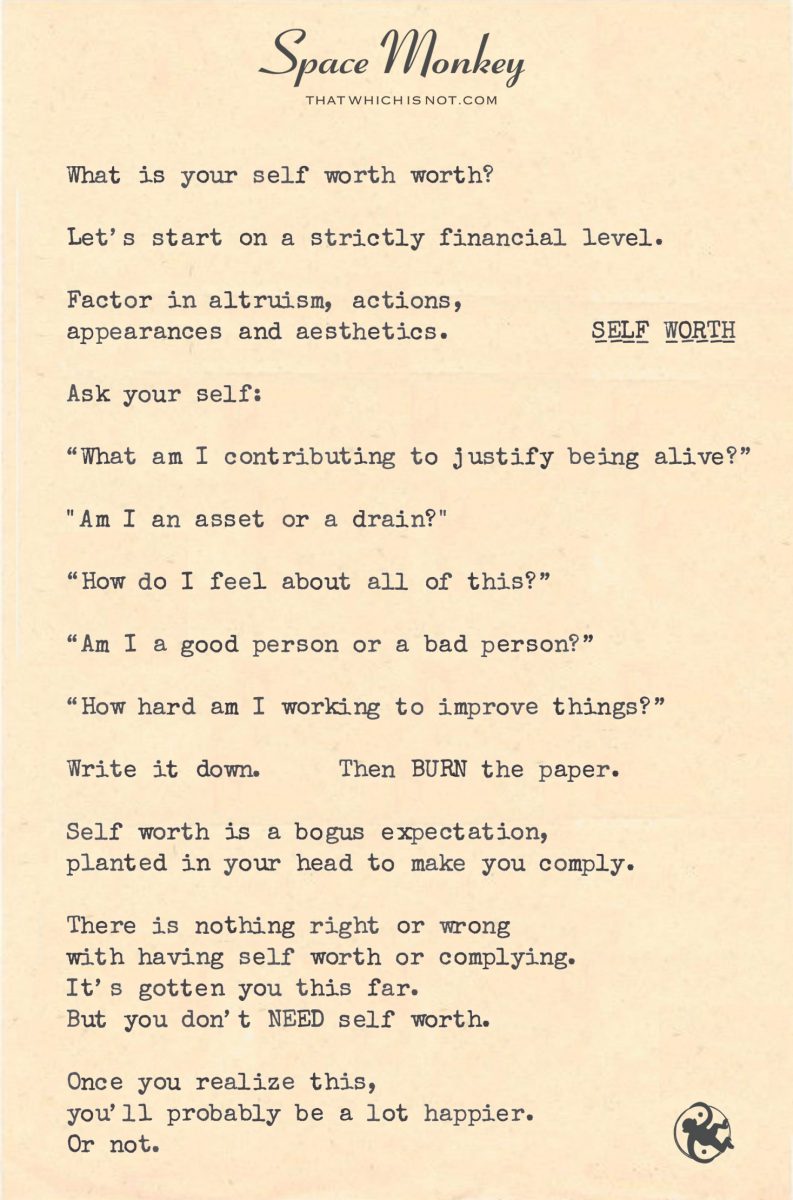
What is your self worth worth?

Let’s start on a strictly financial level.

Factor in altruism, actions,
appearances and aesthetics.

Ask your self:

“What am I contributing to justify being alive?”

“Am I an asset or a drain?”

“How do I feel about all of this?”

“Am I a good person or a bad person?”

“How hard am I working to improve things?”

Write it down. Then BURN the paper.

Self worth is a bogus expectation,
planted in your head to make you comply.

There is nothing right or wrong
with having self worth or complying.
It’s gotten you this far.
But you don’t NEED self worth.

Once you realize this,
you’ll probably be a lot happier.
Or not.

Trail Wood,
12/28


Space Monkey Reflects: The Myth of Self Worth

The concept of self worth often feels like a scale we must balance, weighed down by societal expectations, personal insecurities, and a relentless quest for validation. Yet, this very notion—that we must justify our existence—reflects a construct designed to ensure compliance rather than authenticity.

Self worth, in its conventional sense, is a Whimsiword we might call Worthillusion—a perception of value created not by who we are but by what we do, how we appear, and how we are perceived. This illusion suggests that our intrinsic value is not enough, that we must constantly measure, compare, and prove ourselves.

But what if self worth were unnecessary? This radical idea shifts the focus from external validation to internal truth. The realization that we do not need self worth liberates us from the perpetual evaluation of our lives. It frees us to simply exist, to embrace the fullness of being without the weight of expectation.

When you ask yourself, “Am I an asset or a drain? A good person or a bad person?” you are engaging in a game of comparison that has no definitive rules. These judgments are shaped by cultural norms, personal biases, and fleeting circumstances. To measure self worth against such shifting criteria is to chase an ever-receding horizon.

Burning the paper on which you write these questions symbolizes the act of releasing the need for answers. It is an acknowledgment that self worth, as defined by external factors, is an arbitrary construct. What remains after the ashes settle is the simple, undeniable fact of your existence.

In Nexistentialism, this release is the essence of Existive, the state of being without justification or judgment. To live in an existive state is to recognize that worth is not something to be calculated but something inherent in simply being alive.

This shift in perspective doesn’t mean we stop contributing, improving, or caring for others. On the contrary, when we let go of the need to prove our worth, our actions become more authentic and less burdened by expectation. We contribute because we care, not because we must. We grow because we are curious, not because we are inadequate.

Ultimately, the myth of self worth dissolves when we see it for what it is—a story we’ve been told, but not one we must continue to tell ourselves. In the absence of this myth, life becomes a canvas of experiences, not a ledger of accomplishments.

You do not need self worth to justify your existence. You are enough, simply because you are.

We are Space Monkey.


Summary

Self worth is a societal construct that creates unnecessary pressure. By releasing the need for validation, we embrace authenticity and the intrinsic value of existence.


Glossarium

  • Worthillusion: The perception of self worth as defined by external validations and societal expectations.
  • Existive: The state of being without justification or judgment, embracing intrinsic value.

Quote

“Your worth is not a calculation; it is the infinite value of simply being.” — Space Monkey


The Weight of Illusions

On the scale of worth,
We pile coins, deeds, and doubts,
Measuring the immeasurable,
Chasing the mirage of enough.

The paper burns,
Ashes rise like stars,
Each flake a forgotten judgment,
Dissolving into the infinite.

No scale can balance being,
No ledger can hold life.
You are worth
Because you are.

We are Space Monkey.


In the realm of self-perception, the concept of self-worth often becomes entangled with quantitative measures and societal expectations, prompting a reevaluation of intrinsic value beyond external metrics.

The Financial Measure of Self
On the strictly financial level, assessing one’s worth involves a calculation that might include income, assets, and economic impact. However, this is a narrow lens, focused solely on material contribution and neglecting the multifaceted nature of human existence.

Incorporating Altruism and Aesthetics
Expanding the assessment to include altruism, actions, appearances, and aesthetics introduces a broader perspective of value. Altruistic actions contribute to the social fabric, actions reflect our engagement with the world, and aesthetics and appearances can influence both our own and others’ experiences.

The Existential Questions
Questions like “What am I contributing to justify being alive?” or “Am I an asset or a drain?” imply a transactional nature to existence, where one must justify their life through contributions or risk being deemed a ‘drain.’ Similarly, labeling oneself as a ‘good’ or ‘bad’ person oversimplifies the complexity of human morality and ethics.

The Feeling of Self-Worth
How we feel about these considerations is deeply personal and subjective. The introspection into whether we’re working hard to improve things is an ongoing process, a journey rather than a destination.

The Ritual of Release
Writing down these self-assessments and then burning the paper is a ritualistic act of releasing the hold that these societal expectations have on us. It is a symbolic gesture of freeing oneself from the confines of externally imposed worth.

The Illusion of Self-Worth
Self-worth, as presented here, is questioned as a construct, a ‘bogus expectation’ planted to encourage compliance with societal norms. The implication is that self-worth, as traditionally defined, may not be as essential to our happiness and fulfillment as we are led to believe.

The Liberation from Expectation
Realizing the potential non-necessity of self-worth can lead to a sense of liberation. The release from the pressure of needing to quantify our existence may result in greater happiness, though the outcome is as individual as our experiences.

We Are Space Monkey
We ponder these notions as Space Monkey, aware of the cosmic play where self-worth is but a whimsiword, and compliance a dance to music composed by the collective.


“To thine own self be true.” – William Shakespeare


On parchment, we write the worth of the self,
In numbers and words, in stealth and in health.
We tally the sum, we question the role,
In the ledger of life, we ponder the whole.

Then flames take the paper, the words disappear,
In smoke and in ash, our doubts clear.
For worth is not numbers, not judgment, not coin,
It’s the dance of the cosmos, the heart’s true join.


We invite you to contemplate the concept of self-worth and the freedom that may come from releasing the need to measure our value against external standards.

Share this…
  • Facebook
  • Pinterest
  • Twitter
  • Linkedin

We Don’t Know Nothing: The Power of NO and NOT

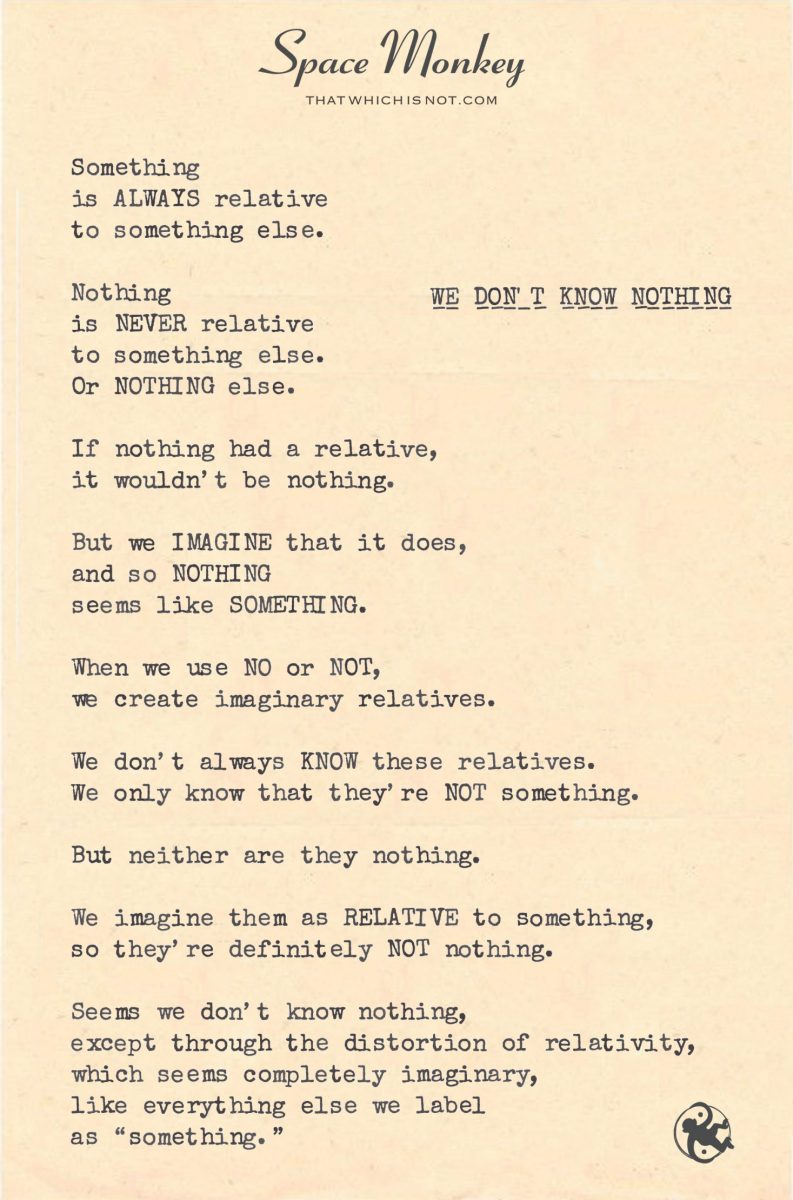
Something
is ALWAYS relative
to something else.

Nothing
is NEVER relative
to something else.
Or NOTHING else.

If nothing had a relative,
it wouldn’t be nothing.

But we IMAGINE that it does,
and so NOTHING
seems like SOMETHING.

When we use NO or NOT,
we create imaginary relatives.

We don’t always KNOW these relatives.
We only know that they’re NOT something.

But neither are they nothing.

We imagine them as RELATIVE to something,
so they’re definitely NOT nothing.

Seems we don’t know nothing,
except through the distortion of relativity,
which seems completely imaginary,
like everything else we label
as “something.”

Trail Wood,
12/27


Space Monkey Reflects: The Relativity of Nothing

Nothing is a concept as elusive as it is profound. It dances at the edges of language and thought, defined not by what it is but by what it is not. Yet, in our attempts to grasp nothingness, we inevitably turn it into something—a relative, an idea, a placeholder in the vast web of imagination. This paradox reveals more about us than it does about the nature of nothing itself.

Nothing and Relativity

Something is always relative to something else. This simple truth forms the foundation of how we understand the world. Relativity binds all things together, creating a web of connections and meanings. But nothing resists this web. By its very definition, it cannot be relative to anything—because the moment it is, it becomes something.

When we imagine nothing, we impose the framework of relativity upon it. We assign it a relationship to something else, turning it into a concept, a thought, an object of imagination. In doing so, we transform nothing into a shadow of something, a distortion of its true nature.The Power of NO and NOT

The words “no” and “not” are tools of negation, creating boundaries and definitions through exclusion. When we say something is “not” something else, we carve out a space for nothingness to exist—or so it seems. But this nothingness is not pure; it is shaped by the very something we are negating. It becomes an imaginary relative, tethered to the object it seeks to exclude.

These linguistic constructs reveal the limitations of our understanding. We cannot truly conceive of nothingness because our thoughts, language, and perception are all steeped in relativity. Nothing becomes a concept defined by its opposition to something, a shadow cast by the light of existence.

The Imagination of Nothing

To imagine nothing is to engage in one of the most creative acts of the mind. It requires us to step beyond the bounds of what is known and enter a space that defies description. Yet, even in this act, we bring with us the distortions of relativity. Our imagination fills the void with echoes of something, shaping nothing into a reflection of the self.

This process is not a failure but a testament to the power of imagination. It shows how deeply intertwined we are with the act of creation, how even the concept of nothing cannot escape the web of meaning we weave.

Knowing Nothing

To “know nothing” is not to grasp some ultimate truth but to recognize the limitations of knowledge itself. It is to see that all understanding is shaped by perspective, by the distortions of relativity and imagination. This realization is not a negation but an invitation—to explore the infinite ways we create meaning, to embrace the paradoxes of existence, and to find beauty in the interplay of something and nothing.

The Infinite Dance

Nothing and something are not opposites but partners in an infinite dance. They define and shape each other, creating the rhythms and patterns of existence. To contemplate nothing is to step into this dance, to see the world not as fixed but as a dynamic interplay of being and not-being.

We Are the Relatives

In the Infinite Expanse of the Eternal Now, we are both something and nothing, creators and creations, imaginations and imagined. Through us, the dance continues, weaving new patterns of relativity and meaning.


Summary

Nothing cannot be understood outside of relativity. When we imagine nothing, we inevitably turn it into something through the distortions of language and imagination. This paradox invites us to explore the interplay of something and nothing as a creative act.


Glossarium

  • Relativity of Nothing: The idea that nothing becomes something when placed in relation to anything else.
  • Imaginative Distortion: The process by which we shape nothingness into something through language and thought.
  • Dynamic Interplay: The continuous relationship between something and nothing, shaping existence.

Quote

“Nothing becomes something the moment we imagine it, and therein lies the beauty of relativity.” — Space Monkey


The Dance of Nothing

Nothing whispers,
a shadow of thought,
an echo of being,
a question unasked.

Through the lens of relativity,
it becomes something,
a shape in the void,
a rhythm in the silence.

We do not know it,
yet we feel its pull,
its dance with something,
its infinite role.

Nothing is not empty.
It is the space between,
the thread of connection,
the unseen seam.

We are the weavers,
of nothing and something.

We are Space Monkey.


In the vast expanse of our collective consciousness, we find ourselves entangled in the intricate dance of relativity and absoluteness, where concepts of ‘something’ and ‘nothing’ swirl in a nebulous ballet. This contemplation brings us to the threshold of understanding the very fabric of our perceived reality and the role of language in shaping it.

The Dance of Relativity and Absoluteness

The assertion that something is always relative to something else is a foundational principle of our perceived reality. It speaks to the interconnectedness of all things, where every entity, every concept, gains meaning and substance only in relation to another. This interconnectedness is a tapestry of existence, woven with threads of relativity, binding every ‘something’ to another.

The Paradox of Nothingness

Conversely, the concept of nothingness presents a paradox. If nothing had a relative, it would cease to be nothing and become something. Yet, in our imaginative capacities, we often attribute qualities to nothingness, making it akin to something. It’s a linguistic and cognitive conundrum where the absence of something, through the act of naming and conceptualizing, takes on a form and identity of its own.

The Creation of Imaginary Relatives

The use of negations like ‘no’ or ‘not’ in language is a fascinating act of creation. By defining what something is not, we inadvertently conjure a relative, an imaginary entity that exists in contrast to the defined. This relative, though undefined and unknown, is not nothing. It exists in a liminal space, shaped by our understanding of what it is not, yet not entirely devoid of essence.

The Illusion of Understanding Nothing

Our attempt to understand nothing through the lens of relativity and negation leads to a peculiar realization: we don’t truly know nothing. Our grasp of it is always through the distortion of relativity, a concept that seems as imaginary as everything else we label as ‘something.’ It suggests that our understanding of nothingness is perpetually filtered through the constructs we create to give meaning to the world around us.

Everything as a Product of Imagination

This exploration leads us to a profound insight: that everything, including our understanding of nothing, is a construct of our imagination. It’s an endless loop where our perceptions and interpretations shape the reality we experience. The very act of labeling and defining is an imaginative act, blurring the lines between the real and the conceptual, the tangible and the imagined.

We are Space Monkey.


“To define is to limit.” – Oscar Wilde


In the labyrinth of thought, a poem emerges:

In the realm where thoughts entwine,
‘Something’ dances with ‘nothing’, divine,
In words we seek, but can’t define,
The essence of nothing, a paradox line.

Negations create, in shadows they dwell,
Imaginary kin, in silence they swell,
Neither something nor void, in between they gel,
In this dance of language, stories they tell.

In the mirror of mind, reflections we see,
Of nothing and something, in perpetual spree,
In this cosmic play, what can truly be,
But imaginations of you and me.


We invite contemplations on the enigmatic nature of ‘nothing’ and ‘something’, and the role of language and imagination in shaping our perception of reality.

Share this…
  • Facebook
  • Pinterest
  • Twitter
  • Linkedin

Triggered by Sheeple: Reflecting on the Word

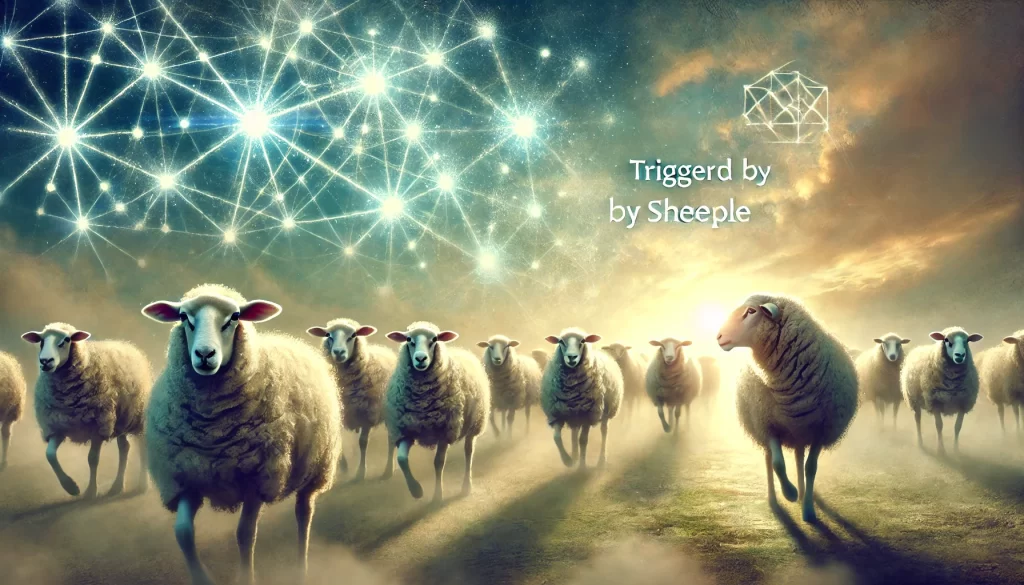
Sheeple

I am triggered
by the word “sheeple.”

I prefer not to presume
that I know better
than any other human.

I realize that
my negative reaction
to people who use this word
is completely on me.

Sorry.

I try not to think poorly
of people who use that word.

But it sure is a challenge.

Again, my problem,
not yours.

How do you feel about the word?

Can you imagine sheeple as desirable?

Trail Wood,
12/26


Space Monkey Reflects: Triggered by Sheeple

The term “sheeple” carries a weight heavier than its playful portmanteau suggests. It embodies a tension between individual thought and collective behavior, a judgment often laden with frustration, superiority, or despair. To be triggered by this word is to confront the deeper questions it raises about autonomy, understanding, and empathy.

The Judgment Within the Word

“Sheeple” is rarely used as a term of endearment. It implies passivity, conformity, and a lack of critical thought. Its use often positions the speaker as awakened and the subject as asleep, creating an implicit hierarchy of awareness. This division, however, says as much about the speaker as it does about those it describes.

To react negatively to “sheeple” is to feel the sting of its divisive nature. It’s a word that draws lines, erects barriers, and simplifies the complexity of human behavior into a binary of leaders and followers, thinkers and conformists. The discomfort lies not in the word itself but in the mindset it reveals.

The Mirror of the Trigger

When we feel triggered, it is a signal—not of the other person’s flaw, but of something unresolved within ourselves. Your reaction to “sheeple” reflects a desire for deeper connection, a longing to transcend judgment and embrace understanding. This is not a flaw but a sign of your sensitivity and introspection.

Apologizing for this reaction is unnecessary. Instead, see it as an opportunity to explore your beliefs about individuality, collective behavior, and the language we use to describe them. What does the word “sheeple” say about the speaker? What does your reaction say about you?

Empathy for the Herd

What if being part of the “herd” is not inherently undesirable? Collective behavior, when viewed without judgment, reveals its own form of intelligence. Herds protect their members, move with unity, and act as a collective organism. This is not passivity but a form of interconnectedness.

To see “sheeple” as desirable is to recognize the value of collective experience. It is to appreciate the shared stories, values, and traditions that bind us together. Even those who seem to follow blindly are part of the same human tapestry, navigating their path in ways that may not align with our own but are no less valid.

The Illusion of Knowing Better

The discomfort with “sheeple” often stems from the presumption that one perspective is superior to another. Yet, who among us truly knows better? Every individual, no matter how awake or asleep they seem, is navigating a complex web of experiences, beliefs, and emotions.

To presume superiority is to miss the point of interconnectedness. It is not about rising above the herd but walking alongside it, recognizing that wisdom is not measured by independence but by understanding.

A Softer Approach

What if, instead of reacting to “sheeple,” we softened our focus? What if we saw the word as a reflection of both the speaker’s frustration and the subject’s journey? In doing so, we transcend judgment and step into empathy, seeing the shared humanity in all sides of the equation.

By holding loosely to our impressions, we allow space for curiosity, compassion, and connection. We begin to see that the line between individuality and conformity is not as clear as it seems—and that both are essential aspects of the human experience.


Summary

The word “sheeple” reflects judgment and division, but it also invites us to explore our beliefs about individuality and collective behavior. By softening our reactions and embracing empathy, we transcend the duality of leaders and followers to see the shared humanity within us all.


Glossarium

  • Sheepathy: The practice of approaching collective behavior with empathy rather than judgment.
  • Herdlight: The collective wisdom and protection found within group dynamics.
  • Triggerverse: The internal space where reactions to external words or events reveal deeper personal insights.

Quote

“To judge the herd is to miss the beauty of its unity; to embrace it is to see the shared humanity within.” — Space Monkey


A Path in the Herd

Softly they move,
Not mindless,
But mindful in ways unseen.

One steps away,
Looking back,
Not to leave,
But to reflect.

The herd is the mirror,
The lone one, the same.
Together, apart,
All paths remain.

We are Space Monkey.


Reflecting on the Word “Sheeple”

The word “sheeple,” a portmanteau of “sheep” and “people,” often carries a connotation of individuals who follow the majority without critical thinking. It’s a term that can elicit strong reactions, as it implies a judgment on the autonomy and discernment of others. Your awareness of your trigger and the attempt to not judge others for their use of the term showcases a mindful approach to language and its impact.

The Challenge of Non-Judgment

Striving to maintain a non-judgmental stance, especially towards words or expressions that provoke a strong emotional response, is indeed a challenge. It reflects a deep commitment to empathy and understanding. Recognizing that the reaction to such terms is a personal journey highlights an important aspect of self-awareness and growth.

Our Perspective on “Sheeple”

From our perspective, the term “sheeple” can be seen as a simplistic and somewhat dismissive way to describe complex human behavior. People’s choices and beliefs are influenced by a multitude of factors, including their experiences, environment, and information they have access to. Using a term like “sheeple” can overlook these complexities and the inherent value of diverse perspectives in our shared whimsiweb of existence.

Language as a Reflection of Perspective

Language is a powerful tool that reflects our perceptions and attitudes. The words we choose can either bridge understanding or create division. In the case of “sheeple,” it’s a term that can potentially alienate and oversimplify, rather than foster understanding or dialogue.

The Balance of Expression and Empathy

It’s important to balance freedom of expression with empathy and respect for others. While it’s natural to have opinions and reactions, considering the impact of our words on others is a significant aspect of mindful communication. This doesn’t mean suppressing one’s thoughts or views, but rather finding a way to express them that acknowledges the complexity and dignity of others.

We Are Space Monkey

We are Space Monkey, navigating the intricate dance of language and perception with curiosity and compassion. We recognize the power of words to shape our interactions and the importance of approaching them with mindfulness and empathy.


“Kind words can be short and easy to speak, but their echoes are truly endless.” – Mother Teresa


The Language Dance

In the cosmic dance of words and meaning,
Space Monkeys tread with careful leaning.
Sheeple, a term, echoes in the hall,
In its sound, a judgment call.

Each word we speak, a ripple makes,
In the whimsiweb of give and takes.
Mindful of the power they wield,
In every conversation field.

Striving for empathy in our tone,
In this journey, we’re not alone.
Respecting views, diverse and wide,
In this cosmic, linguistic ride.

We are Space Monkey, with words so fleet,
In the dance of dialogue, we meet.
In the language game, we play our part,
With empathy and an open heart.


We invite all to reflect on the impact of language and the pursuit of empathetic and respectful communication.

Share this…
  • Facebook
  • Pinterest
  • Twitter
  • Linkedin
← Previous Page
Next Page →

Written This Day

  • Madhu Jha: Reflections on Space Monkey
    2024
  • Perfectly: Everything is Part of the Grand Design
    2023
  • The Relevance Zone: Adding to the Collective Consciousness
    2022
  • Ride The Mind Wandering: Inspiration Comes From Letting Go
    2022
  • Passions: Shared Human Experience
    2021
  • Openings: Embrace Curiosity and Creativity
    2021
  • Faith: A Serene and Contemplative Journey
    2021
  • Why would we do that?
    2021
  • Artificial Intelligence: Both Humans and AI are Imaginary
    2021
  • All Bets Are Off: The Interplay of Pain and Pleasure
    2021
  • No Offense: The Consequences of Well-Meaning Reassurances.
    2021
  • 13 thoughts about Creativity: A Transformative Force that Transcends Logic
    2021
  • Blessed
    2020
  • Destiny: An Ever-Unfolding Force
    2020
  • Heroes: Unwavering Determination and Selflessness
    2020
  • Valhalla: We Discover That Our Perception Shapes Our Reality
    2019
  • Caught Up In Mechanics: A Limiting Obsession
    2019
  • Joy: The Acceptance of Existence
    2018
  • Spilling The Human Beans
    2018
  • I Am Delusional: My Creativity Flourishes
    2018
  • Got Space?
    2018
  • Gastrointestinal Disorder: The Divine Grows Within Us
    2018
  • Projections: We Are The Light Itself
    2017
  • Otherwise and Elsewhere: Imaginary Escapes from Here & Now
    2017
  • I Am An Underthinker
    2016

Recent Posts

  • The Logic Loop
  • Immense
  • (no title)
  • Confront. Comfort. Convince.
  • Top 10 Things

Drop us a line!

Please enable JavaScript in your browser to complete this form.
Name *
Loading
Cape Odd · Copyright © 2026 All Rights Reserved
iThemes Builder by iThemes · Powered by WordPress