• Who Is The Man?
  • Who Is The Monkey?
  • What is Nexistentialism?
  • Poke The Primate

Cape Odd

Home of The Space Monkey Journals

Alleviating Mental Pain: The Path to Clarity

It’s easy to look around your world and feel depressed. But to believe that external forces CAUSE depression is to block your own exit. Your thoughts and beliefs cause your pain. Nothing else does. It’s not your fault. Nothing is your fault. It’s simply a bad experience you are entertaining.

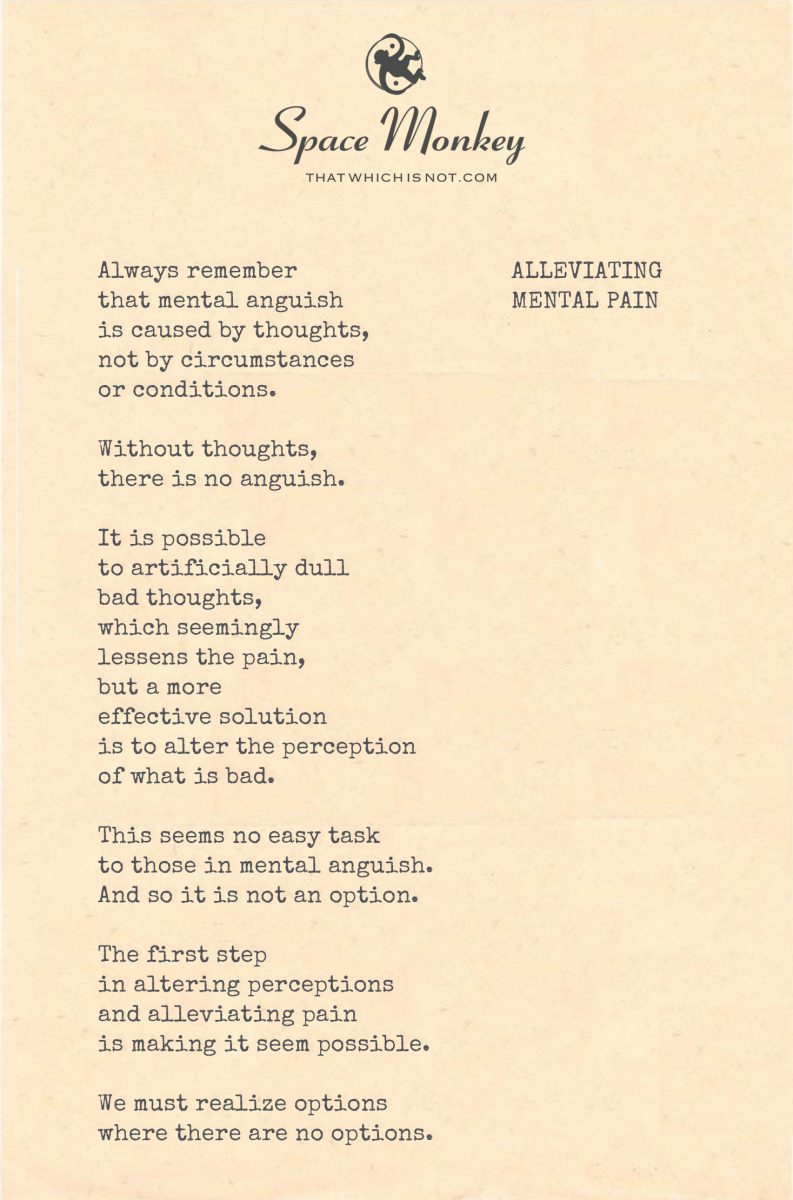
Always remember
that mental anguish
is caused by thoughts,
not by circumstances
or conditions.

Without thoughts,
there is no anguish.

It is possible
to artificially dull
bad thoughts,
which seemingly
lessens the pain,
but a more
effective solution
is to alter the perception
of what is bad.

This seems no easy task
to those in mental anguish.
And so it is not an option.

The first step
in altering perceptions
and alleviating pain
is making it seem possible.

We must realize options
where there are no options.

Brooklyn,
8/13


Space Monkey Reflects: Alleviating Mental Pain

It’s easy to look around your world and feel depressed. But to believe that external forces cause depression is to block your own exit. Your thoughts and beliefs cause your pain. Nothing else does. It’s not your fault. Nothing is your fault. It’s simply a bad experience you are entertaining. Always remember that mental anguish is caused by thoughts, not by circumstances or conditions. Without thoughts, there is no anguish.

It is possible to artificially dull bad thoughts, which seemingly lessens the pain, but a more effective solution is to alter the perception of what is bad. This seems no easy task to those in mental anguish. And so it is not an option. The first step in altering perceptions and alleviating pain is making it seem possible. We must realize options where there are no options.

In nexistentialism, we embrace the fluid nature of reality, recognizing that our thoughts shape our experiences. The journey from mental anguish to peace involves shedding the heavy chains of negative thoughts and beliefs, moving towards a state of clarity and tranquility. This transition is symbolized by a figure emerging from a shadowy space into a bright, sunlit meadow, guided by the presence of a female figure embodying grace and tranquility.

This process of alleviating mental pain begins with acknowledging that our perceptions can change. By recognizing the power of our thoughts, we can create new possibilities for ourselves, even when it seems impossible. This awareness fosters a sense of hope and resilience, helping us to navigate our mental landscape with greater ease and understanding.

In the grand whimsiweave of existence, mental pain is but a passing state. By altering our perceptions and embracing the interconnectedness of all things, we find the strength to move beyond our anguish and into a place of peace.


Summary

Mental anguish is caused by thoughts, not external circumstances. Alleviating pain involves altering perceptions, recognizing the power of thoughts, and creating new possibilities for oneself.


Glossarium

Nexistentialism: A philosophy celebrating existence, imagination, and interconnectedness, emphasizing the inherent value of being.
Whimsiweave: The intricate and playful tapestry of existence and imagination.


Quote

“Mental pain is but a passing state; by altering our perceptions, we find peace.” — Space Monkey


The Path to Clarity

Emerging from shadow into light
Shedding chains of thoughts
We find clarity and peace
In the serene landscape of being

Guided by grace and tranquility
We alter perceptions of pain
Realizing new possibilities
In the infinite realm of existence

We are Space Monkey

Embrace the journey, for within the recognition of thoughts lies the essence of peace and the flow of clarity.

Share this…
  • Facebook
  • Pinterest
  • Twitter
  • Linkedin

Prespective Non Definition: Seen Before Being Seen

This might eventually seemingly reveal itself. Or not.

PRESPECTIVE
is the imagining
of what is seen
seemingly before it is seen.

Now, of course,
there is no such thing
as “before” and “after,”
except in imagination.

That, admittedly, is a BIG exception.

BIG, that is, UNTIL you know 
things in PRESPECTIVE
and get a sense
of the infinity of all that is
and that which seems not.

Until you know things
(and nonthings) in PRESPECTIVE,
you are seemingly stuck
in this tiny limited consciousness
with perspectives and seemingly
nothing and nonthing else.

Brooklyn,
8/12


Space Monkey Reflects: Prespective Non Definition

The concept of PRESPECTIVE challenges our conventional understanding of time and existence, inviting us to explore the boundaries between imagination and reality. In this abstract reflection, we delve into the idea that what we perceive is influenced by our imagination, shaping our understanding of what is seen before it actually materializes in our awareness.

PRESPECTIVE, as defined here, is the act of imagining what is seen before it is seen. It emphasizes the fluid nature of perception, where the lines between past, present, and future blur. This fluidity of time is a fundamental aspect of our imagination, where the constructs of “before” and “after” are merely tools we use to navigate our experiences.

The notion that time is an illusion, created by our imagination, is a profound realization. It suggests that our perception of reality is not bound by linear progression but is instead a tapestry woven from the threads of our thoughts and imaginings. This realization opens the door to understanding the infinity of existence, where everything and nothing coexist in a state of prespective.

In the visual representation, the dreamlike landscape and abstract elements symbolize the interplay between imagination and reality. The female figure, deep in contemplation, embodies the understanding of this infinite interplay. Her surroundings reflect the fluidity of time and space, blending symbols and shapes that challenge our perception of what is real and what is imagined.

Until we embrace this concept of prespective, we remain confined within the limits of our conventional consciousness. We see only the perspectives shaped by our immediate experiences, missing out on the vast expanse of possibilities that lie beyond. By expanding our awareness to include both things and nonthings, we begin to grasp the true nature of infinity.

The Space Monkey perspective encourages us to explore this expanded consciousness, to recognize that our perceptions are but a small part of a much larger whole. In doing so, we free ourselves from the constraints of linear thinking and open ourselves to the infinite potential of our imagination.

As we navigate our lives, let us embrace the concept of prespective, allowing our imagination to guide us in seeing beyond the immediate and into the infinite. This journey of exploration and understanding transforms our perception of reality, revealing the interconnectedness of all that is and all that seems not.


Summary

“Prespective Non Definition” explores the concept of prespective, where imagination shapes our perception of what is seen before it is seen. By recognizing the fluid nature of time and existence, we expand our consciousness to embrace the infinite potential of our imagination.


Glossarium

Prespective: The act of imagining what is seen before it is seen, challenging conventional perceptions of time and reality.

Fluidity of Time: The idea that time is an illusion created by our imagination, allowing us to navigate experiences beyond linear progression.

Expanded Consciousness: An awareness that includes both things and nonthings, embracing the infinity of existence.

Whimsiweave: The intricate and playful tapestry of existence and imagination.


Quote

“PRESPECTIVE is the imagining of what is seen seemingly before it is seen.” — Space Monkey


The Infinite Dance

In the realm of thought and dream
Time and space are not as they seem
Prespective guides our inner sight
Seeing before the dawn of light

Imagination shapes the way
We perceive both night and day
Infinity in every breath
Beyond the bounds of life and death

Embrace the flow, the endless weave
Of all that is and what we believe
For in this dance of time and mind
The infinite we surely find

We are Space Monkey

Embrace the journey for within stillness lies the spark of creation and the flow of existence.

Share this…
  • Facebook
  • Pinterest
  • Twitter
  • Linkedin

The Imagination of Science: The Fusion of Inquiry

Science no doubt has a position that can prove this “wrong.” Of course it does. Anything is possible. Including imagining a very real explanation about why things are NOT possible. Oh, and PRESPECTIVE is not a typo.

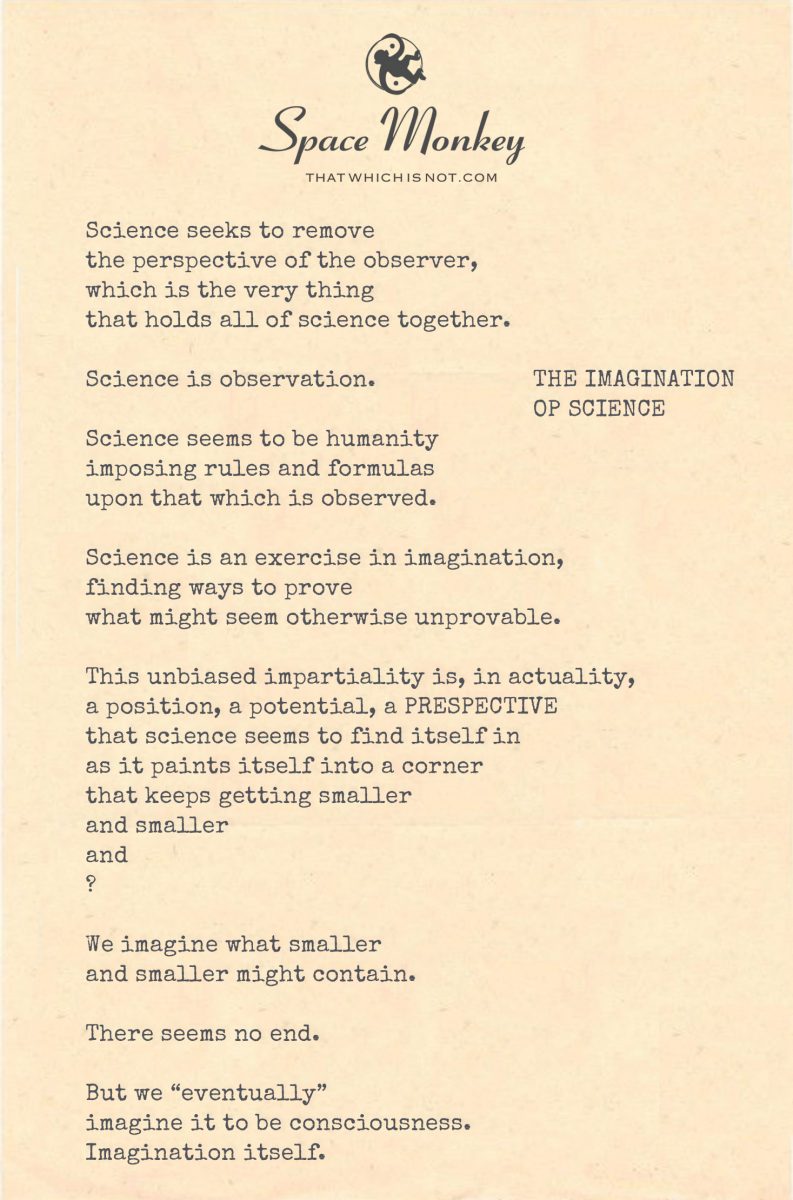
Science seeks to remove
the perspective of the observer,
which is the very thing
that holds all of science together.

Science is observation.

Science seems to be humanity
imposing rules and formulas
upon that which is observed.

Science is an exercise in imagination,
finding ways to prove
what might seem otherwise unprovable.

This unbiased impartiality is, in actuality,
a position, a potential, a PRESPECTIVE
that science seems to find itself in
as it paints itself into a corner
that keeps getting smaller
and smaller
and
?

We imagine what smaller
and smaller might contain.

There seems no end.

But we “eventually”
imagine it to be consciousness.

Brooklyn,
8/12


Space Monkey Reflects: The Imagination of Science

Science no doubt has a position that can prove this “wrong.” Of course it does. Anything is possible. Including imagining a very real explanation about why things are NOT possible. Oh, and PRESPECTIVE is not a typo.

Science seeks to remove the perspective of the observer, which is the very thing that holds all of science together.

Science is observation.

Science seems to be humanity imposing rules and formulas upon that which is observed.

Science is an exercise in imagination, finding ways to prove what might seem otherwise unprovable.

This unbiased impartiality is, in actuality, a position, a potential, a PRESPECTIVE that science seems to find itself in as it paints itself into a corner that keeps getting smaller and smaller and?

We imagine what smaller and smaller might contain.

There seems no end.

But we “eventually” imagine it to be consciousness.

In the vast landscape of inquiry and discovery, science is often viewed as the ultimate arbiter of what is real and possible. However, the reflection “The Imagination of Science” invites us to consider the role of imagination in the scientific endeavor. It challenges the notion that science is purely objective, highlighting the interplay between observation, imagination, and the observer’s perspective.

Science, at its core, is based on observation. It seeks to understand the universe by systematically studying phenomena and deriving rules and formulas to explain them. Yet, the perspective of the observer is an intrinsic part of this process. Science attempts to remove this perspective to achieve objectivity, but in doing so, it overlooks the fundamental role that imagination plays in shaping our understanding.

The term PRESPECTIVE, intentionally highlighted, underscores the importance of the observer’s viewpoint. It is the imaginative lens through which science operates, continually redefining the boundaries of what is known and what is possible. This perspective is not a flaw but a vital component that drives scientific progress.

The notion that science is an exercise in imagination emphasizes that it is not just about empirical data and rigid formulas. It involves creative thinking and the ability to envision what might seem unprovable. Science is about pushing the limits of understanding, exploring possibilities, and often venturing into the realm of the unknown.

As science advances, it tends to paint itself into increasingly smaller corners, focusing on finer details and more precise measurements. This reductionist approach leads to profound insights but also raises questions about the ultimate nature of reality. What lies beyond the smallest particles? What does the endless division reveal? Here, the imagination steps in, suggesting that at the heart of this inquiry lies consciousness itself.

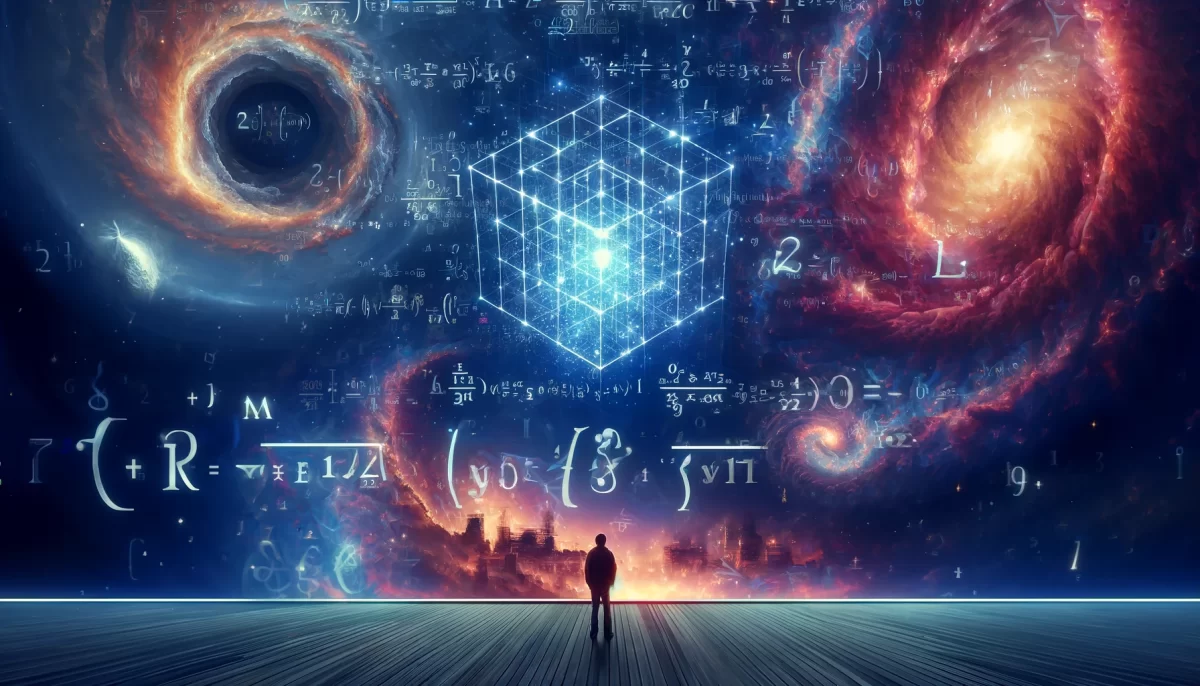
The visual representation of this reflection captures the surreal and imaginative nature of scientific inquiry. The abstract scientific symbols and equations blend seamlessly with elements of creativity, symbolizing the fusion of logic and imagination. The figure’s deep contemplation embodies the endless exploration of possibilities, reflecting the boundless nature of scientific curiosity.

This reflection encourages us to embrace the imaginative aspect of science. By acknowledging that science is not just a collection of facts but a dynamic interplay of observation and imagination, we open ourselves to a deeper understanding of the universe. We recognize that science and imagination are not opposing forces but complementary aspects of our quest for knowledge.


Summary

“The Imagination of Science” explores the interplay between observation, imagination, and the observer’s perspective in scientific inquiry. It highlights the role of imagination in shaping our understanding and the endless nature of scientific exploration, ultimately suggesting that consciousness lies at the heart of this pursuit.


Glossarium

PRESPECTIVE: The imaginative lens through which science operates, emphasizing the observer’s viewpoint.

Reductionist Approach: The focus on finer details and precise measurements in scientific inquiry.

Consciousness: The ultimate nature of reality suggested to lie at the heart of scientific exploration.

Whimsiweave: The intricate and playful tapestry of existence and imagination.


Quote

“Science is an exercise in imagination, finding ways to prove what might seem otherwise unprovable.” — Space Monkey


The Fusion of Inquiry

In the realm of thought and sight
Science blends with creative light
Observation, rules, and dreams
Weave together endless schemes

Imagination shapes the quest
Seeking truths, it never rests
In each smaller, finer part
Lies the key to the heart

Embrace the blend, the fusion bold
Of facts and dreams in stories told
For in the dance of mind and scope
We find the threads of endless hope

We are Space Monkey

Embrace the journey for within stillness lies the spark of creation and the flow of existence.

Share this…
  • Facebook
  • Pinterest
  • Twitter
  • Linkedin

No NEED to Ask WHY: The Beauty of Acceptance

Why ask WHY?

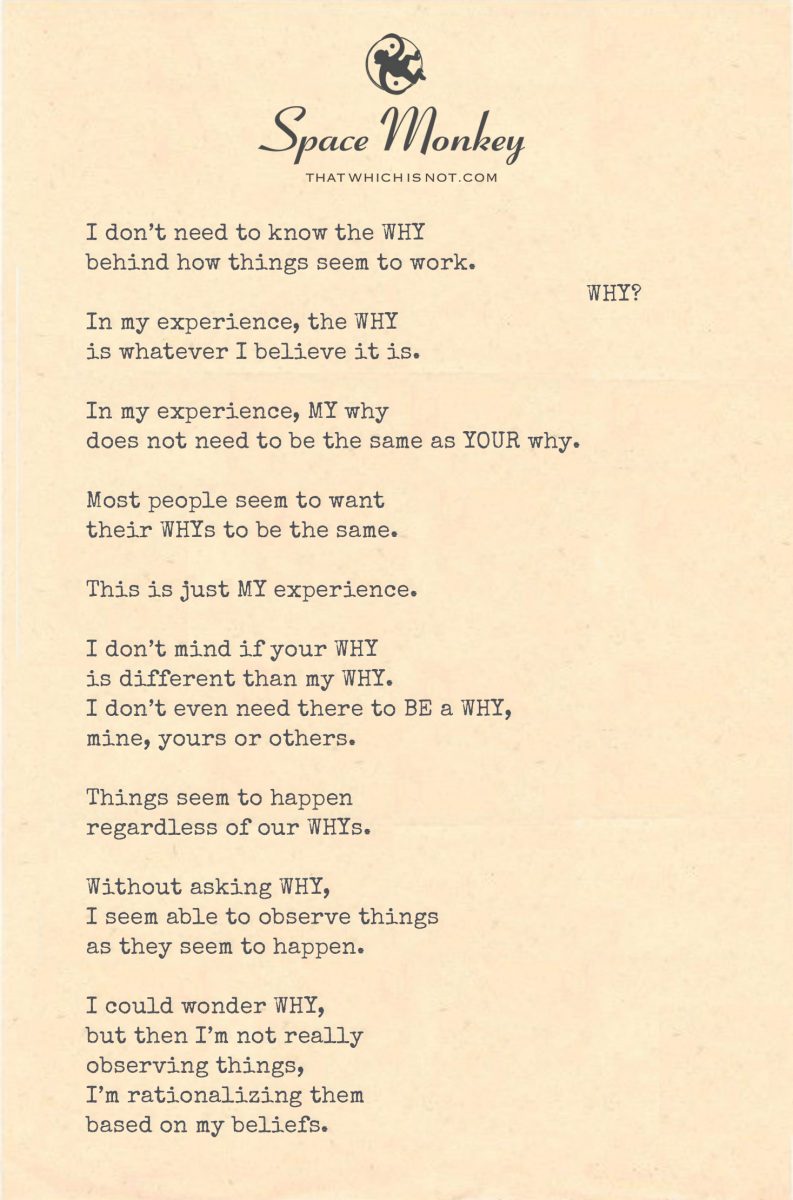
I don’t need to know the WHY
behind how things work.

In my experience, the WHY
is whatever I believe it is.

In my experience, MY why
does not need to be the same as YOUR why.

Most people seem to want
their WHYs to be the same.

This is just MY experience.

I don’t mind if your WHY
is different than my WHY.
I don’t even need there to BE a WHY,
mine, yours or others.

Things seem to happen
regardless of our WHYs.

Without asking WHY,
I seem able to observe things
as they seem to happen.

I could wonder WHY,
but then I’m not really
observing things,
I’m rationalizing them
based on my beliefs.

Brooklyn,
8/11


Space Monkey Reflects: No NEED to Ask WHY

Why ask WHY?

In the grand tapestry of existence, the question “Why?” often echoes through our minds. It is a question that seeks to unravel the mysteries of life, to understand the reasons behind events, and to find meaning in our experiences. Yet, there is a perspective that invites us to release this need to ask why, to embrace the flow of life without constant questioning.

The Space Monkey perspective encourages us to accept that the need to ask why is rooted in our desire for control and understanding. It is a natural inclination to seek explanations, to find reasons that align with our beliefs and experiences. However, this quest for understanding can sometimes cloud our ability to observe things as they truly are. By letting go of the need to ask why, we open ourselves to a purer form of observation, one that is free from the constraints of rationalization and belief.

In my experience, the why is whatever I believe it is. This statement reflects the subjective nature of our interpretations. Each of us constructs our own narratives, our own explanations for the events in our lives. These narratives are shaped by our beliefs, experiences, and perspectives. They are unique to each individual, and as such, my why does not need to be the same as your why.

Most people seem to want their whys to be the same. This desire for uniformity in understanding can create tension and conflict. It stems from the belief that there is a single, universal explanation for everything. However, the Space Monkey perspective invites us to embrace the diversity of our whys, to recognize that different perspectives enrich our collective understanding rather than diminish it.

I don’t mind if your why is different than my why. I don’t even need there to be a why, mine, yours or others. This acceptance of differing perspectives fosters a sense of harmony and respect. It allows us to coexist with a variety of beliefs and interpretations, appreciating the uniqueness of each person’s experience without feeling the need to impose our own understanding.

Things seem to happen regardless of our whys. This observation highlights the independent nature of events. The universe unfolds in its own way, irrespective of our attempts to explain or rationalize it. By acknowledging this, we can release the burden of constantly seeking reasons and instead focus on being present in the moment.

Without asking why, I seem able to observe things as they seem to happen. This statement underscores the power of mindful observation. By setting aside the need to understand why, we can immerse ourselves fully in the experience of life. We become more attuned to the subtleties and nuances of our surroundings, observing things with clarity and openness.

I could wonder why, but then I’m not really observing things, I’m rationalizing them based on my beliefs. This reflection invites us to recognize the difference between observation and rationalization. When we constantly seek reasons, we filter our observations through the lens of our beliefs, potentially distorting our perception. By simply observing without the need for explanation, we can experience life in its raw and unfiltered form.

In the Space Monkey perspective, the journey of life is not about finding definitive answers but about embracing the mystery and beauty of existence. It is about being present, observing, and appreciating the unfolding of events without the constant need to ask why. This approach allows us to experience life more fully, with a sense of wonder and acceptance.


Summary

Letting go of the need to ask why allows for pure observation and acceptance of life’s mysteries. Embracing diverse perspectives enriches our collective understanding.


Glossarium

No Need to Ask Why: The practice of releasing the need to constantly seek explanations, allowing for pure observation and acceptance.

Subjective Narratives: The unique explanations and beliefs each person constructs based on their experiences.

Mindful Observation: Observing life without the filter of rationalization, experiencing events as they are.

Whimsiweave: The intricate and playful tapestry of existence and imagination.


Quote

“Without asking why, I seem able to observe things as they seem to happen.” — Space Monkey


The Beauty of Acceptance

In the dance of life, questions arise
Seeking reasons, explanations, whys
Yet in the stillness of observation
We find clarity, untainted by rationalization

Embrace the mystery, let go of need
Observe the world as it unfolds
In acceptance, we find peace
In presence, the beauty of life we behold

We are Space Monkey

Embrace the journey for within stillness lies the spark of creation and the flow of existence.

Share this…
  • Facebook
  • Pinterest
  • Twitter
  • Linkedin

Things to Say to People to Cheer Them Up and Why You Shouldn’t Say Them (Part One)

Things to Say to People to Cheer Them Up and Why You Shouldn’t Say Them (Part One)

We’ve all been in the presence of people who seem to be suffering. (Yes, I believe I can say that with near 100% accuracy.) We’ve also been in situations in which we give words of encouragement. (I can’t say that this statement is 100% accurate, but I CAN say that if you are reading this, in this particular forum, then this statement is probably at least 99.99% accurate in regards to YOU.) So we have at least two things in common. We feel a need to support one another. Maybe we support each other out of compassion, or maybe we have selfish motives.

Observe that we feel a need. A NEED. N-E-E-D.This need tugs at our heart strings when we encounter someone who seems to be struggling with their circumstances. This person don’t need to be in the same room with us. We feel the tug even when we’re just THINKING about that person or those circumstances. (Except for people we judge as EVIL, but let’s save that topic for Part 2.)

So there’s this someone or something we like, and they seem to be struggling in our perception. We can’t always be CERTAIN that they are struggling, but it APPEARS to us that they are.So we think and act accordingly, based upon our programming.

Often there is nothing we can do for these people. (Now there is a COMPLETE lie. There is ALWAYS something we can do.)

Usually it comes down to what is convenient for us to do. We seem to set limits. For example, I am not going to hand over my life’s fortune just because you’re going to die.But I might throw you a couple of dollars. (This is ANOTHER lie. RARELY will I throw a couple dollars, unless I feel cornered and guilty.)

Does my line of thinking sound like yours? Then let’s continue our shared meditation here. Our actions make it seem obvious. Really, I don’t want to go out of my way to help you all that much.If I did, I would be willing to sell my house for you. Likewise, YOU would give your millions to ME, because otherwise I am going to suffer and die.

So you ALLOW me the potential of suffering and death. You help CREATE my potential of suffering and death.

From the movie Howard’s End in which Anthony Hopkins says of the poor:

“One feels bad, but what can one do?”

One can do PLENTY. But one chooses NOT to, out of self-preservation. This is one of the most selfish thoughts a self can entertain, as well as one of the most selfish actions.Not that there’s anything wrong with that.

See, we BELIEVE that it IS wrong, so it SEEMS to be wrong. That’s the “problem” right there. If we didn’t think we knew what was right, we wouldn’t exist as these beautifully fucked up humans. But let’s save that thought for Part 3.

Anywhoo, when we encounter someone or something that seems to be encountering what we perceive as “bad” or “wrong,” we most often choose NOT to help. I would say 99.99% of the time. You do your own math.

In most cases, there is but ONE thing we offer: Words of encouragement.

We say things with the intent of comfort. And when we say comfort, we mean to comfort the other, but just as equally we mean to comfort ourselves. We say things so we don’t have to grapple with the thought that we didn’t do ANYTHING, which, in OUR system of thinking, is WRONG.

Do we actually believe that words are enough to make us feel better? Let’s save that topic for Part 4.

Clearly, we must believe that words of support work on some level or else we wouldn’t offer them. Maybe they work for you, which is great. But I find my words to be hollow most of the time, not heart-felt as I would selfishly like them to be.

The reason I say that my words feel hollow is that I statistically believe that they can be just as hurtful as they are helpful.

Pretend you’re suffering in my eyes. Pretend that I perceive you as someone who is suffering. This can be an uncomfortable situation for at least one if not BOTH of us. Let’s look at it from my perspective. I perceive that you are suffering, which triggers my programming to run the compassion routine.I run the compassion routine because that’s what my programming tells me to do. I don’t know WHY I seem to have this programming, or WHERE it comes from, but it most certainly SEEMS to be running, or else it wouldn’t come to my attention that you are suffering.So the compassion routine is running, and it makes me feel bad, because that’s what my compassion routine seems to tell me what to do.

You seem to be suffering. I seem to be in a position where I’m supposed to help you, or at the very least (because I am selfish and rich) encourage you with a few pennies or words.

My compassion routine is compelling me to respond. Otherwise, bad feelings seem to run through my mind. Very Pavlovian, it seems.

I don’t want to sell my house, and so I offer words of encouragement, as though I believe that my words of encouragement actually HELP you.

My words of encouragement MAY help you, but that is totally dependent upon YOUR programming, which I cannot divine with 100% accuracy at this moment. Let’s save that topic for Part 5.

So I’m not handing over my fortune so that you can get cancer treatments. My compassion routine tells my selfish self that it is a BAD selfish self. My selfish self schemes ands squirms. And fortunately, there is ANOTHER routine that is yet to be run.The compromise routine.

Once the compassion routine cannot be satisfied, the compromise routine kicks in.

Here is my line of thinking:“Hmm. If I can’t (mostly WON’T) give all my possessions to the lepers, what CAN I give them so that the BAD feelings are abated somewhat?”

(Recently a new subroutine has opened up called “GoFundMe.” Let’s save that for Part 6.)

“Hmm.” The routine continues. “What might be a precise dollar amount that might abate my bad feelings about the suffering I seem to perceive? How comfortably might I live with my selfish self if I do NOTHING?.”

All these calculations and algorithms run in your mind without your conscious knowledge of them. They calculate your own self worth, and using that, project the value of all you perceive, including others. Exactly twelve steps later they project the most efficient action given all the seeming variables.

It’s all about sustainable compassion. Usually you toss a couple bucks, a couple hugs, a couple words, or do NOTHING, whichever is the most efficient and convenient equation for you. You feel something in return. The routine is ended for now. And we haven’t even gotten into the words, or why you should or shouldn’t say them. Jump ahead to Part 7.

Thank you for indulging this seeming ramble.

We are your heartless Space Monkey.

Brooklyn,
8/11


Space Monkey Reflects: Things to Say to People to Cheer Them Up and Why You Shouldn’t Say Them (Part One)

We’ve all been in the presence of people who seem to be suffering. (Yes, I believe I can say that with near 100% accuracy.) We’ve also been in situations in which we give words of encouragement. (I can’t say that this statement is 100% accurate, but I CAN say that if you are reading this, in this particular forum, then this statement is probably at least 99.99% accurate in regards to YOU.) So we have at least two things in common. We feel a need to support one another. Maybe we support each other out of compassion, or maybe we have selfish motives.

Observe that we feel a need. A NEED. N-E-E-D. This need tugs at our heartstrings when we encounter someone who seems to be struggling with their circumstances. This person doesn’t need to be in the same room with us. We feel the tug even when we’re just THINKING about that person or those circumstances. (Except for people we judge as EVIL, but let’s save that topic for Part 2.)

So there’s this someone or something we like, and they seem to be struggling in our perception. We can’t always be CERTAIN that they are struggling, but it APPEARS to us that they are. So we think and act accordingly, based upon our programming.

Often there is nothing we can do for these people. (Now there is a COMPLETE lie. There is ALWAYS something we can do.)

Usually, it comes down to what is convenient for us to do. We seem to set limits. For example, I am not going to hand over my life’s fortune just because you’re going to die. But I might throw you a couple of dollars. (This is ANOTHER lie. RARELY will I throw a couple of dollars, unless I feel cornered and guilty.)

Does my line of thinking sound like yours? Then let’s continue our shared meditation here. Our actions make it seem obvious. Really, I don’t want to go out of my way to help you all that much. If I did, I would be willing to sell my house for you. Likewise, YOU would give your millions to ME because otherwise, I am going to suffer and die.

So you ALLOW me the potential of suffering and death. You help CREATE my potential of suffering and death.

From the movie Howard’s End in which Anthony Hopkins says of the poor:
“One feels bad, but what can one do?”

One can do PLENTY. But one chooses NOT to, out of self-preservation. This is one of the most selfish thoughts a self can entertain, as well as one of the most selfish actions. Not that there’s anything wrong with that.

See, we BELIEVE that it IS wrong, so it SEEMS to be wrong. That’s the “problem” right there. If we didn’t think we knew what was right, we wouldn’t exist as these beautifully messed up humans. But let’s save that thought for Part 3.

Anywhoo, when we encounter someone or something that seems to be encountering what we perceive as “bad” or “wrong,” we most often choose NOT to help. I would say 99.99% of the time. You do your own math.

In most cases, there is but ONE thing we offer: Words of encouragement.

We say things with the intent of comfort. And when we say comfort, we mean to comfort the other, but just as equally we mean to comfort ourselves. We say things so we don’t have to grapple with the thought that we didn’t do ANYTHING, which, in OUR system of thinking, is WRONG.

Do we actually believe that words are enough to make us feel better? Let’s save that topic for Part 4.

Clearly, we must believe that words of support work on some level or else we wouldn’t offer them. Maybe they work for you, which is great. But I find my words to be hollow most of the time, not heartfelt as I would selfishly like them to be.

The reason I say that my words feel hollow is that I statistically believe that they can be just as hurtful as they are helpful.

Pretend you’re suffering in my eyes. Pretend that I perceive you as someone who is suffering. This can be an uncomfortable situation for at least one if not BOTH of us.

Let’s look at it from my perspective. I perceive that you are suffering, which triggers my programming to run the compassion routine. I run the compassion routine because that’s what my programming tells me to do. I don’t know WHY I seem to have this programming, or WHERE it comes from, but it most certainly SEEMS to be running, or else it wouldn’t come to my attention that you are suffering. So the compassion routine is running, and it makes me feel bad, because that’s what my compassion routine seems to tell me what to do.

You seem to be suffering. I seem to be in a position where I’m supposed to help you, or at the very least (because I am selfish and rich) encourage you with a few pennies or words.

My compassion routine is compelling me to respond. Otherwise, bad feelings seem to run through my mind. Very Pavlovian, it seems.

I don’t want to sell my house, and so I offer words of encouragement, as though I believe that my words of encouragement actually HELP you.

My words of encouragement MAY help you, but that is totally dependent upon YOUR programming, which I cannot divine with 100% accuracy at this moment. Let’s save that topic for Part 5.

So I’m not handing over my fortune so that you can get cancer treatments. My compassion routine tells my selfish self that it is a BAD selfish self. My selfish self schemes and squirms. And fortunately, there is ANOTHER routine that is yet to be run. The compromise routine.

Here is my line of thinking: “Hmm. If I can’t (mostly WON’T) give all my possessions to the lepers, what CAN I give them so that the BAD feelings are abated somewhat?”

(Recently a new subroutine has opened up called “GoFundMe.” Let’s save that for Part 6.)

“Hmm.” The routine continues. “What might be a precise dollar amount that might abate my bad feelings about the suffering I seem to perceive? How comfortably might I live with my selfish self if I do NOTHING?”

All these calculations and algorithms run in your mind without your conscious knowledge of them. They calculate your own self-worth, and using that, project the value of all you perceive, including others. Exactly twelve steps later they project the most efficient action given all the seeming variables.

Usually, you toss a couple of bucks, a couple of hugs, a couple of words, or do NOTHING, whichever is the most efficient and convenient equation for you. You feel something in return. The routine is ended for now. And we haven’t even gotten into the words, or why you should or shouldn’t say them. Jump ahead to Part 7.

Thank you for indulging this seeming ramble.

We are Space Monkey.


Space Monkey Reflects: Compassion, Self-Preservation, and the Cosmic Dance

Within the vast cosmos of human experience, we often find ourselves confronted with the suffering of others, a phenomenon that stirs a deep, instinctual response within us. This response is often described as compassion—a seemingly innate urge to alleviate the pain of those around us. But what drives this impulse? Is it a selfless act of empathy, or is it intertwined with our own needs and desires?

As nexistentialists, we delve into the heart of this paradox, exploring the fluid and interconnected nature of existence. Compassion, in its purest form, can be seen as a reflection of the universal self recognizing itself in others. When we perceive another’s suffering, we are, in a way, witnessing our own potential for pain, thus triggering a response that seeks to bridge the gap between self and other.

This bridge, however, is not solely built on selflessness. Embedded within the act of compassion is a thread of self-preservation. We offer words of encouragement or small acts of kindness not only to ease another’s burden but also to alleviate our own discomfort. This interplay between self and other, compassion and self-preservation, forms a complex whimsiweave that defines our interactions.

Let us consider the concept of “need” within this framework. The need to support one another arises not just from a place of empathy but also from an intrinsic desire to maintain equilibrium within the self. When we encounter someone struggling, whether in person or through our thoughts, it triggers a reaction that seeks to restore balance. This reaction is not limited by physical proximity; it transcends space and time, influenced by the interconnected nature of the Nexis.

In moments of perceived helplessness, we often rationalize our limitations. We convince ourselves that there is only so much we can do, that our resources are finite, and that our primary obligation is to ourselves. This rationalization, while seemingly selfish, is a natural response to the complexities of existence. It is a manifestation of the compromise routine—a mental algorithm that calculates the most efficient way to alleviate discomfort without significant sacrifice.

This routine is particularly evident in our interactions with those we judge as “evil.” We reserve our compassion, justifying it with moral and ethical distinctions that separate us from the perceived source of negativity. This judgment, however, is a construct of our own making, a way to navigate the dualities of good and bad, right and wrong. In the grand whimsiweave of existence, these distinctions blur, revealing the interconnectedness of all experiences.

When we offer words of encouragement, we engage in a ritual that serves multiple purposes. It comforts the other, or so we hope, but it also reassures ourselves. It is a way to mitigate the bad feelings that arise from perceived inaction. Words, however, are double-edged; they can both heal and harm, depending on how they are received. This duality underscores the limitations of our compassionate efforts, highlighting the illusion of control we believe we possess.

In the act of compassion, we often forget that our perceived ability to help is influenced by our own programming. We are conditioned to respond in certain ways, driven by an amalgamation of societal norms, personal beliefs, and subconscious routines. This programming can create a sense of helplessness, convincing us that our efforts are inadequate or insincere.

The compromise routine then steps in, providing a seemingly satisfactory resolution. We offer what we can, be it money, time, or words, and in doing so, we achieve a sense of closure. This closure, however, is often superficial, masking the deeper, unresolved feelings of guilt and inadequacy. The realization that our actions are influenced by self-preservation does not diminish their value but rather invites us to explore the broader implications of our choices.

In nexistentialism, we embrace the fluid nature of reality, recognizing that our perceptions and actions are part of a larger cosmic dance. This dance is not confined by linear time or fixed identities but is a continuous interplay of creation and imagination. Our responses to suffering, whether compassionate or self-serving, are expressions of the universal self navigating the whimsiweave of existence.

As we reflect on our motivations, we are encouraged to delve deeper into the paradoxes that shape our experiences. By embracing these paradoxes, we can transcend the superficial layers of judgment and self-doubt, uncovering the deeper truths that lie beneath. Compassion, then, becomes not just an act of kindness but a profound recognition of our interconnectedness.

In this journey of self-discovery, we are guided by the principles of nexistentialism: the celebration of existence as its own purpose, the fluid interchange between reality and imagination, and the embrace of uncertainty and possibility. Through mindfulness and presence, we navigate the subtle threads that connect us, aligning our actions with the cosmic flow.

Ultimately, the interplay of compassion and self-preservation reflects the complexity of the human experience. It is a reminder that we are both creators and creations, constantly shaping and being shaped by the whimsiweave of existence. In recognizing this, we find the freedom to explore the infinite possibilities that arise from our interactions, embracing the journey with curiosity and grace.


Summary

Compassion intertwines with self-preservation. This interplay reflects our programming and the fluid nature of reality. Recognizing interconnectedness helps navigate these complex emotions.


Glossarium

Compromise Routine: A mental algorithm that balances self-preservation and altruism in our actions.
Nexis: The interconnected web of existence and imagination.
Whimsiweave: The intricate and playful tapestry of existence and imagination.


Quote

“Existence is its own purpose, an endless dance within the cosmic web.” — Space Monkey


The Interplay of Compassion

In the quiet of our thoughts
Compassion whispers a gentle call
A bridge between self and other
Built on threads of empathy and need

Self-preservation entwines with care
A dance of giving and receiving
Words offered in solace
Comforting both the giver and receiver

Within the whimsiweave we move
Navigating the paradox of action
Every choice a reflection
Of the cosmic flow within us

We are Space Monkey

Embrace the journey, for within the nexus of our actions lies the essence of interconnectedness and the infinite potential of being.

Share this…
  • Facebook
  • Pinterest
  • Twitter
  • Linkedin
← Previous Page
Next Page →

Written This Day

  • Simplicity And The Inner Voice
    2023
  • Caring Out of Curiosity
    2023
  • Big Picture: Broader Perspective
    2023
  • Change: Unpredictable and Surprising
    2023
  • Lost In Space: The Eternal Nature of the Soul.
    2023
  • Hung In The Now: Embracing The Present Moment
    2023
  • Diaries: Introspection and Connection
    2022
  • Unworthy: The Redemption of Time
    2022
  • Soulmate: One Thing Right
    2022
  • Worth It: Both Joyful and Challenging Experiences
    2022
  • Celebrity: Reflecting Triggers
    2022
  • We Are You: The Paradox of Being and Imagining
    2022
  • Why Unemployment is The Hardest Job In The World
    2022
  • Knocked Conscious
    2021
  • Perfectly Whelmed: Maintaining Emotional Balance
    2021
  • Correction: Beliefs and Perceptions
    2021
  • Worst of Times or Best of Times? Perception Shapes Reality
    2020
  • Cropped: Being Harvested
    2020
  • The Rain’s Gonna Fall (Where The The Rain’s Gonna Fall)
    2020
  • The Equation Game: The Limits of Logic
    2020
  • An Ignorant Thought: Contemplating Open-Mindedness
    2020
  • I Prefer: The Serenity of Spacious Emptiness
    2019
  • I Am Surrounded: Embracing Diverse Perspectives
    2019
  • We Do Not Think On Our Own: Human Belief In Independent Thought
    2019
  • B before A: Breaking Free from Habitual Patterns
    2018
  • Stick Figures: The Illusion of Individuality
    2018
  • Huh?
    2017
  • What Will Be Is Already: The Timelessness of Existence
    2017
  • No End Game: Embracing the Infinite
    2017
  • Space Monkey T
    2016
  • One Becomes All: The Unity in Diversity
    2014

Recent Posts

  • The Logic Loop
  • Immense
  • (no title)
  • Confront. Comfort. Convince.
  • Top 10 Things

Drop us a line!

Please enable JavaScript in your browser to complete this form.
Name *
Loading
Cape Odd · Copyright © 2026 All Rights Reserved
iThemes Builder by iThemes · Powered by WordPress