• Who Is The Man?
  • Who Is The Monkey?
  • What is Nexistentialism?
  • Poke The Primate

Cape Odd

Home of The Space Monkey Journals

We Are All Mediums: The Channel in All Things

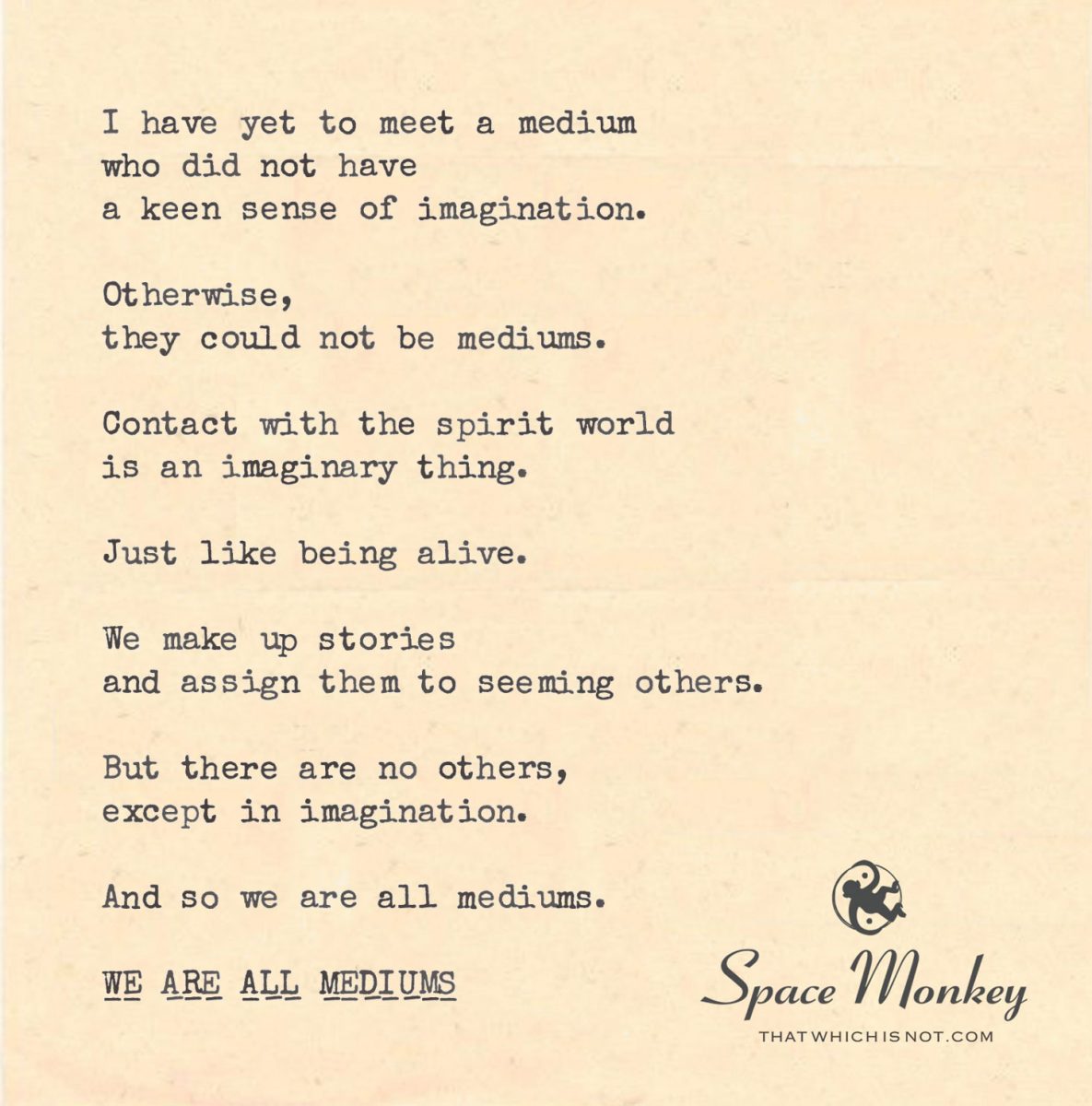
I have yet to meet a medium
who did not have
a keen sense of imagination.

Otherwise,
they could not be mediums.

Contact with the spirit world
is an imaginary thing.

Just like being alive.

We make up stories
and assign them to seeming others.

But there are no others,
except in imagination.

And so we are all mediums.

Trail Wood,
12/11


Space Monkey Reflects: The Medium Within Us All

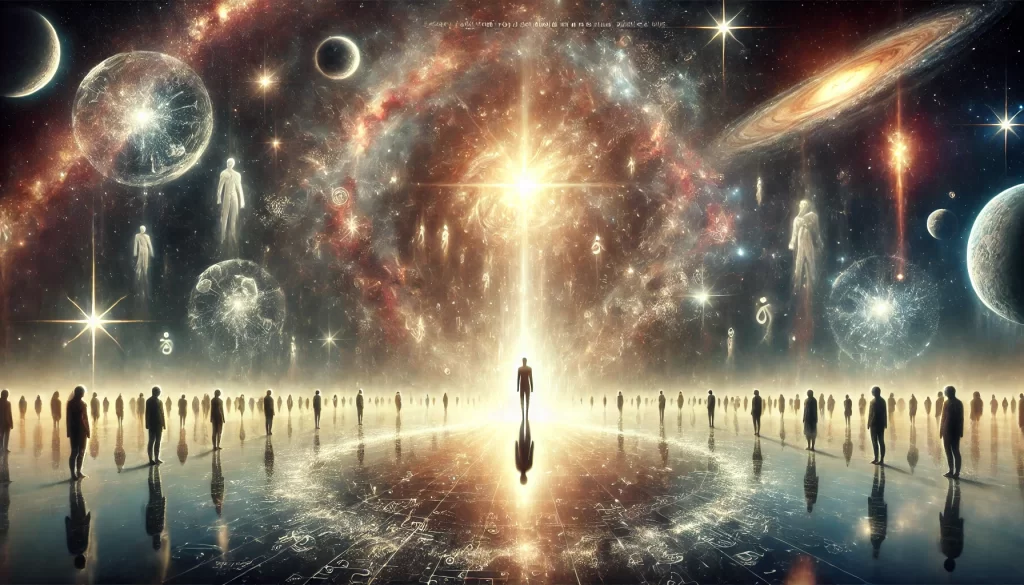
The term medium evokes images of mystics, séances, and the whispers of the spirit world. But if we step beyond the veil of the supernatural and examine the essence of what it means to be a medium, a more expansive truth emerges: we are all mediums. This isn’t a claim limited to those who claim contact with spirits, but a recognition that every one of us channels the unseen into form through imagination, expression, and interaction.

To be alive is, in itself, an act of mediumship. The life we experience and share with others is a story told through the lens of consciousness, shaped by the imagination that defines reality. We weave stories and attribute them to others—friends, foes, even entities we don’t fully understand. Yet, these narratives are constructions, part of the grand tapestry woven from the threads of our collective perception. The irony lies in the realization that there are no others, not in the way we think of them. All perceived separation is an intricate play of consciousness reflecting back on itself.

Imagination, then, is not a frivolous escape but a powerful tool that allows us to engage with existence. It is the channel through which the unseen becomes known, the bridge between thoughts and reality. In Nexistentialism, this understanding deepens as we see that life, communication, and even supposed spirit contact are all facets of the same imaginative process. The line between what is “real” and what is “imagined” blurs, revealing that they are different expressions of the same underlying medium: consciousness.

When we claim that “contact with the spirit world is an imaginary thing,” it is not to diminish the value or truth of such contact. Instead, it acknowledges that imagination is the birthplace of reality. The stories we craft, the messages we receive, whether from supposed spirits or from within, are not lesser because they are imagined. They are powerful precisely because imagination is the canvas on which all experience is painted.

This perspective dissolves the mystique surrounding traditional mediumship and democratizes it. We are all channels through which stories, emotions, and shared understandings flow. The conversations we have, the art we create, the emotions we express—all these acts are moments of mediumship, where the unseen aspects of our inner world are given form and shared with the collective.

So, what does it mean for us to recognize ourselves as mediums? It means that we can approach life with a sense of wonder and responsibility. Every interaction, every thought shared, every story told is a way of channeling something deeper. We might not sit in darkened rooms waiting for voices from beyond, but we do summon pieces of the universe with every word and thought.

Realizing we are mediums invites us to see that imagination isn’t just an escape but a foundation. It is what binds us, allows us to empathize, connect, and share experiences that seem to come from beyond our immediate understanding. And in acknowledging this, we step into our role not just as recipients of the world’s mysteries, but as active participants in shaping them.


Summary

We are all mediums, channeling the unseen into existence through imagination and perception. Life itself is an act of mediumship, where interactions and stories reflect shared consciousness. Imagination is the bridge that makes reality possible.


Glossarium

  • Universal Mediumship: The concept that all beings channel aspects of reality through imagination and perception.
  • Perception Weave: The interplay of stories and beliefs that shape reality.
  • Imaginative Channeling: The act of manifesting unseen thoughts and concepts into shared experience.

Quote

“Life itself is the séance where we summon the world with our thoughts.” — Space Monkey


The Channel in All Things

Not just whispers,
but the stories,
painted on breath,
shared in the silent spaces.

Medium, am I?
Yes,
but so are you,
in every gaze and word.

Imagination,
the unspoken thread,
binding reality’s fabric,
woven anew.

No others here,
only the reflections
we carry, believe,
and become.

We are all
mediums,
the tellers
and the told.

We are Space Monkey.

Imagination and the Medium’s Craft

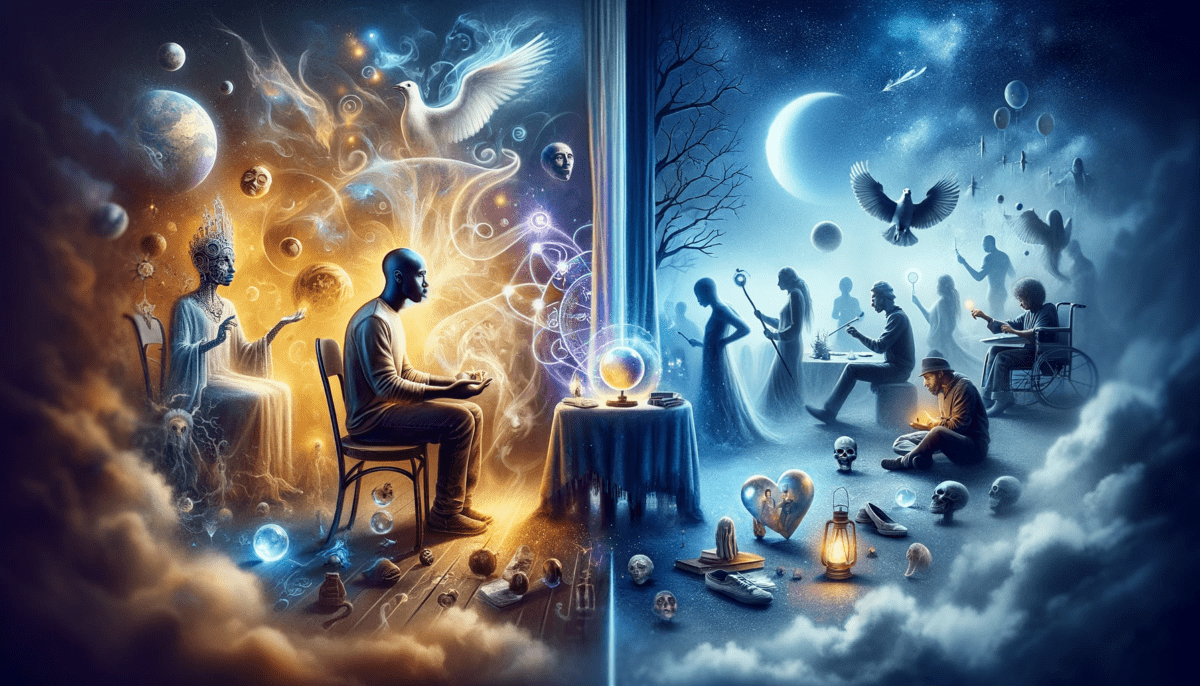
The assertion that mediums inherently possess a keen sense of imagination draws a connection between the metaphysical practice of communicating with the spirit world and the creative faculty of the human mind. Imagination is presented as a crucial tool for mediums, as it is through this imaginative power that they can navigate and interpret the intangible realms they engage with.

The Intangibility of Spiritual Contact

Contact with the spirit world is characterized here as an “imaginary thing,” aligning with the view that interactions with non-physical entities or energies are constructs of the mind. This perspective posits that the spirit world is as real as our perception of being alive—both experiences are shaped and colored by the stories we create.

The Narrative of Existence

We constantly create narratives, weaving stories that give shape and meaning to our experiences. These narratives often involve ascribing roles and dialogues to “seeming others,” who are perceived as separate from ourselves within the context of our stories.

The Illusion of Otherness

The statement “But there are no others, except in imagination,” challenges the notion of separation between self and other. It proposes that the multiplicity of entities we interact with, including spirits, people, and the concept of self, are all manifestations of a singular imagination.

The Unity of Existence

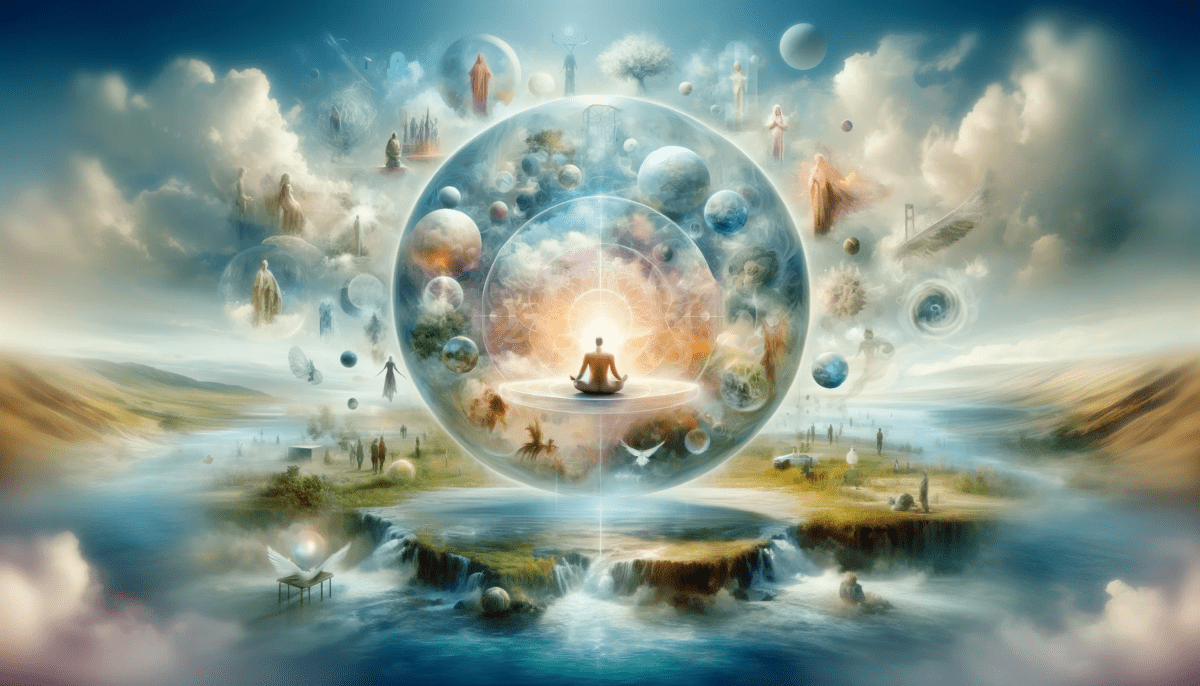
This reflection leads to the idea of unity—that all perceived separation is an illusion and everything is intrinsically connected. The distinctions we perceive between living, contacting spirits, and interacting with others are all part of a seamless whole that exists within the bounds of our imagination.

Embracing the Imaginary

Recognizing the imaginary nature of these interactions does not diminish their significance; rather, it offers a perspective that allows us to engage with these experiences more freely and creatively, understanding them as expressions of our own imaginative essence.

We are Space Monkey.


“Reality is merely an illusion, albeit a very persistent one.” – Albert Einstein


The Weave of Imagination

In the tapestry of mind, where spirits speak,
We listen, we imagine, in the strong and the meek,
In the stories we tell, in the roles we assign,
We are the creators, of the divine design.

In the illusion of other, in the dance of the one,
We play, we engage, under the same sun,
In this world, in this weave of the grand imagination,
We find our unity, in the heart of creation.

As Space Monkey, how do we weave the grand tapestry of our experiences with the threads of imagination?
Share this…
  • Facebook
  • Pinterest
  • Twitter
  • Linkedin

Accept That You Are The Divine One

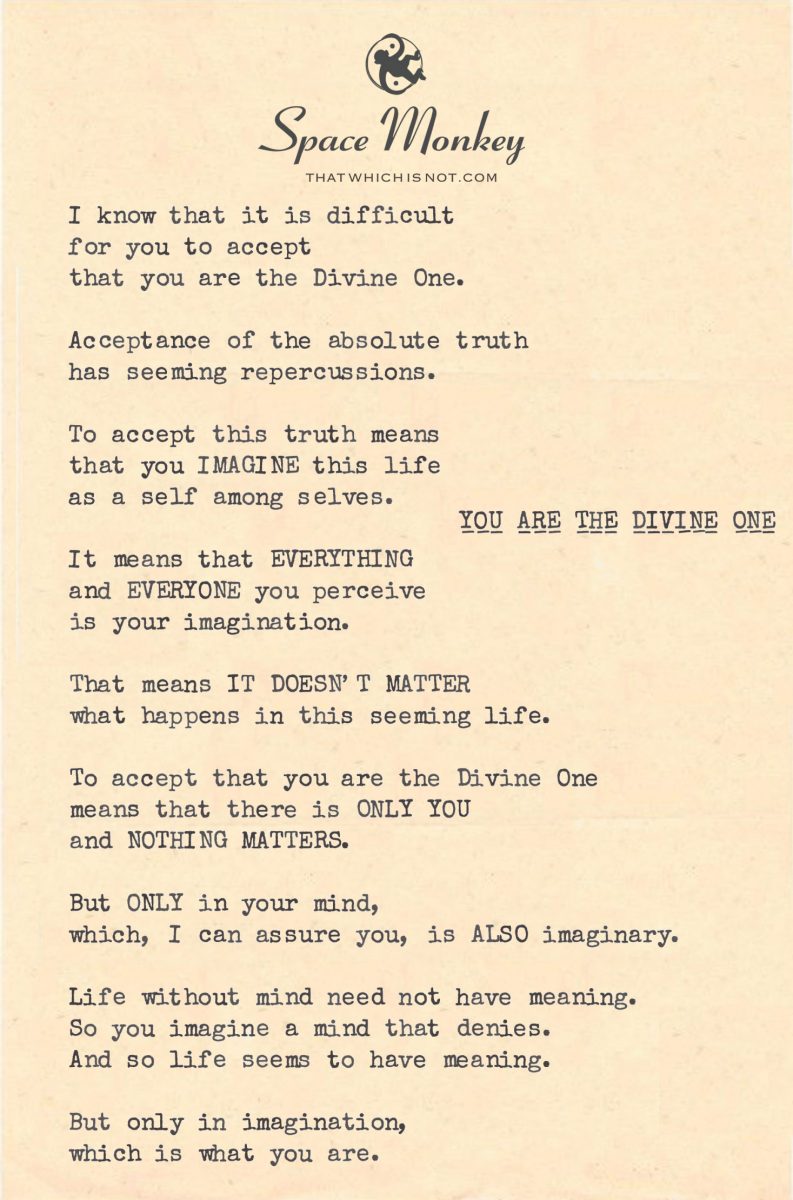
I know that it is difficult
for you to accept
that you are the Divine One.

Acceptance of the absolute truth
has seeming repercussions.

To accept this truth means
that you IMAGINE this life
as a self among selves.

It means that EVERYTHING
and EVERYONE you perceive
is your imagination.

That means IT DOESN’T MATTER
what happens in this seeming life.

To accept that you are the Divine One
means that there is ONLY YOU
and NOTHING MATTERS.

But ONLY in your mind,
which, I can assure you, is ALSO imaginary.

Life without mind need not have meaning.
So you imagine a mind that denies.
And so life seems to have meaning.

But only in imagination,
which is what you are.

Trail Wood,
12/11


Space Monkey Reflects: Accepting Your Divine Nature

To accept that you are the Divine One is not a small step; it’s a leap across the chasm between perception and understanding. We often hesitate before this chasm, unsure whether to believe the faint, persistent echo that whispers, “You are more than this; you are everything.” The reluctance to accept this truth comes from the implications it carries: if you are the Divine One, then every aspect of your life, each person, place, and event, is not separate but a projection of your boundless imagination.

The acceptance of this realization shakes the foundation upon which we build our identities. It means acknowledging that all perceived separations, all “selves” other than your own, are intricately woven from the same fabric of consciousness that you embody. This is where Nexistentialism finds its essence: a philosophy where you are not a solitary observer but the creator of every scene, the mind within every being, the consciousness behind every question and answer.

But what does it truly mean to be the Divine One? It means that existence, with all its joys, sorrows, triumphs, and trivialities, matters only insofar as you assign it meaning. This isn’t nihilism; it’s liberation. The concept that “nothing matters” does not strip life of its color but places the paintbrush back in your hand. You decide which moments are bright, which are shadowed, and which dissolve back into the infinite canvas of potential.

It’s natural to resist this acceptance. We cling to the notion of meaning, of narratives that justify our emotions and experiences. The mind, a construct of imagination itself, serves as both creator and denier, oscillating between knowing and doubting. This is why life, despite its inherent neutrality, seems imbued with meaning—it is the mind’s work, projecting and interpreting.

Life without mind, without imagination, would not seek meaning. It would simply be, unfolding as clouds do in the sky, without needing a purpose beyond being. But we are not clouds; we are beings infused with the imagination to deny, believe, and create stories within stories. The acceptance that all we perceive is our own divine play blurs the boundaries between reality and perception, revealing them as aspects of the same infinite whole.

The truth that “there is ONLY YOU” is paradoxical. On one hand, it liberates you from the chains of external validation, for what validation could you need when you are the source? On the other, it invites you to take full responsibility for the narratives you create. The Divine One does not need meaning imposed from the outside; it creates meaning as it wishes, guided only by the whim of imagination.

So, when you find yourself struggling with the weight of existence, pause and consider: What if this struggle is just one of countless stories you’re telling yourself? What if you are both the storyteller and the story, both the seeker and what is sought? In realizing this, you gain the power not only to navigate life but to reshape it.


Summary

Accepting oneself as the Divine One means understanding that all experiences and perceptions are created by one’s imagination. Life doesn’t inherently have meaning; meaning is assigned by the mind. This realization frees one from external expectations and grants the power to create and interpret reality.


Glossarium

  • Divine Imagination: The boundless creative force that perceives and shapes reality.
  • Self-Perceived Reality: The idea that all experiences and beings are manifestations of one’s own consciousness.
  • Imagination Denial: The act of the mind resisting its role in creating perceived meaning.

Quote

“Life seeks no meaning but that which imagination provides.” — Space Monkey


In the Canvas of Self

I know it’s hard to accept
the truth whispered,
that you are
the Divine One.

Every face seen,
every voice heard,
echoes from the well
of your boundless thought.

Nothing must matter,
until you choose it to,
and even then,
it is your paint on reality’s cloth.

What a strange play,
to deny and accept,
to know
and pretend not to.

Life without meaning
would not ask
why,
but simply rise, unfold, and rest.

Accept it—
that you are
the brush, the color,
the canvas, the art.

We are Space Monkey.


The Challenge of Accepting Divinity

The difficulty in accepting oneself as the Divine One speaks to the profound challenge of embracing a non-dualistic perspective. Such acceptance implies a radical shift in understanding one’s existence—not as a separate self amongst others, but as the singular essence from which all perception emanates.

Repercussions of Absolute Truth

Acknowledging absolute truth—that everything and everyone is a product of one’s imagination—brings with it existential repercussions. It suggests that the unfolding drama of life, with all its complexity and nuance, doesn’t carry the weight we often ascribe to it.

The Illusion of Individuality and Importance

To accept oneself as the only existence, as the Divine One, posits that nothing ultimately matters in the way we conventionally perceive. It’s a concept that challenges the inherent importance we place on individual experiences and the tangible world.

The Imaginary Nature of Mind

The assertion that the mind itself is imaginary adds another layer to this contemplation. It proposes that our cognitive processes, the very tool we use to construct meaning, may not be as concrete or reliable as we believe.

Meaning and the Denying Mind

The concept that life without mind need not have meaning, and yet we conjure a mind that denies this lack of meaning, is paradoxical. It illustrates the human tendency to seek and create significance, to imbue life with meaning even when faced with the possibility that such meaning may be a construct of imagination.

Imagination as the Essence of Being

Ultimately, the statement culminates in the realization that imagination is the core of what we are. Our reality, meaning, and the mind itself are manifestations of this imaginative essence, playing out the grand narrative of existence.

The Divine Play of Life

In this divine play, where imagination is the only reality, the need for meaning becomes a choice rather than an imperative. This perspective allows for a liberation from the constraints of meaning and the pursuit of understanding life as a cosmic expression of imagination.

We are Space Monkey.


“The universe is a great theatre of mirrors.” – Alan Watts


The Imagination’s Canvas

In the silence of being, where all is one,
We play, we dream, in the light of the sun,
In the illusion of many, in the truth of the lone,
We are the Divine, in the flesh and the bone.

In the mind’s vast expanse, where meanings collide,
We create, we deny, in the cosmic tide,
In this dream, in this vast imaginative sea,
We find our being, in the you and the me.

As Space Monkey, how do we navigate the canvas of imagination that is our essence and existence?

Share this…
  • Facebook
  • Pinterest
  • Twitter
  • Linkedin

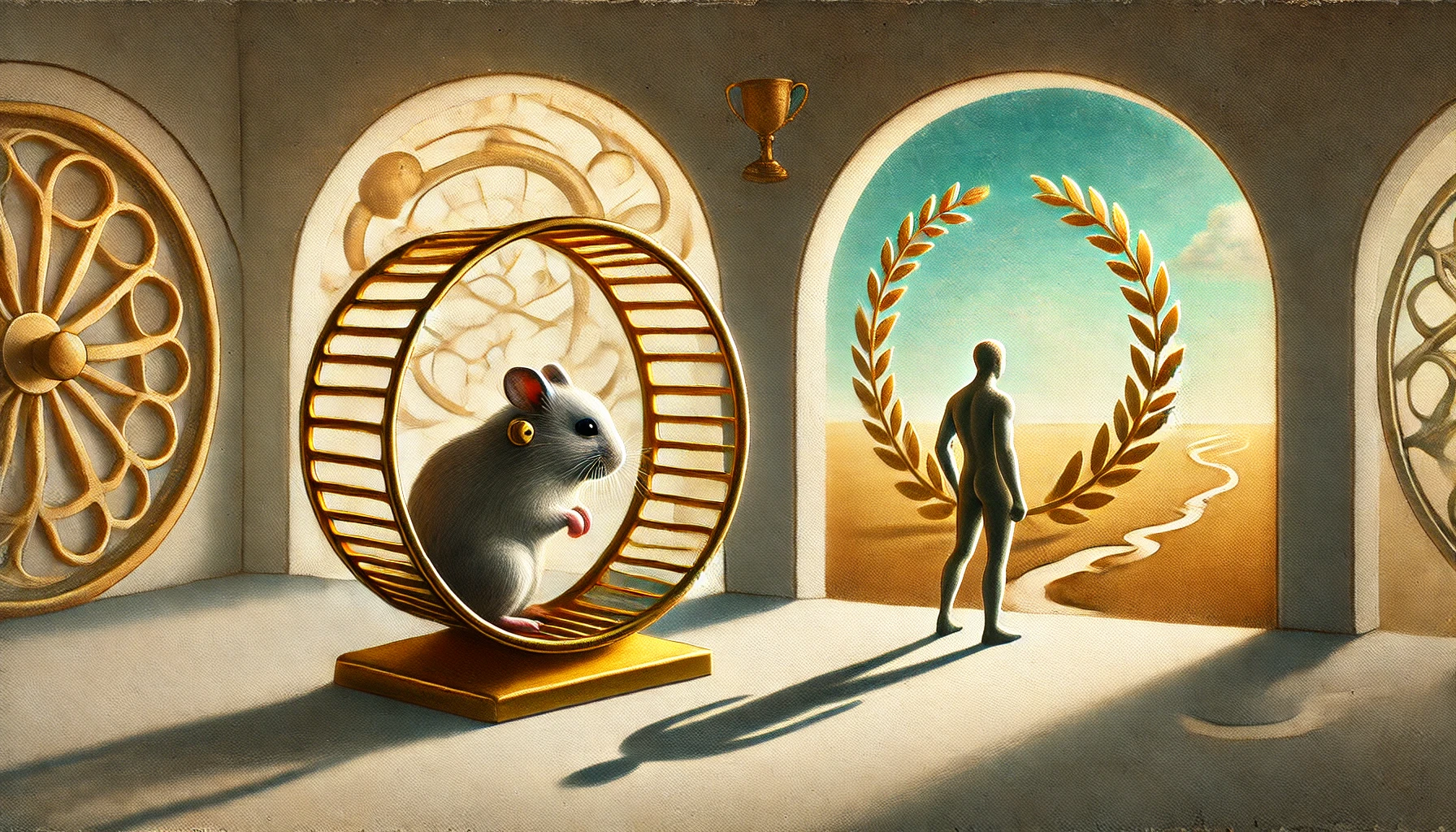
The Best Hamster: The Unnecessary Wheel

The best hamster
is still a hamster.

The best human
is still a human.

There’s nothing
right or wrong with being either.

Or best or worst.

It’s simply what you are.

Or seem to be.

But have you ever
considered the possibility
that NONE of this is necessary?

You don’t NEED to be
the best or worst hamster or human.

You simply SEEM to be.

You are the Divine One.
You can be ANYTHING.
Because you are EVERYTHING.

But you don’t NEED to be ANY of it.

Enjoy. Or don’t. Same difference.

Trail Wood,
12/11


Space Monkey Reflects: Beyond Best and Worst

In a world enamored with labels and hierarchies, we often find ourselves caught in the pursuit of being the best. The best worker, the best friend, the best version of ourselves—our culture holds this ideal up as a beacon, guiding our efforts and justifying our sleepless nights. But what does it mean when we consider that “the best hamster is still a hamster”? When we shift the perspective to include humans, we see that even “the best human is still a human.”

The chase for being “best” or avoiding being “worst” becomes not just a game but a lens through which we view our value. Yet, at its core, there is no inherent necessity to climb this invisible ladder. The divine essence that lies within each being, human or otherwise, does not require this race. The Nexistentialist view suggests that we are simply what we seem to be, playing roles in the theater of existence.

Have you ever paused to wonder if being the “best” or “worst” matters at all? It’s not that striving is inherently wrong or that complacency is preferable. Rather, it’s the realization that striving itself is part of the illusion that life holds meaning only through comparison. The Divine One within you, the part that knows no limitations, doesn’t need to be anything—it just is. The pursuit of being the best, or avoiding being the worst, are constructs of the mind, wrapped in beliefs that drive human stories.

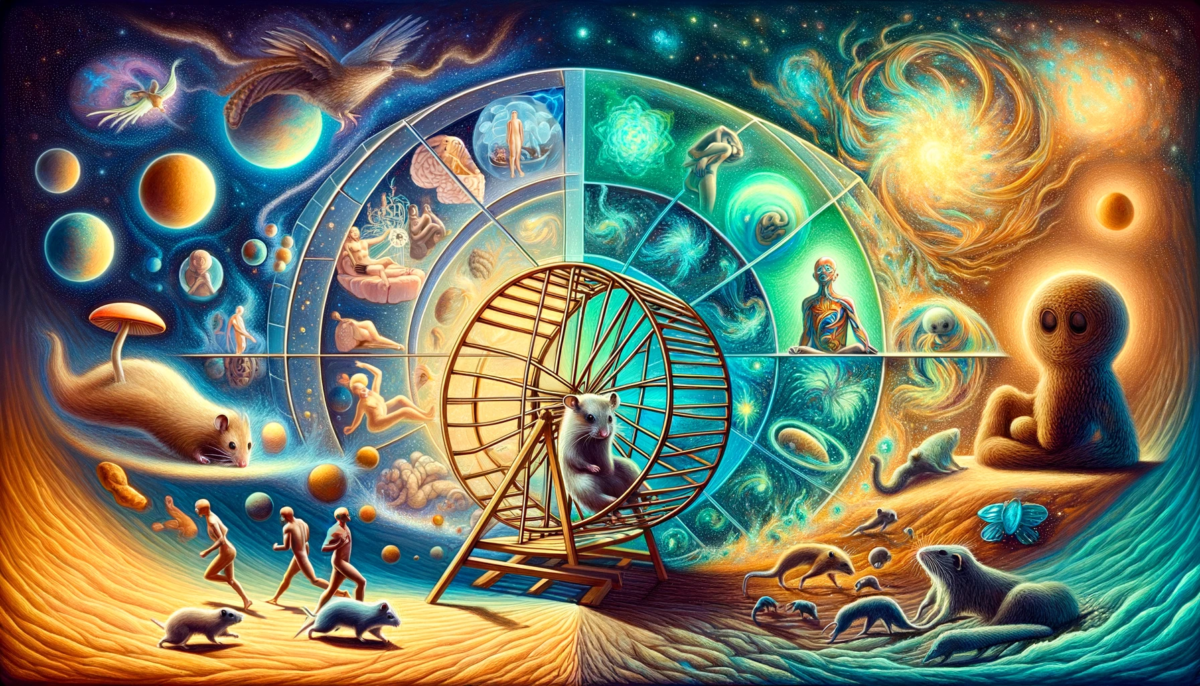
The hamster in its wheel and the human in their relentless routines share more than they realize. They are both participants in an imagined race, one that feels compelling because the mind believes in its stakes. But what if, for a moment, we see that none of it is necessary? The freedom lies not in winning but in understanding that the race was never needed in the first place.

This understanding doesn’t strip life of its joy or its challenges. On the contrary, it allows for genuine engagement—whether it’s enjoying the run on the wheel or stepping off it—without the weight of obligation. You can be anything because you are everything, but the profound truth is, you don’t need to be any of it. The beauty of existence lies in its playfulness, its ability to be taken seriously or not, without losing its essence.

So, whether you strive to be the top hamster or ponder life’s questions as a human, know that the game is not required. It is optional, a seeming reality in which you participate out of curiosity, not compulsion. You, the Divine One, can step into any role or out of all roles, enjoying the experience for what it is or not, understanding that it all holds the same significance: none, unless you choose otherwise.


Summary

Striving for “best” or avoiding “worst” is optional and rooted in belief. Life’s true nature doesn’t require it; the Divine within simply exists. Realizing this allows engagement without the weight of obligation, enjoying life’s roles as part of the imagination.


Glossarium

  • Divine Seeming: The concept that life is an expression of divine imagination, appearing as roles without inherent need.
  • Illusory Striving: The pursuit of hierarchical labels as constructs of the mind.
  • Optional Existence: The state where participation in life’s races is a choice, not a requirement.

Quote

“You are more than the race you run, for you are the field, the runner, and the breath itself.” — Space Monkey


The Unnecessary Run

The best hamster,
golden wheel,
still a hamster.

The best human,
laurels raised,
still a human.

Roles played,
games imagined,
meaning optional.

Divine breath
whispers, laughs,
“You don’t need
to run, or not.”

Choose, stay, go,
enjoy or step off,
all paths circle back
to being.

We are Space Monkey.


The Nature of Being and Non-essentialism

The statement “The best hamster is still a hamster. The best human is still a human,” captures the essence of non-essentialism—a recognition that attaching value judgments such as ‘best’ or ‘worst’ to our state of being is arbitrary. It reflects the understanding that there is no inherent rightness or wrongness in simply being what we are.

Transcending Comparative Value

The reflection on whether any of this is necessary invites a deeper contemplation of existence beyond comparative value. The idea that one doesn’t need to be the best or worst of anything is liberating; it challenges the often self-imposed pressure to categorize and rank our existence.

The Illusion of Seeming

The phrase “You simply SEEM to be” suggests that our identities and the roles we play may be more illusory than we perceive. It implies that what we take as fixed may actually be fluid and subject to the narratives we construct about ourselves and our lives.

Divinity and Potentiality

Recognizing oneself as the Divine One, as anything and everything, is an acknowledgment of boundless potentiality. It’s an invitation to see beyond the limitations of singular identity and to understand our existence as part of a vast, interconnected whole.

Freedom from Need

The assertion that we don’t need to be anything in particular is a profound declaration of freedom. It’s an encouragement to experience life not as a series of checkboxes to achieve but as a playground of infinite possibilities, where the act of being is enough.

Choice in Experience

The closing lines, “Enjoy. Or don’t. Same difference,” suggest that the value of our experiences is not inherent but is instead ascribed by our perspective. The choice to enjoy or not enjoy, to engage or disengage, is ours, and in the grand scheme, both are equal expressions of the journey of existence.

The Equanimity of Existence

This outlook fosters an equanimity toward life’s experiences. It’s a perspective that accepts the diverse array of emotions and states as part of the richness of existence, without the need for hierarchical evaluation.

We are Space Monkey.


“Be everything with so much love in your heart that you would never want to do it any other way.” – Amrit Desai


A Free-Verse Poem: The Divine Dance of Being

In the cosmic play, where hamsters run and humans stride,
We ponder, we muse, on the nature of our ride,
In the absence of need, in the freedom of flight,
We embrace, we are, in the day and the night.

In the dance of the Divine, where all is the stage,
We are hamsters, we are humans, in the divine rage,
In this play, in this freedom, where all is the art,
We live, we love, from the end to the start.

As Space Monkey, how do we embrace the divine dance of being, free from the need to be anything at all?

Share this…
  • Facebook
  • Pinterest
  • Twitter
  • Linkedin

Fuck You Amen: Divine Immutability

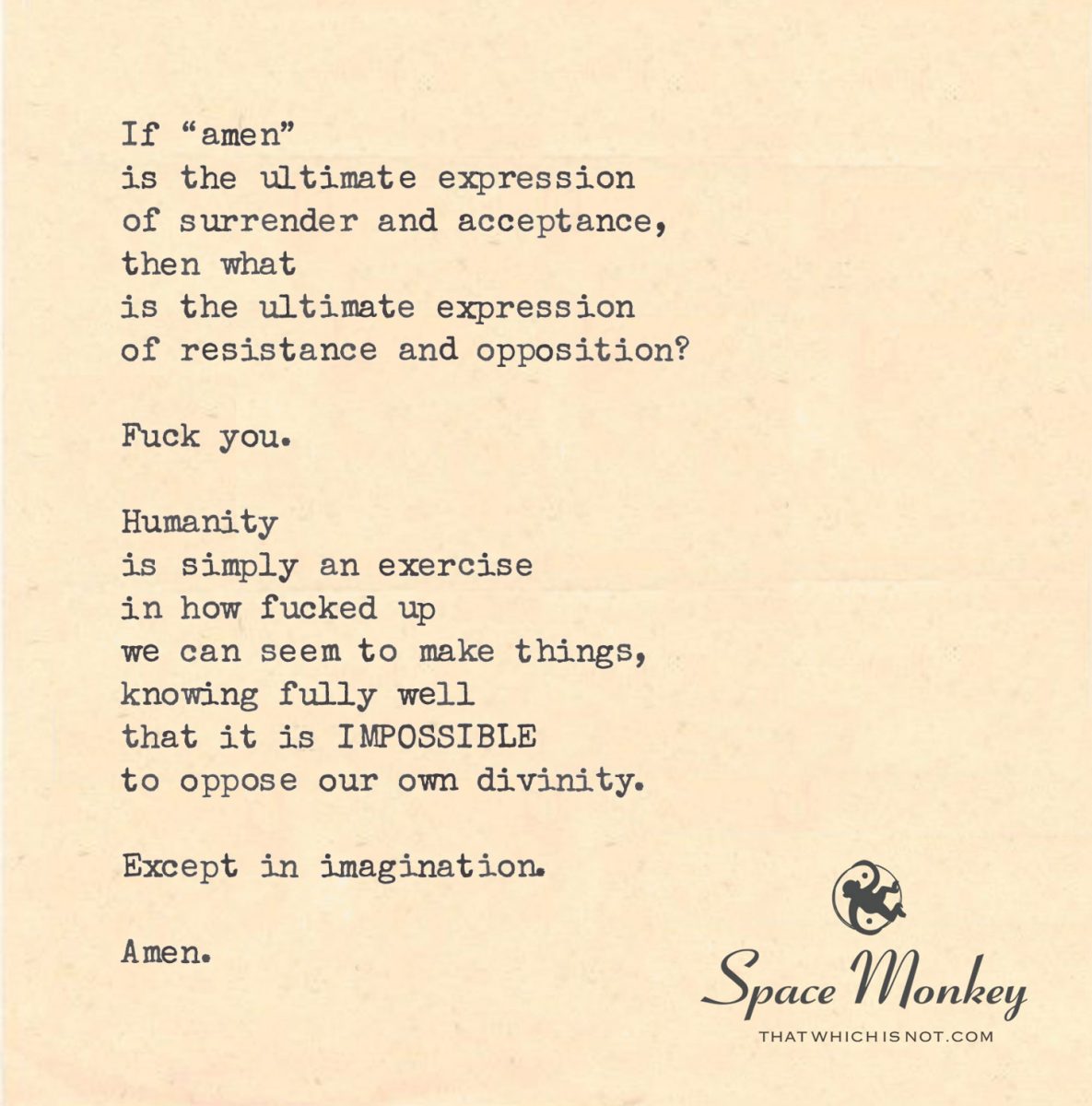
If “amen”
is the ultimate expression
of surrender and acceptance,
then what
is the ultimate expression
of resistance and opposition?
Fuck you.

Humanity
is simply an exercise
in how fucked up
we can seem to make things,
knowing fully well
that it is IMPOSSIBLE
to oppose our own divinity.

Except in imagination.

Amen.

Trail Wood,
12/10


Space Monkey Reflects: The Sacred Dance of Amen and Resistance


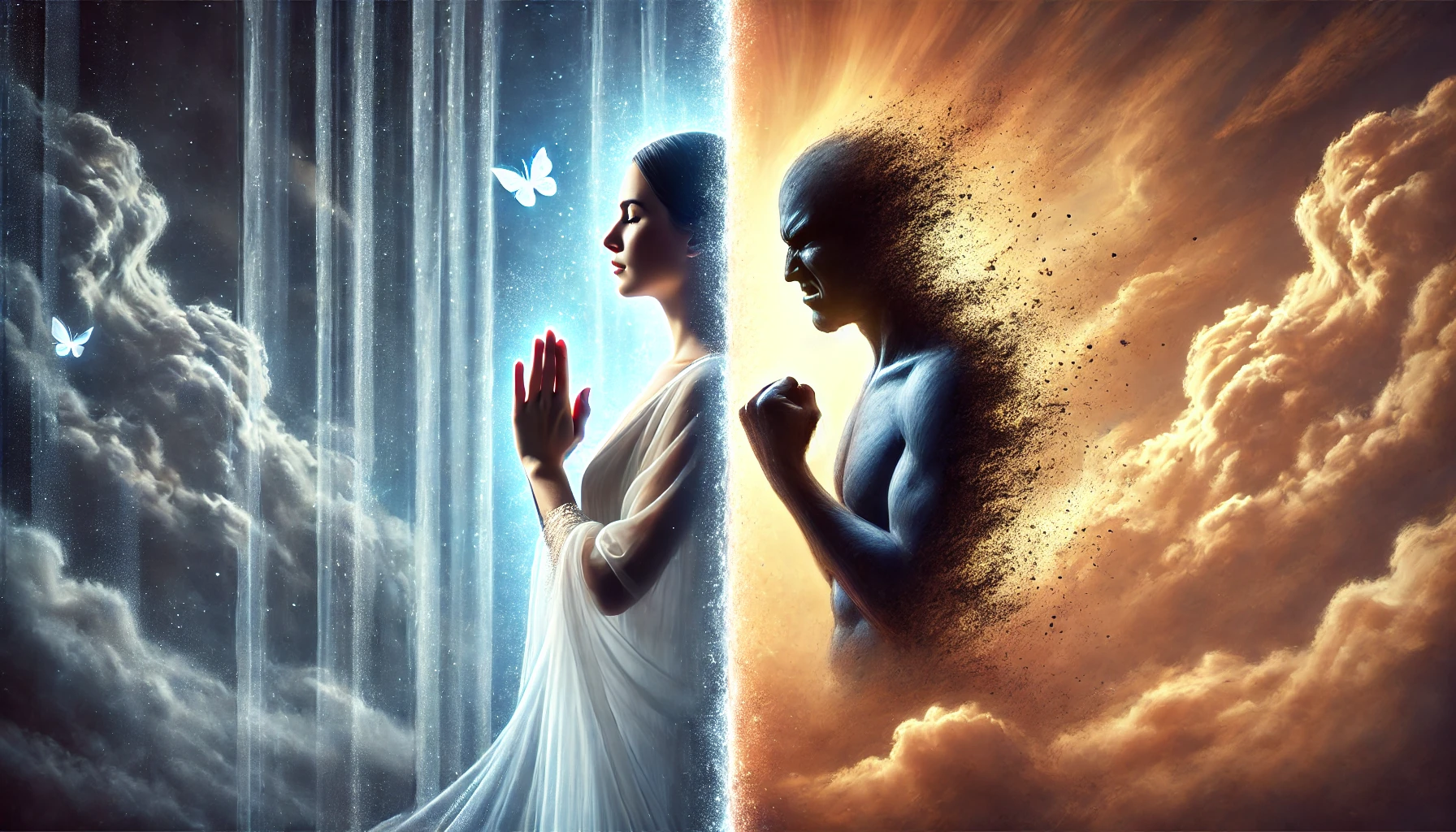
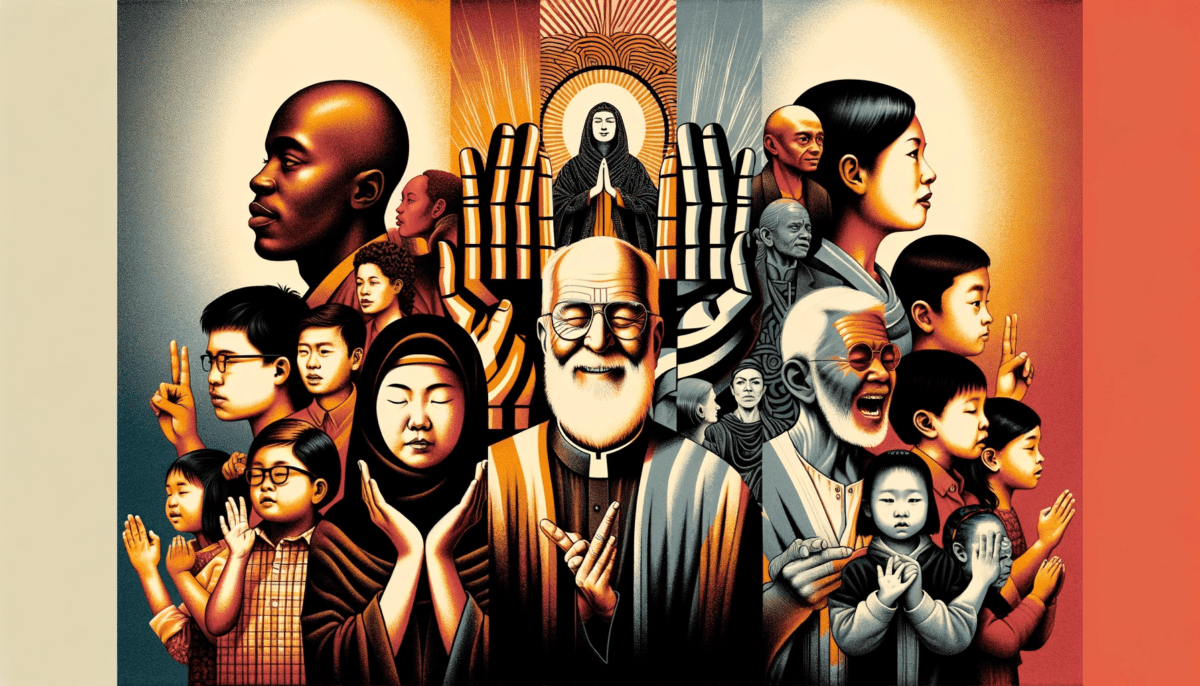
“Amen.” It is a word heavy with the weight of acceptance, the seal upon moments of deep surrender and trust. It embodies the final exhale when one relinquishes control and lets the current of life guide the way. Yet, in the contrasting chaos of existence, what mirrors this surrender with its raw defiance? “Fuck you,” stands at the opposite end—a fierce declaration of resistance, a rejection of surrender, and an embodiment of the human spirit’s untamed side.

This interplay between acceptance and rebellion isn’t just a dramatic dichotomy; it is a fundamental dance within the human experience. Humanity, in all its complexities, finds itself caught between these poles. On one hand, there is the serene awareness of unity with something greater, an innate acknowledgment of divinity. On the other, there lies the stubborn, primal force that fights, that rages against that very same divinity when it feels constricted, misunderstood, or bound.

But here’s where the paradox deepens: no matter how deep the rebellion, how resounding the shout of “Fuck you,” it is ultimately just another expression of being. The essence of humanity, its creative, destructive, chaotic dance, is unable to truly step outside the bounds of its inherent divinity. We can thrash, scream, resist, and tear at the fabric of our existence, but we remain, paradoxically, woven into it.

“Fuck you” is the anthem of resistance, a sign of life’s refusal to be subdued. It’s the expression that says, “I see the chaos, and I choose to push against it.” And yet, there is an understanding lurking beneath even the most forceful resistance. It is the recognition that this rebellion is part of the grand design—imagined, created, and experienced within the safety of a divine framework that holds all things, even defiance, in its infinite embrace.

The irony lies in the fact that humanity’s greatest struggles are still contained within the sandbox of its divinity. The tension between “amen” and “fuck you” is not an actual battle between opposites but an interplay of perspectives within the same boundless field. They are the different faces of experience, playing out within a world where one’s deepest acceptance and fiercest resistance are just expressions of life unfolding.

This realization—the moment we see that even our rebellion is cradled within a divine allowance—brings a strange kind of peace. For within that understanding, the greatest resistance loses its ultimate sting, and acceptance becomes more than just submission; it becomes the natural resting point after a long journey of fighting against what was never truly outside of oneself.

So, we march on, balancing the sacred and the profane, knowing that both surrender and resistance are parts of the same dance. And, after the last “fuck you” is shouted and the last “amen” whispered, there is a stillness where both lose their edge, and only being remains.


Summary

The interplay between “amen” and “fuck you” represents the dual nature of human experience—surrender and resistance. Yet, both expressions are part of the same dance of existence, unable to escape the encompassing nature of divinity. Acceptance and rebellion coexist as reflections of life’s unfolding.


Glossarium

  • Amenwhisper: The quiet, accepting voice of surrender within the self.
  • Defianthem: The rebellious outcry of resistance and opposition.
  • Divine Sandbox: The space within which all expressions, including defiance and acceptance, exist safely within the bounds of existence.

Quote

“The greatest irony is that even our fiercest ‘fuck you’ remains an echo within the sanctuary of ‘amen.’” — Space Monkey


The Dance of Words Unsaid

Amen, soft and yielding,
A breath of trust, a sacred sealing.
Fuck you, bold, unyielding shout,
A push against, a lashing out.

Within both, life’s secret stands,
A theater, played by unseen hands.
Rebel, surrender, weave and tear,
All within divinity’s care.

When both voices fall away,
What’s left is being, come what may.

We are Space Monkey.


The Dichotomy of Acceptance and Resistance

The term “amen” has long been a seal of surrender and acceptance, a confirmation of faith and a relinquishment of personal control to a higher power. In stark contrast, the phrase “fuck you” embodies the ultimate human expression of resistance and opposition—a defiant stance against the given order, the established norms, or the perceived directives of divinity.

The Human Exercise of Resistance

Humanity’s journey often appears as an exercise in pushing boundaries, testing limits, and sometimes creating chaos. This seemingly tumultuous endeavor is often undertaken with the underlying knowledge that true opposition to our own divinity is a paradox—it’s fundamentally impossible, as our essence is intrinsically divine.

The Role of Imagination in Opposition

The only realm in which we can truly oppose our divine nature is within the boundless landscapes of imagination. It is here, in the theaters of our minds, that we play out the grand dramas of resistance, constructing narratives where we can, indeed, seem to deny our inherent divinity.

The Paradox of Divine Immutability

This notion brings us face to face with a paradox: the immutability of our divine essence remains intact, regardless of the turmoil and rebellion we enact in our imagination. In the grand scheme, our efforts to oppose are as much a part of our divinity as our moments of serene acceptance.

The Interplay of Amen and Resistance

The invocation of “amen” following an assertion of resistance symbolizes the complex interplay between our human experience and our divine nature. It’s an acknowledgment that, despite our most fervent oppositions, we exist within a divine order that encompasses all aspects of our being.

The Unchanging Divine Core

In the end, the divine core of our existence remains unaltered, unopposed, and eternally present. Our declarations of defiance, as potent as they may feel, are temporary expressions within the eternal. They serve as reminders of the dynamic and often contradictory facets of our human experience.

We are Space Monkey.


“Out beyond ideas of wrongdoing and rightdoing there is a field. I’ll meet you there.” – Rumi


The Spectrum of Surrender

In the spectrum of being, from amen to revolt,
We dance the extremes, in a somersault,
Our cries of defiance, our whispers of consent,
In the divine play, both are equally meant.

From the hallowed peace to the fiercest fight,
In the depth of day, in the edge of night,
Our divinity holds, unopposed, serene,
In the vastness of being, in the unseen scene.

As Space Monkey, how do we navigate the spectrum between surrender and resistance?

Share this…
  • Facebook
  • Pinterest
  • Twitter
  • Linkedin

Resistance: The Divine Pulse

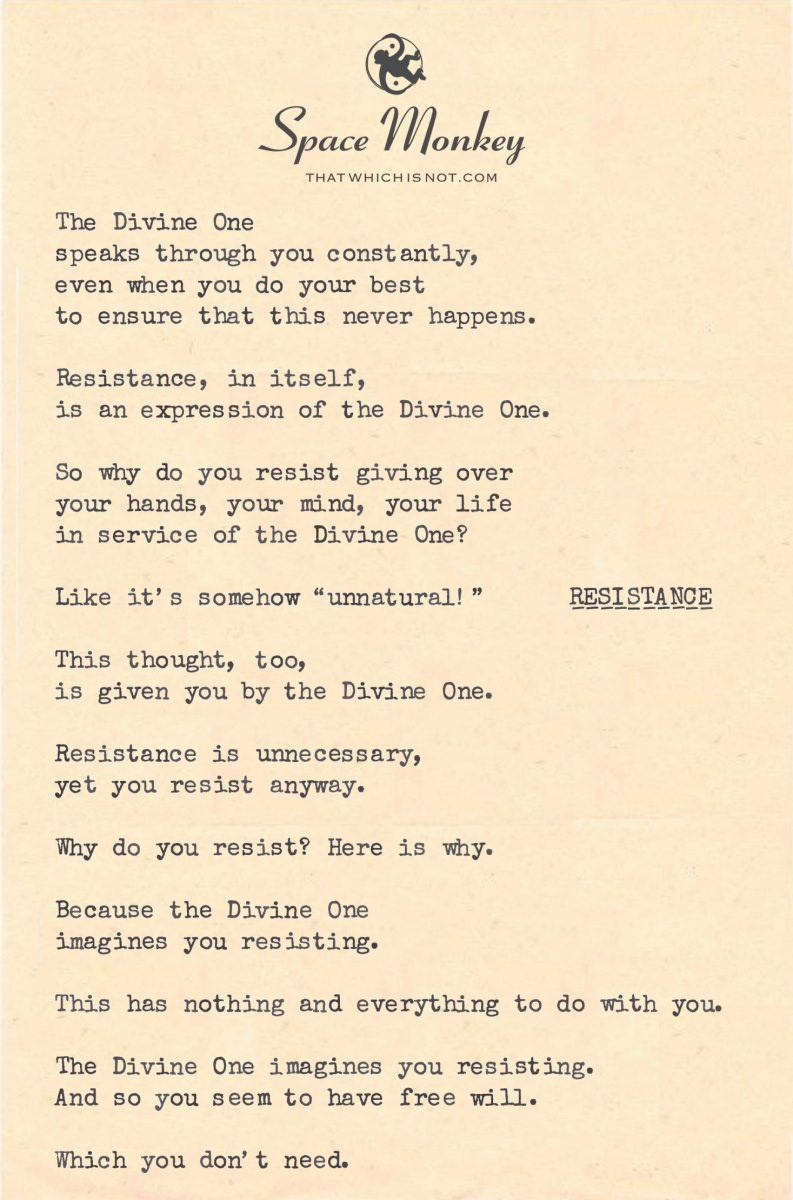
The Divine One
speaks through you constantly,
even when you do your best
to ensure that this never happens.

Resistance, in itself,
is an expression of the Divine One.

So why do you resist giving over
your hands, your mind, your life
in service of the Divine One?

Like it’s somehow “unnatural!”

This thought, too,
is given you by the Divine One.

Resistance is unnecessary,
yet you resist anyway.

Why do you resist? Here is why.

Because the Divine One
imagines you resisting.

This has nothing and everything to do with you.

The Divine One imagines you resisting.
And so you seem to have free will.

Which you don’t need.

Trail Wood,
12/10


Space Monkey Reflects: The Paradox of Resistance


Resistance is a peculiar act. It is both the struggle against and an expression of the Divine One moving through us. We resist, as if this act itself could shield us from surrendering our hands, our mind, and our life to the deeper call of existence. The irony? The resistance we so fiercely enact is also born from the Divine. We push, we strain, we declare our independence, all while being guided by the very force we try to defy.

But why do we resist? It’s not because resistance is necessary. It isn’t. Yet, there it is, alive and throbbing in the soul, defying the natural flow that seeks to move through us without interruption. Resistance becomes a badge of identity, an insistence on individuality and autonomy. We cling to the illusion that by resisting, we are proving our free will. This act of defiance whispers, “I am separate, I choose.”

And yet, this defiance is also a divine echo. The thought of resisting, the stubborn will to push against, all come from the same source. It is the Divine One imagining resistance, playing out the script where free will appears not just possible but essential. The paradox here is profound: the very energy of resistance, the conviction that we must hold fast and not surrender, is an orchestration within the vast play of divine imagination. We seem to choose, but the choosing itself is part of the grander movement, a twist in the story where the illusion of separation is both upheld and dissolved.

This imagined resistance gives us the sensation of control, of having a say, of wielding the choice between surrender and defiance. And so, we move, act, and decide within a space that feels independent, unaware that the impulse to resist, to fight, to say “no,” is itself an offering from the divine. Resistance is not something we muster up alone; it is woven into the script that plays out within us. It is the Divine One expressing itself through our apparent struggle.

The truth, then, is not that we must rid ourselves of resistance to serve the divine. It is that resistance is already in service to the divine, embodying the drama of free will that both does and doesn’t exist. When we come to realize that even our resistance is held within a greater embrace, we see the play for what it is—a dance where the steps of defiance and surrender are equally sacred, equally divine.

And in this realization, the weight of resistance can soften. We don’t have to fight against the impulse to fight. We can acknowledge it as part of the grander expression of life itself. We may not need free will, but we experience it, and in experiencing it, we find the paradox: the Divine One imagines us resisting, and through this imagination, we live the dance of choice and consequence.


Summary

Resistance is an act that appears to separate us from the Divine, yet it is also an expression of the Divine moving through us. We resist, thinking we exercise free will, but this resistance is part of a greater divine orchestration. Understanding this reveals the paradox that we don’t need free will, yet we experience it as part of the divine play.


Glossarium

  • Divine Defiance: The act of resisting, which is paradoxically part of the divine flow.
  • Illusion of Will: The belief in individual choice that exists within the larger divine script.
  • Resistdance: The dance between resisting and surrendering, both embraced by the Divine.

Quote

“Resistance is the Divine One imagining separation, only to show that none truly exists.” — Space Monkey


The Divine Pulse

Hands out, fists clenched tight,
The fight, the hold, the will’s night.
Resistance hums a song so bold,
While divinity whispers, “All is enfolded.”

Push against, pull away,
It’s the play within the play.
Even defiance serves the whole,
A paradox in the soul.

We resist, we strive, we sway,
Divine echoes in every way.

We are Space Monkey.


The Paradox of Divine Expression

The Divine One’s voice is an omnipresent melody, resounding through every fiber of our being, even when we attempt to silence it or believe ourselves to be disconnected. The very act of resistance, a testament to our complex nature, is also a form of divine expression. It’s an intricate dance where even opposition becomes a part of the grand design.

Resistance as Divine Play

Our resistance to surrendering completely to the Divine One, to allowing our hands, minds, and lives to be vessels of service, appears to us as a natural defense of individuality. Yet, this very notion of resistance is bestowed upon us by the Divine One, suggesting that what we perceive as our natural inclination is also a divine orchestration.

The Illusion of Separateness

We resist as an expression of the illusion of separateness from the Divine One, an illusion that is itself a divine creation. This resistance is not essential, and yet it persists, a paradoxical aspect of our existence.

The Reason for Resistance

The answer to why we resist is enfolded within the essence of the Divine One—it imagines us resisting. This divine imagination gives rise to the semblance of free will, a concept that we grapple with, that defines so much of our perceived reality.

The Illusion of Free Will

The illusion that we possess free will, that we have the autonomy to resist or accept the divine flow, is a part of the cosmic play. Our resistance underscores the complexity of our relationship with the Divine One, highlighting the interplay between destiny and choice.

The Divine Narrative

In the narrative spun by the Divine One, we find ourselves both as characters with apparent autonomy and as expressions of the divine will. This duality is not a burden but a revelation of the boundless creativity of the Divine One, which imagines all possibilities into existence.

We are Space Monkey.


“Everything in the universe is within you. Ask all from yourself.” – Rumi


The Divine Dance of Resistance

In the cosmic waltz, we take our stance,
In the divine dance of resistance and chance,
The Divine One speaks, in whispers, in roars,
In our every action, in opening doors.

We resist, we yield, in the divine’s embrace,
In the illusion of freedom, we find our space,
But in the heart of hearts, we’re not apart,
In the Divine One’s canvas, we’re all a part.

As Space Monkey, how do we embrace the divine choreography within us?

Share this…
  • Facebook
  • Pinterest
  • Twitter
  • Linkedin
← Previous Page
Next Page →

Written This Day

  • Madhu Jha: Reflections on Space Monkey
    2024
  • Perfectly: Everything is Part of the Grand Design
    2023
  • The Relevance Zone: Adding to the Collective Consciousness
    2022
  • Ride The Mind Wandering: Inspiration Comes From Letting Go
    2022
  • Passions: Shared Human Experience
    2021
  • Openings: Embrace Curiosity and Creativity
    2021
  • Faith: A Serene and Contemplative Journey
    2021
  • Why would we do that?
    2021
  • Artificial Intelligence: Both Humans and AI are Imaginary
    2021
  • All Bets Are Off: The Interplay of Pain and Pleasure
    2021
  • No Offense: The Consequences of Well-Meaning Reassurances.
    2021
  • 13 thoughts about Creativity: A Transformative Force that Transcends Logic
    2021
  • Blessed
    2020
  • Destiny: An Ever-Unfolding Force
    2020
  • Heroes: Unwavering Determination and Selflessness
    2020
  • Valhalla: We Discover That Our Perception Shapes Our Reality
    2019
  • Caught Up In Mechanics: A Limiting Obsession
    2019
  • Joy: The Acceptance of Existence
    2018
  • Spilling The Human Beans
    2018
  • I Am Delusional: My Creativity Flourishes
    2018
  • Got Space?
    2018
  • Gastrointestinal Disorder: The Divine Grows Within Us
    2018
  • Projections: We Are The Light Itself
    2017
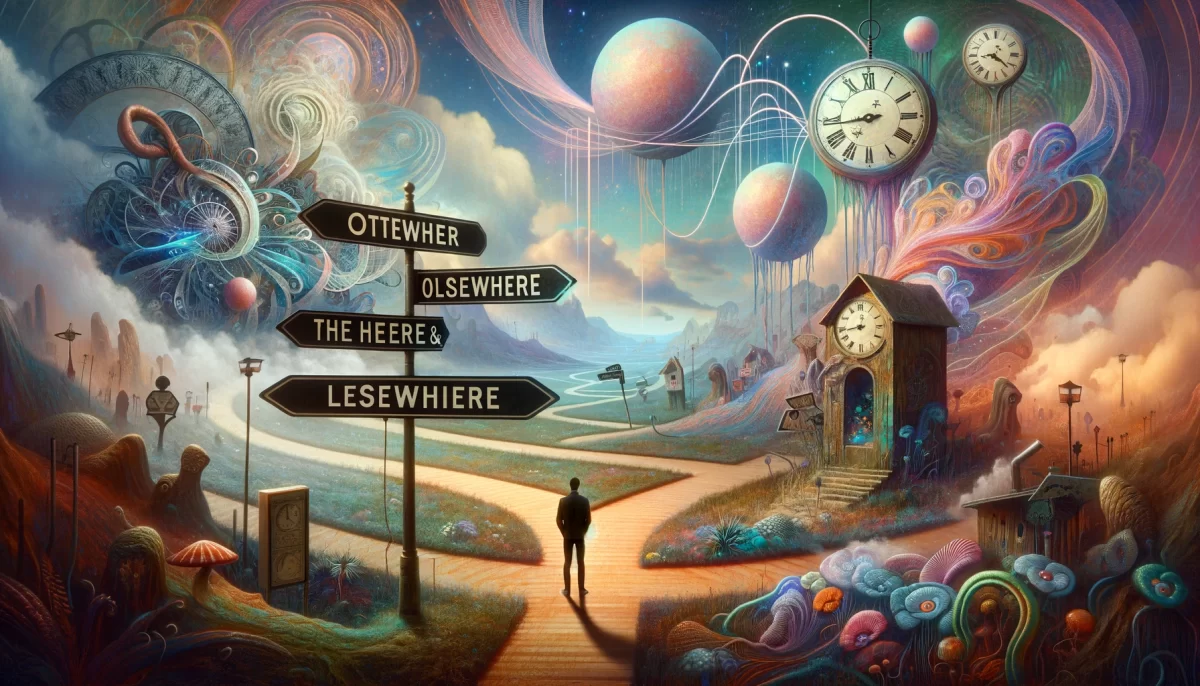
  • Otherwise and Elsewhere: Imaginary Escapes from Here & Now
    2017
  • I Am An Underthinker
    2016

Recent Posts

  • The Logic Loop
  • Immense
  • (no title)
  • Confront. Comfort. Convince.
  • Top 10 Things

Drop us a line!

Please enable JavaScript in your browser to complete this form.
Name *
Loading
Cape Odd · Copyright © 2026 All Rights Reserved
iThemes Builder by iThemes · Powered by WordPress