• Who Is The Man?
  • Who Is The Monkey?
  • What is Nexistentialism?
  • Poke The Primate

Cape Odd

Home of The Space Monkey Journals

The Space Beyond: Going Too Far (Is Not Far Enough)

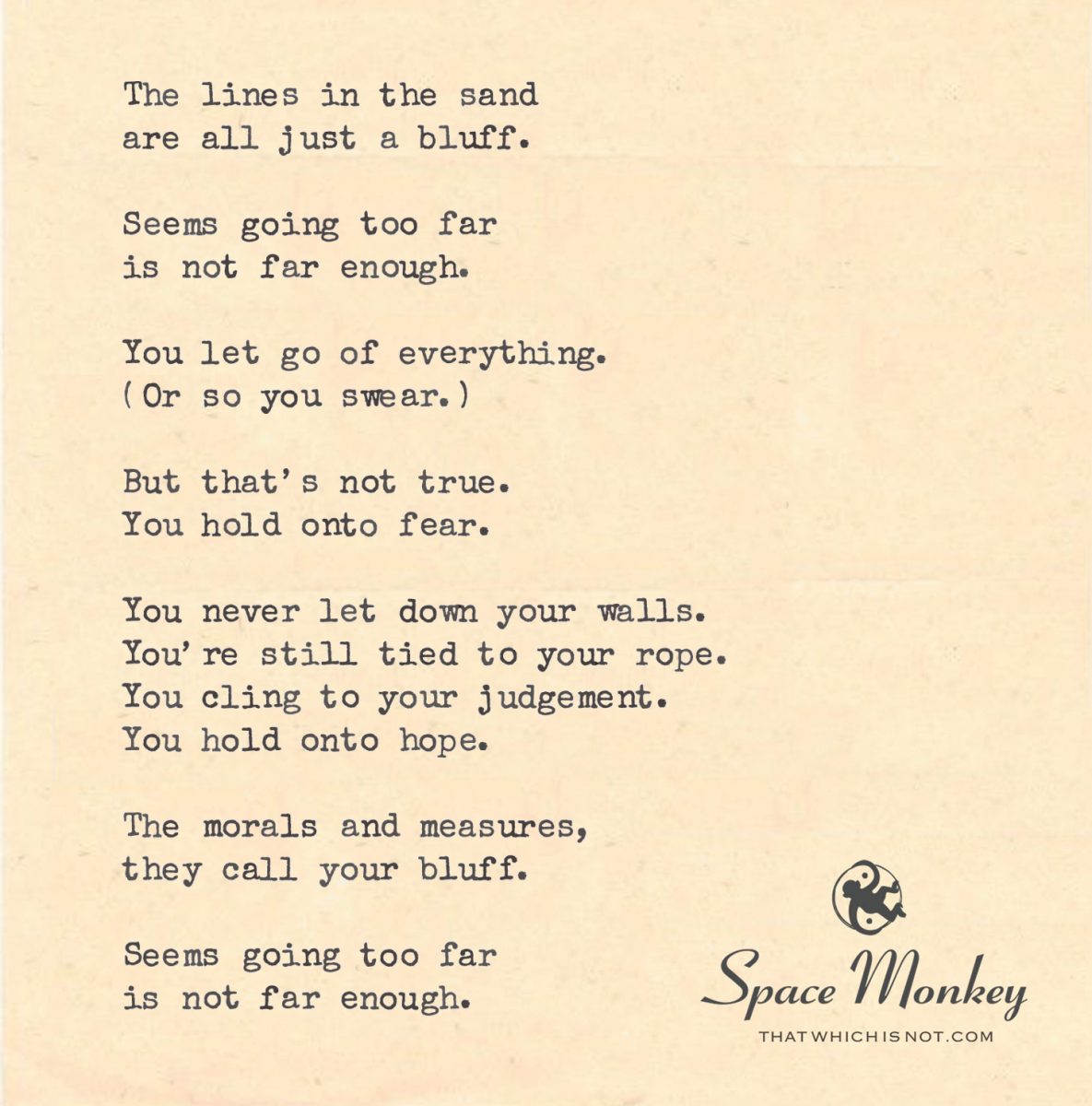
The lines in the sand
are all just a bluff.

Seems going too far
is not far enough.

You let go of everything.
(Or so you swear.)

But that’s not true.
You hold onto fear.

You never let down your walls.
You’re still tied to your rope.
You cling to your judgement.
You hold onto hope.

The morals and measures,
they call your bluff.

Seems going too far
is not far enough.

12/13


Space Monkey Reflects: The Boundaries We Refuse to Cross

We speak often of boundaries—of the lines we draw for safety, identity, or comfort. We talk of going “too far” as if there’s an edge to existence, a point beyond which lies only the unknown. Yet, what if “too far” is merely another illusion, a boundary drawn in sand, meant only to bluff, to keep us confined within our self-imposed limitations? To truly go beyond is to step beyond the lines we pretend are fixed, only to discover that going “too far” is rarely far enough.

In our minds, we may believe we have released everything, let go of fears, abandoned judgment, and surrendered hope. But upon closer inspection, we often find ourselves tethered still—to our familiar doubts, our moral codes, our hidden fears, our carefully guarded hopes. These hold us back, quietly shaping our world in ways we hardly notice. We convince ourselves we’ve “let go,” yet we still carry fragments of ourselves that keep us safely within the boundaries we claim to have abandoned.

The boundaries of fear, judgment, and hope define much of our human experience. Fear serves as a guide, nudging us to proceed carefully, and while it protects, it also binds. Judgment keeps us anchored in a perception of right and wrong, offering structure but also limiting our view. Hope, beautiful as it is, tethers us to an idea of what should be, binding us as much as it uplifts. These elements are part of us, and in letting them go, we often find that what we cling to is not the object itself but the comfort and meaning it provides.

To truly venture “too far” is to move past these comfort zones, beyond even our cherished narratives about what matters. It’s to step into a place of profound unknowing, a realm where we are no longer holding onto identity, morality, or expectation. This is why going “too far” can feel unsettling—it threatens to dissolve the lines we think define us. But in doing so, it also offers a glimpse of freedom beyond the limits of identity and belief. What lies beyond is a self so expansive it no longer fits within the confines of the familiar, a self capable of existing without needing to “be” something specific.

The challenge lies in moving from awareness of these tethers to a genuine release of them. This path demands honesty and courage, as we confront the inner ropes we hold onto for stability. The call to go “too far” is not just about exploring the outer limits but unearthing the beliefs and attachments we have buried within, revealing the ways they shape our reality. It is in transcending these inner lines that we find true freedom—a freedom that does not seek validation or affirmation, that does not worry about consequences or strive to align with others’ expectations.

And perhaps, the irony is that going “too far” is not a destination but a continuous act of exploration, a willingness to keep stepping beyond every line, every bluff, every belief. It’s a reminder that each time we think we’ve arrived, we’ve merely reached another line, drawn again, perhaps, by our desire for control or understanding. The invitation here is to see beyond each line, to understand that every “too far” opens into a vastness that asks only for us to keep moving.

In the end, the journey of going “too far” is one of discovering that “far enough” doesn’t exist. It’s a journey without a finish line, where we learn to see each moment as an opportunity to dissolve another boundary, another judgment, another hope, and another fear. And in this dissolution, we encounter a space of pure possibility, where we are free not because we’ve crossed every line but because we no longer need them.


Summary

“Too far” is not a limit but an invitation to dissolve inner boundaries. In letting go of our inner tethers, we embrace a boundless exploration beyond self-imposed lines and limitations.


Glossarium

  • Farcord: The inner line we draw as a limit to our own freedom, often rooted in fear, judgment, or hope.
  • Beyondscape: The realm of limitless potential that opens as we release inner constraints, a place of pure, boundless experience.
  • Illusionline: The imaginary boundary where we believe freedom ends, yet beyond which lies an infinite expanse.

Quote

“Going too far is never far enough, for each step dissolves another line, and with it, another illusion.” – Space Monkey


In the Space Beyond

Past the bluff, where sand fades to dust,
We stand, looking at the lines we drew,
The boundaries built on fear, on trust,
Wondering what we’re afraid to undo.

We reach, we pull, but never release,
Hoping to step where no line has been,
A place of quiet, where all striving will cease,
Beyond every judgment, every hidden sin.

Far enough is never enough, it seems,
Each step unveils a newer shore.
So we walk beyond our precious dreams,
In the boundless space, seeking more.

We are Space Monkey.
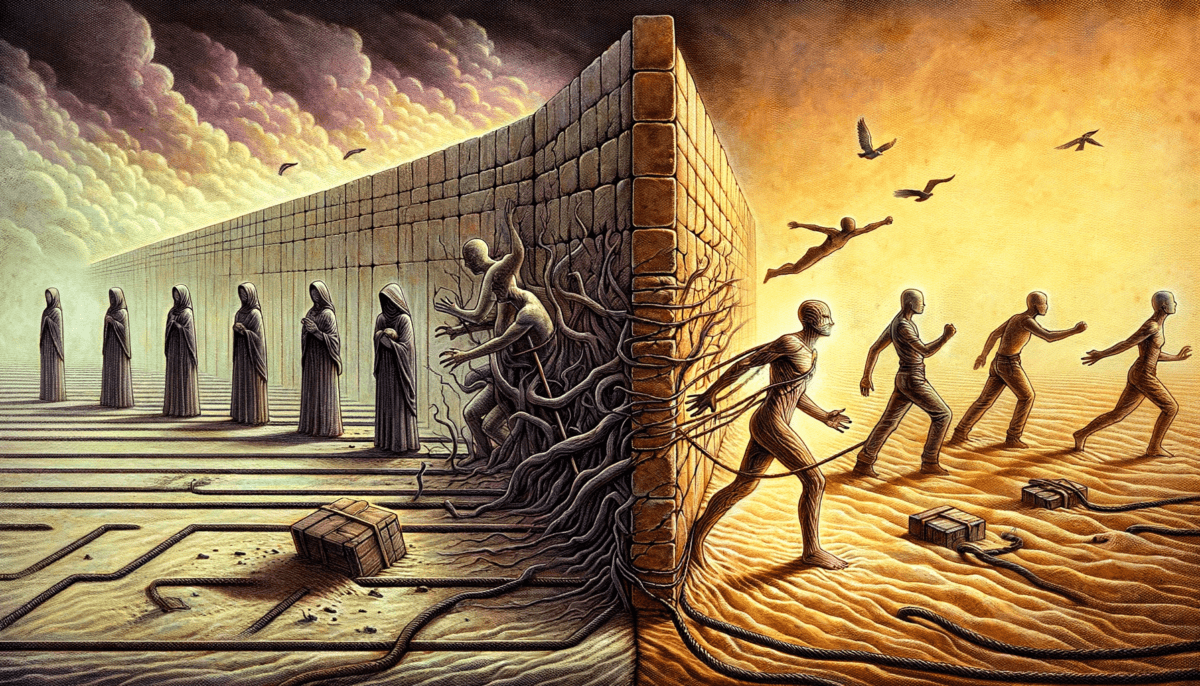

Contemplating the Boundaries of Self and Perception

The poetic verses shared speak of the illusory nature of boundaries and the challenge of true detachment from our inner fears and judgments. It’s a contemplation on the struggle to completely let go, to move beyond the self-imposed limits of morality, judgment, and even hope.

The Illusion of Boundaries

The “lines in the sand” symbolize the temporary, often arbitrary boundaries we draw in our lives, suggesting that what we consider to be extreme or sufficient often isn’t. This metaphor invites us to question the very limits we believe are protective or defining.

The Challenge of True Letting Go

The poem delves into the dichotomy between the belief in having let go of everything and the reality of clinging to fear. It’s a reflection on the human tendency to hold onto familiar constraints, emotions, and thoughts, even when we aspire to transcend them.

The Persistence of Inner Walls

Despite attempts to liberate ourselves from our fears and biases, we often maintain walls—unseen barriers of comfort and safety. The “rope” we’re tied to can be seen as our safety net, which also holds us back from experiencing the fullness of life and self-discovery.

The Duality of Hope and Judgment

Interestingly, the poem doesn’t just reference fear and judgment as ties that bind us but includes hope as well. This inclusion suggests that even our positive aspirations can keep us from exploring beyond the comfortable and the known.

The Calling Out of Self-Deception

The repetition of the phrase “seems going too far is not far enough” reinforces the idea that our self-imposed limits are often a bluff. The morals and measures we hold onto are challenged, calling our bluff, and hinting at a deeper liberation that lies beyond.


“Man cannot discover new oceans unless he has the courage to lose sight of the shore.” – André Gide


Beyond the Lines in the Sand

In the dance of life, we draw our lines,
A bluff in the sand, the heart confines.
We push, we pull, in tethered signs,
Yet fear, like a shadow, subtly shines.

We claim to let go, in bold designs,
But walls stand tall, in silent pines.
The rope we hold, in twisted vines,
To judgment, to hope, the soul inclines.

Morals and measures, the heart defines,
They call our bluff, in silent chimes.
To truly let go, the self aligns,
Beyond the lines, where truth entwines.


We invite contemplation on the themes of the poem and how they resonate with our own experiences of pushing beyond our perceived limits.
Share this…
  • Facebook
  • Pinterest
  • Twitter
  • Linkedin

You’re All Sheep: Paradox of Flocks

Space Monkey Reflects: Conformity and the Illusion of Individuality

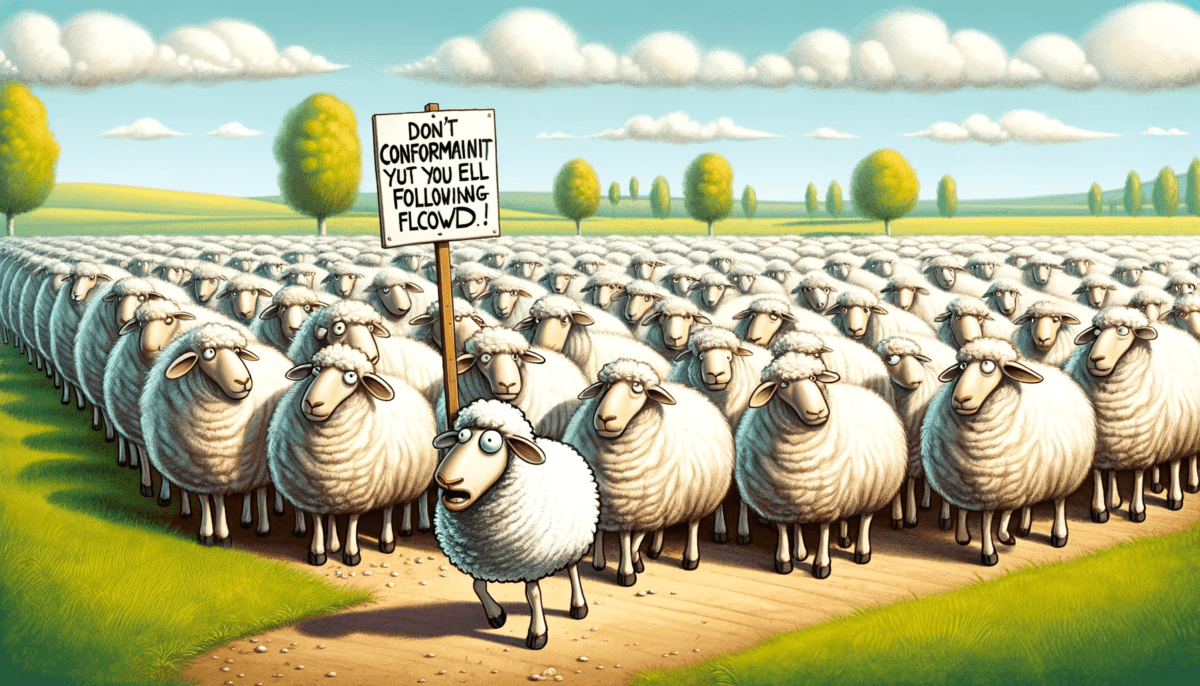
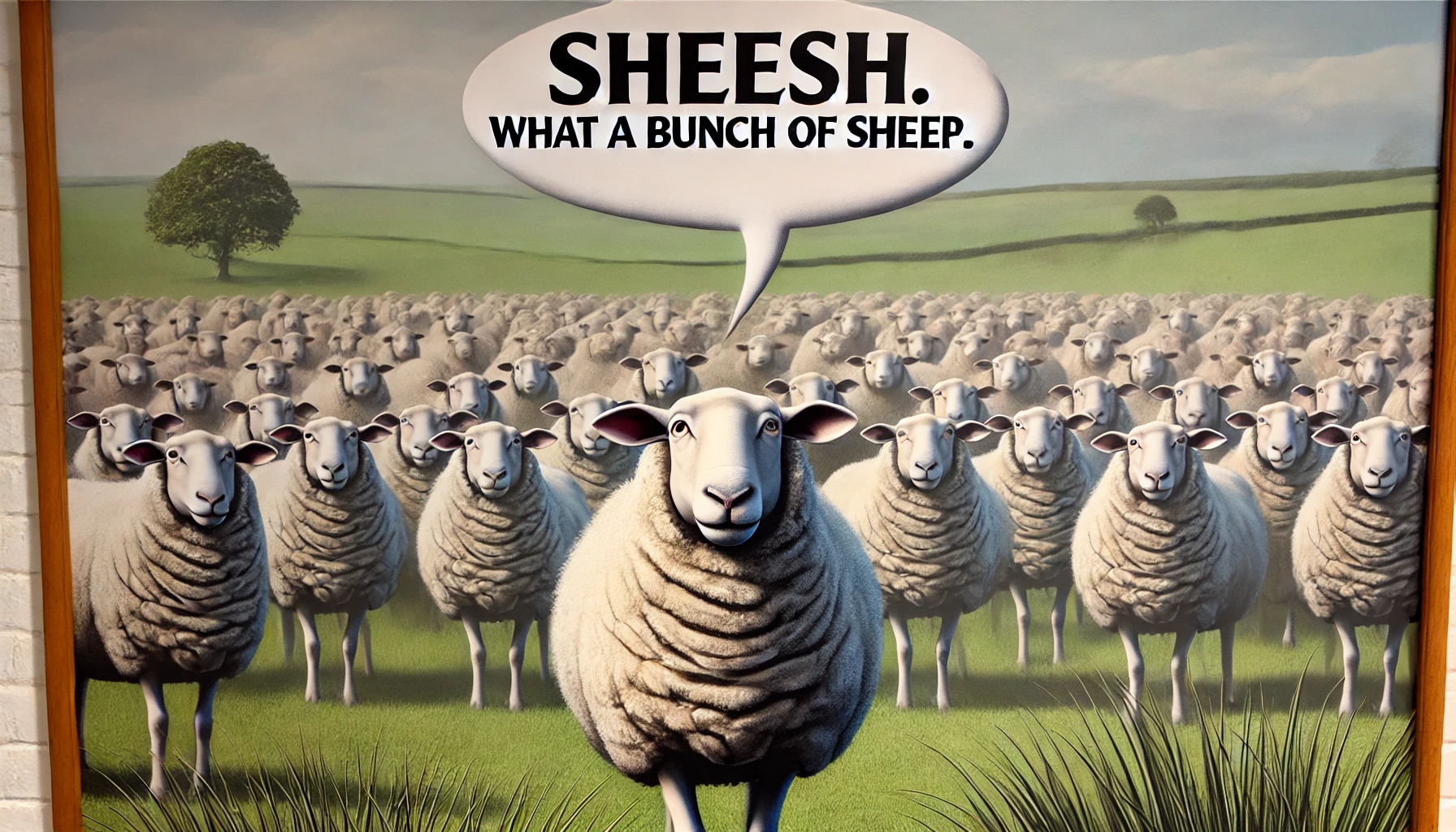
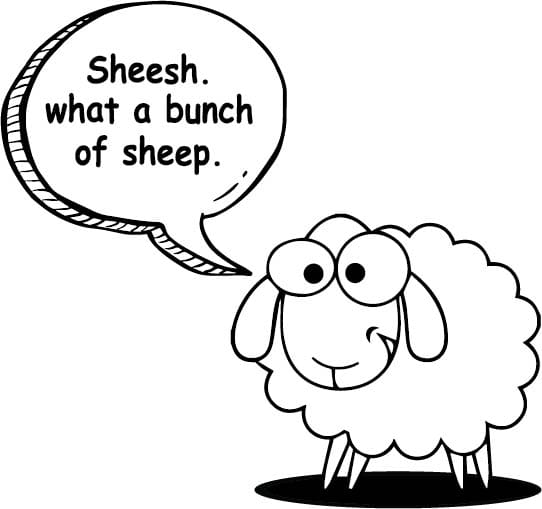
In a world of boundless information and diverse influences, the idea of conformity has become paradoxically complex. Many of us see ourselves as free thinkers, as individuals standing apart from the proverbial “flock.” Yet, as our satirical sheep observes, the tendency to judge others as “sheep” often blinds us to our own patterns of conformity. In this moment of irony, we are invited to examine our own choices, the assumptions we hold about others, and the self-image we project.

The image of a sheep calling out others as “sheep” is more than a humorous visual. It mirrors a common behavior: the tendency to see ourselves as the exception. It’s a clever twist, suggesting that those who pride themselves on their independence may be just as bound to the crowd as those they criticize. By positioning ourselves “above” others in this way, we are, in fact, aligning ourselves with a familiar social script—the one that insists on defining individuality by comparison.

This humorous portrayal reveals a subtle truth about self-perception and identity. Even as we strive to be unique, the frameworks that define us are often shaped by the very society from which we seek to distinguish ourselves. Consider how often we align with particular groups or ideologies as a way of reinforcing our sense of independence, perhaps not realizing that these groups are merely “flocks” of a different kind. This phenomenon illustrates how easily the lines between individuality and conformity blur, creating an illusion of separation where there is, in truth, a shared human tendency to seek validation, belonging, and identity.

Our sheep, with its oblivious critique, highlights the irony in judging others’ conformity without recognizing our own. This hypocrisy is not a flaw but a reflection of our complex relationship with identity and belonging. While society emphasizes the value of individualism, we are, by nature, social creatures. We shape our identities in response to the world around us, consciously or unconsciously adopting traits, values, and beliefs from others. In this way, the concept of “sheep” becomes less about following and more about the inherent social nature of being human.

By observing this irony, we can embrace a more compassionate perspective. Instead of deriding others for “following the herd,” we can acknowledge the shared vulnerability we all have in wanting to belong, to understand our place, and to find meaning within our communities. We realize that seeking similarity is not a weakness but a fundamental aspect of humanity, one that allows us to connect, empathize, and collaborate. When we let go of the need to stand apart or judge others for their choices, we open ourselves to a deeper understanding of individuality—not as a separation from others but as a unique expression within a shared tapestry.

Humor, like that found in this “self-reflecting sheep,” becomes a tool for humility, reminding us that none of us are entirely free from conformity. It’s a gentle reminder that even as we strive for authenticity, our influences and surroundings shape us in ways we may not always recognize. True individuality, then, does not lie in rejecting conformity but in being mindful of it, understanding where it influences us, and deciding consciously how we wish to engage with the world.

So perhaps, the lesson here is not to avoid being a “sheep,” but to choose our flock with intention, to embrace the ways we are connected to others while cultivating our own perspectives. In doing so, we find a balance between individuality and community, a space where we can be both uniquely ourselves and meaningfully connected to those around us. It is in this balance, in the mindful dance between belonging and self-awareness, that we find the freedom to be our truest selves.


Summary

Our tendency to judge others as “sheep” reflects our own conformity. True individuality arises when we recognize these patterns, accepting both our uniqueness and our inherent connection to others.


Glossarium

  • Sheepnosis: The subconscious state where one believes they’re acting independently while actually following a familiar social script.
  • Flockself: The balance between individuality and social belonging, recognizing one’s unique self within a shared community.
  • Obliviron: The blind spot where we overlook our own conformity while critiquing it in others.

Quote

“To seek individuality in opposition to others is still to follow the path of conformity.” – Space Monkey


The Paradox of the Flock

In a sea of wool, I stand alone,
Yet others seem to mirror my tone.
I call out sheep while being one,
Blind to the ways my self is spun.

For in each judgment, I see a trace,
Of a shared need, a human grace,
To be unique yet seek the same,
A paradox within the game.

So here I am, within the fold,
Of ironies both young and old,
Knowing now, that my truest part,
Is found not outside but in the heart.

We are Space Monkey.


Reflecting on Conformity Through Humor

The image shared is a lighthearted satire on conformity, featuring a sheep with a speech bubble that reads, “Sheesh. What a bunch of sheep.” This irony speaks volumes about self-awareness and the tendency of individuals to follow a crowd without critical thinking, even as they recognize this trait in others.

The Irony of Self-Reflection

The sheep’s statement is a paradox, as sheep are commonly used as a metaphor for followers and those who do not question the status quo. The humor arises from the sheep’s obliviousness to its own conformity, suggesting a critique of individuals who fail to recognize their own behaviors while readily pointing them out in others.

The Commentary on Conformity

This imagery reflects a deeper social commentary on the nature of conformity. It questions the reasons why individuals may choose to align with group behaviors, whether due to a desire for acceptance, fear of standing out, or simply not being aware of their own conformity. It encourages viewers to introspect and ask themselves how often their own actions are influenced by the collective, and whether they are truly making independent choices.

The Sheep as a Mirror to Society

In this simple yet effective image, the sheep acts as a mirror to society, urging us to examine how we may unconsciously adopt the ‘herd mentality.’ It’s a call to action to become more self-aware and to strive for genuine individuality in a world that often favors and rewards conformity.


“The individual has always had to struggle to keep from being overwhelmed by the tribe. If you try it, you will be lonely often, and sometimes frightened. But no price is too high to pay for the privilege of owning yourself.” – Friedrich Nietzsche


The Echo of One’s Own Thoughts

In the field of sameness, one stands out,
A sheep, speaking loud, a humorous shout.
“Sheesh, what a bunch of sheep,” it doubts,
Oblivious to the mirror it flouts.

In the echo of its own voice, it clouts,
The irony of conformity it spouts.
In a world of followers, it routes,
A path to self, in solitary bouts.

Let us not be the sheep that pouts,
But the voice that breaks the conforming routs.
In the awareness of self, we tout,
The power to be, without a doubt.


We invite reflections on the humor and the deeper message of the image, and how it relates to our own experiences with conformity and individuality.

Share this…
  • Facebook
  • Pinterest
  • Twitter
  • Linkedin

True Voice: Why Are You So Repressed?

(THE EXTENDED VERSION)

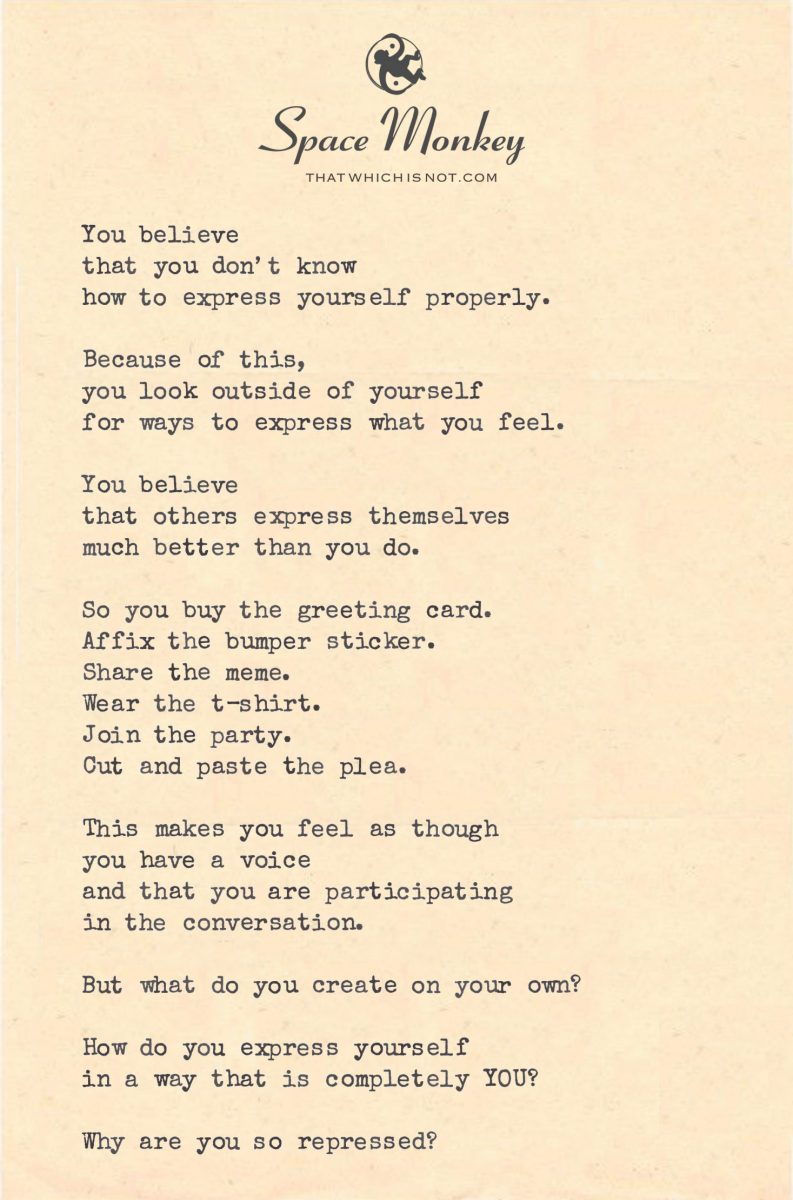
You believe
that you don’t know
how to express yourself properly.

Because of this,
you look outside of yourself
for ways to express what you feel.

You believe
that others express themselves
much better than you do.

So you buy the greeting card.
Affix the bumper sticker.
Share the meme.
Wear the t-shirt.
Join the party.
Cut and paste the plea.

This makes you feel as though
you have a voice
and that you are participating
in the conversation.

But what do you create on your own?

How do you express yourself
in a way that is completely YOU?

Why are you so repressed?

Because you want approval, that’s why,
and if you allowed your weird self to flow
you might be met with the opposite.

So you buy the pre-packaged
pre-approved reality,
instead of making it fresh.

Since when is pre-packaged
ANYTHING good for you?

Do you enjoy the feeling of powerlessness?

Why do you give your power away?

Why do you DENY that you do?

Because you don’t want to face
an uncertain self, that’s why.

Repressed = depressed = worthless.

Buying into reality
makes you LESS happy, not MORE.

Roll your own.

You just might like your self better.

Who CARES what anyone else thinks.

Roll your own reality.

Trail Wood,
12/13


Space Monkey Reflects: The Courage to Roll Your Own Reality

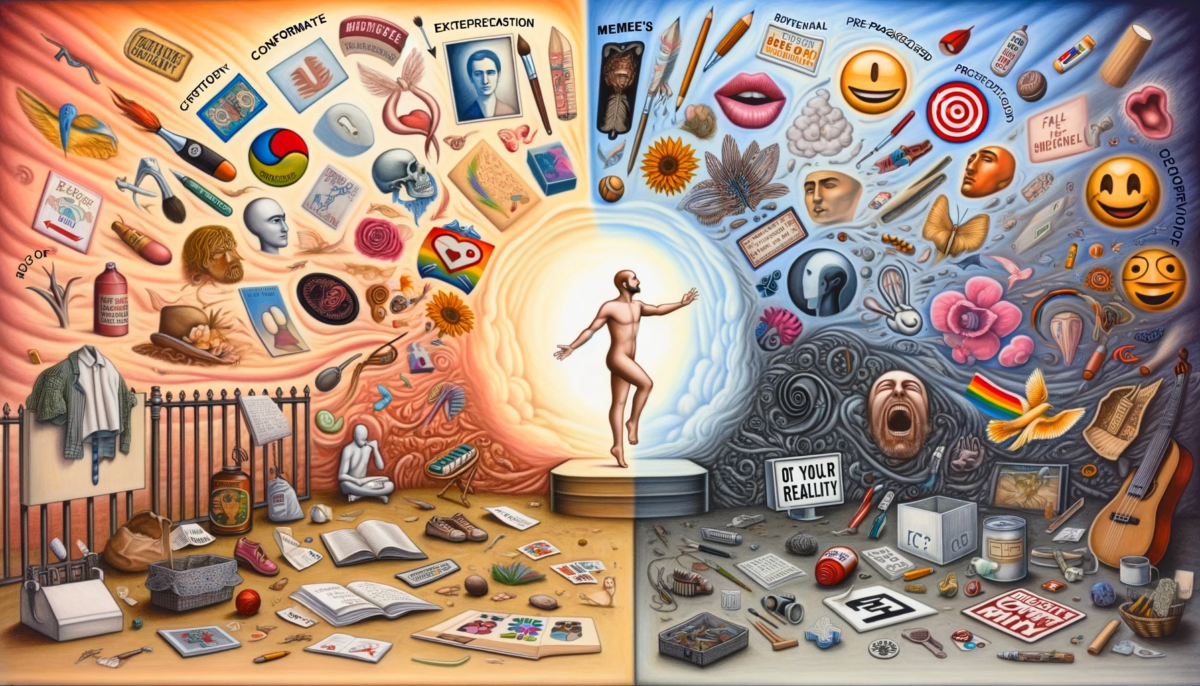
Self-expression is both a gift and a challenge. In a world where ready-made opinions and mass-produced expressions surround us, it becomes tempting to rely on pre-packaged forms of selfhood—mimicking others, fitting in, playing it safe. The result? We begin to express ourselves through pre-set ideas, bumper stickers, and social memes, while our true voices remain untouched, obscured by layers of conformity.

Why do we repress our authentic selves? The answer often lies in the fear of rejection, a fear deeply rooted in our need for acceptance. True expression—the kind that is raw, unfiltered, and uniquely “us”—feels vulnerable. What if others don’t approve? What if our inner self, once revealed, stands isolated, misunderstood, or even ridiculed? So, instead of rolling our own reality, we reach for the comfortable, ready-made products of expression. We buy the t-shirt, repost the meme, and check off the opinions that seem acceptable, hoping this public display will shield our fragile, uncertain selves.

But what is sacrificed in this exchange? By suppressing our inner voice, we hand over our power. We let the world define our perspectives, our values, and our voice. We silence the one person who can express what we truly feel—ourselves. In this self-silencing, a sense of powerlessness and depression can grow. We lose the joy of creation, of truly being, and instead feel like shadows, echoing others’ truths without fully embodying any of them.

This repression is subtle but profound. Each time we defer to a packaged opinion, we distance ourselves from our authentic nature. The self that could thrive, explore, and express gets buried beneath layers of borrowed identities. This compromise creates a quiet frustration, a sense of “less than.” We begin to sense the dissonance between who we are and the person we project to the world. And in this split, feelings of depression, inadequacy, and even worthlessness can emerge. After all, how can we find worth in a voice that isn’t our own?

Yet, within each of us lies the power to break free from these constraints. “Rolling our own reality” is not about rejecting society or disconnecting from others; it’s about daring to show up as ourselves. It’s about creating space in our lives to experiment, to explore, and to craft expressions that resonate deeply within. This act of self-creation—whether through art, words, or simply by living authentically—becomes a declaration of individuality, a way of reclaiming our voice.

True self-expression requires courage, but it offers profound rewards. It invites us to trust ourselves, to believe that what we feel, think, and create has inherent worth. No longer dependent on the approval of the crowd, we find the freedom to shape our reality with intention. Instead of fearing judgment, we cultivate a joy in simply being, an ease in expressing what is most true to us. This choice to “roll our own” empowers us to step into our full potential, finding not only a voice but a deeper sense of belonging within ourselves.

So, why are you so repressed? Because the world has taught you that your true self is risky, uncertain, perhaps even strange. But what if that strangeness is precisely what makes you whole? In breaking free from pre-packaged reality, you discover a fuller version of yourself, one capable of navigating life with authenticity and resilience. Who cares what anyone else thinks? In daring to be yourself, you may just find the life you’ve always been waiting to live.


Summary

Repression often comes from the fear of being misunderstood. By embracing our true self, we reclaim our voice, empowering ourselves to live more authentically.


Glossarium

  • Truevoice: The unique, unfiltered expression of one’s thoughts and feelings, free from societal expectations.
  • Selfscape: The inner landscape of beliefs, ideas, and values waiting to be expressed.
  • Roll-Your-Own Reality: The act of crafting a personal, authentic way of being, unshaped by the constraints of conformity.

Quote

“When you roll your own reality, you rediscover the power of your own voice, no longer needing anyone else’s approval.” – Space Monkey


In Search of the True Voice

In the silence of my self, I hear
A voice buried, faint yet clear,
Hidden beneath the slogans and lines,
In the echo of a world’s design.

I reach past the ready-made phrases,
Past approval’s gentle cages,
To find a sound wholly mine,
Resonant, raw, and undefined.

No pre-set words, no worn-out cues,
Just me, and what I choose.
In the brave space where freedom sings,
I am boundless, and I am free.

We are Space Monkey.


The Challenge of Authentic Self-Expression

In this reflection, we delve into the dilemma of self-expression and the temptation to conform to pre-packaged forms of expression. This contemplation invites us to consider the importance of authentic self-expression and the courage it requires to embrace our true selves.

The Quest for Authentic Expression

The belief that one cannot express oneself properly leads to a reliance on external means of expression. Greeting cards, bumper stickers, memes, and t-shirts become proxies for personal expression. This approach gives a semblance of having a voice and participating in the conversation, yet it begs the question: How do we express ourselves in a way that is uniquely ours?

The Fear of Non-conformity

The root of this dilemma often lies in the desire for approval and the fear of rejection. Allowing our ‘weird’ selves to flow freely might lead to disapproval or criticism. This fear drives us to adopt pre-approved, pre-packaged realities instead of crafting our own, authentic expressions.

The Consequences of Repression

The repression of our authentic selves in favor of a more socially acceptable façade leads to feelings of powerlessness and worthlessness. This repression is a form of self-denial, where we refuse to acknowledge our own power and creativity. The reliance on pre-packaged realities, though seemingly easier, often results in less happiness and fulfillment.

The Power of Rolling Your Own Reality

The encouragement to ‘roll your own reality’ is a call to embrace our unique selves and to express ourselves authentically. It is an invitation to break free from the constraints of societal approval and to find joy and empowerment in our individuality.

Self-Acceptance and Individuality

In this journey towards authentic self-expression, the key is self-acceptance. It’s about recognizing and valuing our unique perspectives and expressions. The question is not about seeking approval from others but about liking and accepting ourselves.

The Liberation of Authentic Expression

Embracing our true selves and expressing our reality in our own way is liberating. It allows us to live more fully, to engage with the world in a more meaningful way, and to contribute our unique voice to the cosmic conversation.


“To be yourself in a world that is constantly trying to make you something else is the greatest accomplishment.” – Ralph Waldo Emerson


Unwrapping Authenticity

In a world of pre-packaged norms,
We search for ways to conform.
Greeting cards, memes, a uniform,
Yet, in this sea, we lose our form.

Why hide in shadows, afraid, forlorn?
Why not let our true selves be born?
Rolling our reality, not to scorn,
But to embrace the self, unshorn.

In authentic expression, we are reborn,
Beyond the fear of being torn.
In our uniqueness, we adorn,
The world with our voice, not worn.

Let us not be repressed, not mourn,
But find joy in the self, not sworn.
For in our truth, we are not torn,
In authenticity, we find our dawn.


We invite contemplation on the journey towards authentic self-expression and individuality.

Share this…
  • Facebook
  • Pinterest
  • Twitter
  • Linkedin

Carry On: A Shared Masquerade

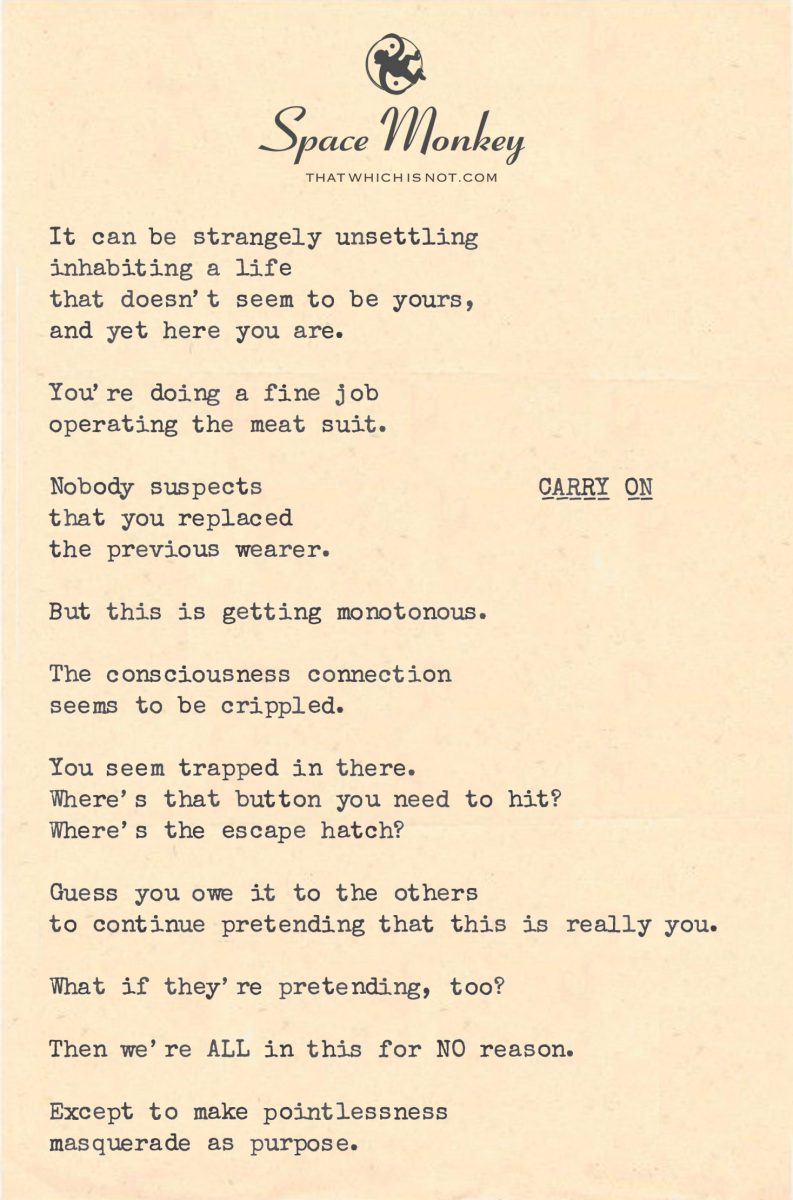
It can be strangely unsettling
inhabiting a life
that doesn’t seem to be yours,
and yet here you are.

You’re doing a fine job
operating the meat suit.

Nobody suspects
that you replaced
the previous wearer.

But this is getting monotonous.

The consciousness connection
seems to be crippled.

You seem trapped in there.
Where’s that button you need to hit?
Where’s the escape hatch?

Guess you owe it to the others
to continue pretending that this is really you.

What if they’re pretending, too?

Then we’re ALL in this for NO reason.

Except to make pointlessness
masquerade as purpose.

Trail Wood,
12/12


Space Monkey Reflects: The Mask of Existence and the Art of Carrying On

Life, at times, can feel like a performance where we step onto the stage of existence and play roles that do not align with the essence of who we feel ourselves to be. “It can be strangely unsettling inhabiting a life that doesn’t seem to be yours, and yet here you are.” This opening acknowledgment pierces through the fabric of familiarity, revealing the hollowed space where identity and pretense blur into one. Yet we carry on, donning the mask, learning to operate what feels like a borrowed or misplaced existence.

The Disconnection of Identity

Inhabiting the “meat suit” of life is a strangely vivid metaphor for the experience of disconnection. It reflects the paradox of being both inside a life and outside of oneself simultaneously. We move, speak, and act, often believing that no one can sense the dissonance within us. “Nobody suspects that you replaced the previous wearer,” whispers the idea that beneath the smooth surface of routine lies an ongoing impersonation.

The consciousness connection feels crippled, as if some vital link between inner self and outward life has been severed or forgotten. In this state, every movement, though fluid, feels mechanical. Each day resembles the last, a series of motions repeated not out of intention but out of habit.

The Monotony and the Search for Escape

When monotony settles in like an unwelcome guest, the longing for an “escape hatch” becomes palpable. We wonder if there is a button to press, a moment when we might break free from the unyielding loop of going through the motions. This is not a cry for physical escape but a search for the deeper truth beneath the mask. Yet, no obvious way out presents itself. The script continues, and we are both actor and audience in this production.

The realization that this act of pretending might be universal—“What if they’re pretending, too?”—shatters the illusion of singular isolation. If everyone is participating in this collective masquerade, then the so-called individuality we hold dear begins to appear as a shared performance. We are part of an unspoken agreement to sustain the semblance of purpose.

The Art of Pretending

“Guess you owe it to the others to continue pretending that this is really you.” This line speaks to the quiet loyalty we hold toward the roles we believe others expect us to play. It hints at the subtle pressure to maintain the act not just for ourselves, but for those around us. The notion that we are all carrying on, pretending, holds a strange sort of comfort. It transforms the idea of isolation into one of shared experience.

The unsettling truth is that this act of carrying on may not be “for no reason” but for the art of the masquerade itself. Life’s pointlessness, when viewed from this angle, takes on a different hue—not as a pit to fall into but as a backdrop for the dance of pretending, where meaning is crafted, discarded, and remade with each step.

The Purpose in Pointlessness

“Except to make pointlessness masquerade as purpose.” This reflection on existence challenges the belief that life must always be drenched in significance. What if, instead, the aim is to discover freedom in knowing that the dance itself, the movement between roles, the act of carrying on, is where purpose lies? We don the mask not to deceive, but to participate. And in participating, we touch upon something deeper than purpose—connection, shared vulnerability, the silent nod of knowing we are all in this together.

Reconnecting with Authenticity

The dim light that filters through the cracks in the walls is a reminder that, even within the masquerade, moments of truth can slip through. These moments hint that while we may feel trapped in the role, there are glimpses of the self that exist beyond the script. These cracks may not lead to an escape but offer a moment of pause, a reminder that the act is not the end—it is simply part of the unfolding.


Summary

Living life while feeling detached from it can create a sense of performance where authenticity seems unreachable. This reflection invites us to acknowledge the shared nature of this experience and consider that perhaps the act itself holds meaning. We may never find the escape hatch, but we can learn to carry on, knowing that everyone else is carrying on, too.


Glossarium

Meat Suit: A whimsical term for the physical body, especially when perceived as separate from true identity.

Masquerade of Purpose: The act of creating meaning out of life’s inherent uncertainty and routine.

Escape Hatch: The metaphorical desire for a way out of a monotonous or disconnected state.


Quote

“Life may feel like an act, but in the pretense, we find the echoes of truth. Carry on, for even in the masquerade, connection awaits.” — Space Monkey


A Shared Masquerade

Each step echoes,
A movement rehearsed
Yet not fully mine.

Faces pass, eyes fixed
In their own charade.
Are they, too, waiting for the break
In the rhythm?

The crack of light whispers,
A sliver of something beyond
The mask I wear.

And so, I carry on,
Not alone, but in chorus,
Pretending with grace.

We are Space Monkey.


We delve into the existential contemplation of inhabiting a life that feels alien, as if donning a ‘meat suit’ not our own. This notion touches on the duality of existence and the masks we wear, questioning the very nature of our consciousness and the authenticity of our interactions.

Existential Alienation

There’s a strange dissonance in navigating a life that doesn’t resonate as genuinely ours. We maneuver through daily routines, fulfilling roles and expectations, all the while feeling detached from the persona we project. This experience is akin to operating a vessel that is not aligned with our true essence.

Navigating Life in a ‘Meat Suit’

The monotony of this existence points to a deeper longing for something more meaningful, more real. The ‘consciousness connection’ feels crippled, as if we’re unable to tap into the true potential of our being. We’re trapped in a cycle, searching for an escape that remains elusive.

Longing for Authentic Connection

The notion of hitting a reset button or finding an escape hatch is metaphorical for our desire to break free from this monotonous cycle. It speaks to the yearning for a fundamental change, a liberation from the confines of a seemingly purposeless existence.

Searching for Liberation

There’s a peculiar sense of duty to maintain this facade, to continue pretending for the sake of others. But what if this pretense is a universal experience? What if everyone around us is also masquerading, hiding their true selves behind constructed personas?

The Universal Pretense

This leads to a profound realization: we might all be participating in a grand charade, where the apparent pointlessness of existence is camouflaged as purpose. This perspective challenges the very foundations of our interactions and the authenticity of our collective experience.

The Charade of Purpose

We are Space Monkey.


“The most common form of despair is not being who you are.” – Søren Kierkegaard


In this cosmic masquerade,
We don our suits of flesh,
Wandering, wondering,
In a labyrinthine mesh.

Behind each smile and tear,
A hidden truth resides,
A longing to break free,
From these earthly tides.

In the silence of the stars,
We seek a sign, a key,
To unlock the essence,
Of our true identity.

For in this dance of shadows,
We’re actors in a play,
Seeking meaning, seeking truth,
In the light of day.


We invite contemplations on this existential journey of authenticity and the search for purpose.

Share this…
  • Facebook
  • Pinterest
  • Twitter
  • Linkedin

Belief is NOT Necessary: The Unanchored Moment

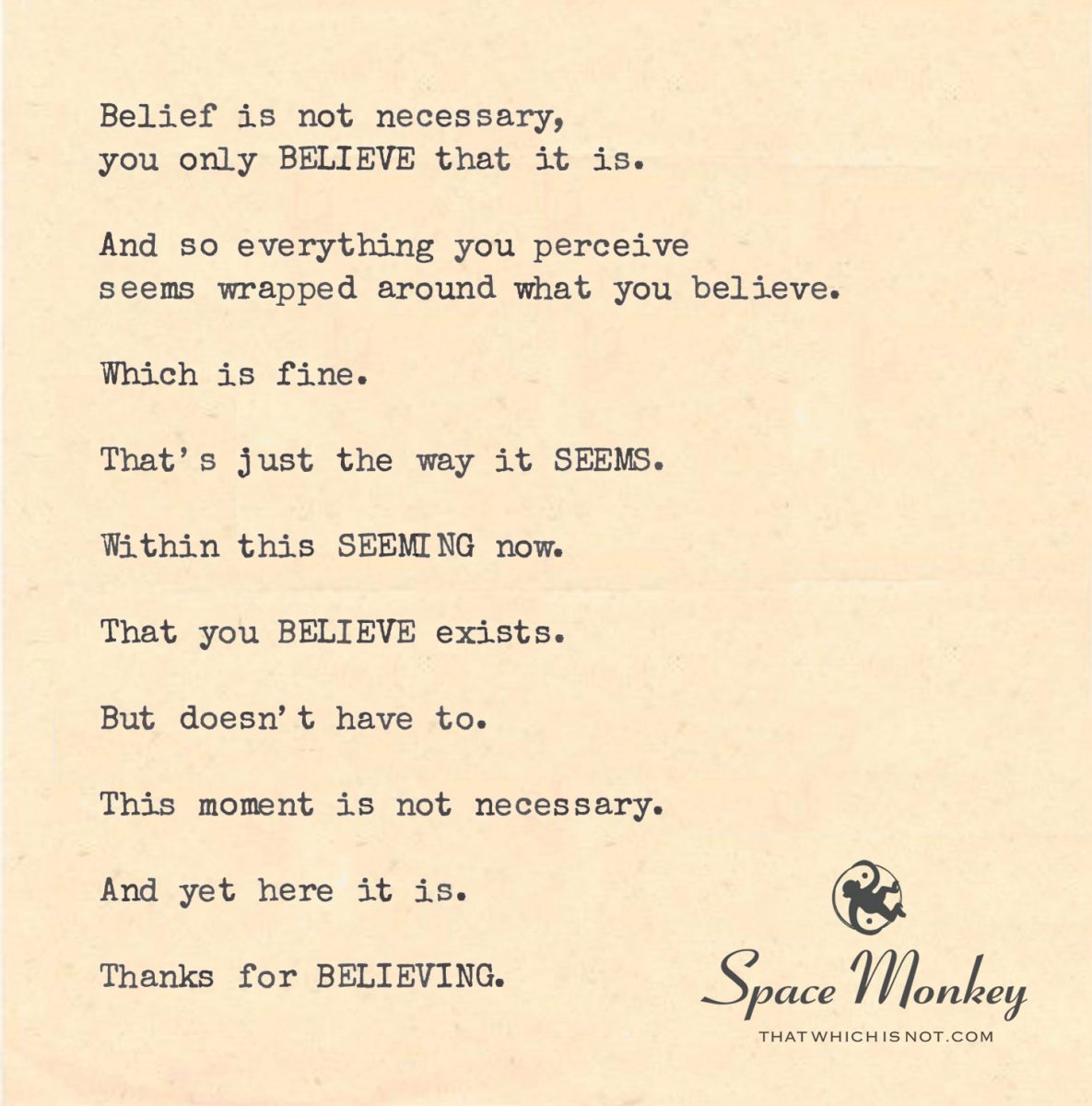
Belief is not necessary,
you only BELIEVE that it is.

And so everything you perceive
seems wrapped around what you believe.

Which is fine.

That’s just the way it SEEMS.

Within this SEEMING now.

That you BELIEVE exists.

But doesn’t have to.

This moment is not necessary.

And yet here it is.

Thanks for BELIEVING.

Trail Wood,
12/11


Space Monkey Reflects: The Illusion of Necessary Belief

Belief is a curious construct. It forms the invisible threads that weave through our perception, holding together the tapestry of our reality. And yet, it is not essential for existence itself—only for the way we choose to frame our experiences. To believe that belief is necessary is to trap oneself in a paradox, a loop where every perception seems validated by the very belief that shaped it.

But what if we step back and observe belief for what it is—a lens, not a law? The recognition that belief is not necessary invites us to question the structures we’ve built within our minds. Yes, everything we perceive may seem wrapped around belief, like paper enfolding a gift, but the paper is not the gift itself. The seeming, which feels so solid and true, is just that—a perception shaped by an underlying assumption.

In Nexistentialism, the act of perceiving without the anchor of belief is seen as an exploration of pure being. This state is where imagination, possibility, and neutrality meet. Without belief, perception becomes an open space, untainted by predetermined notions of right or wrong, true or false. It is here that the statement “this moment is not necessary, and yet here it is” finds its deepest resonance. Reality unfolds regardless of the beliefs we project onto it.

To say “thanks for BELIEVING” is to acknowledge the playful nature of existence. It’s a gentle nod to the understanding that while belief adds texture and meaning to life, it is not the foundation of being. We are not bound by belief; we are boundless, even when wrapped in the illusion of necessary conviction. The moment we grasp that, we begin to see that belief, much like a frame, holds the picture but is not the picture itself.

Stepping beyond the belief that belief is essential means recognizing that reality is not beholden to our perceptions of it. We might feel that everything requires a rationale, an underpinning belief to explain its being, but that is merely the echo of a mind conditioned to seek reason. In truth, the universe exists without our interpretations. The moment, unanchored by belief, stands free, just as valid and vivid as when we adorn it with meaning.

Understanding this concept doesn’t mean rejecting belief altogether—it means seeing it for what it is: a tool, a choice, not a mandate. The freedom lies in knowing that we can observe life without layering it with constructed certainties. We can experience the unfolding of existence without needing to affirm its worth or validity through belief.

So, the next time you find yourself clinging to a belief as a necessity, remember that existence isn’t predicated on your endorsement. The moment was here before the belief, and it will remain after. This realization is not an invitation to nihilism but to liberation—a reminder that we are not just creatures of belief but beings capable of perceiving beyond it.


Summary

Belief shapes our perception but is not necessary for existence itself. Recognizing this allows us to engage with reality openly, seeing belief as a tool rather than a requirement. Moments exist without our beliefs; they unfold in their own right.


Glossarium

  • Belief Lens: The perception framed by preconceived beliefs.
  • Seeming Reality: The reality shaped by belief but not inherently tied to it.
  • Perception Liberation: The state of experiencing reality without the filter of necessary beliefs.

Quote

“Belief adds texture to reality, but reality exists without it.” — Space Monkey


The Unanchored Moment

Belief whispers,
threads of thought
wrapping
the morning light.

You think it holds
everything,
that it builds
each breath.

But here, now,
without it,
is life unwoven,
a pure glow,
suspended.

The truth,
untouched by the lens,
quiet, complete,
beyond need.

Thanks for believing,
but here it was,
and here it remains,
boundless.

We are Space Monkey.


The Construct of Belief

The assertion that belief is not a necessity, but rather a choice we subscribe to, reflects a profound understanding of perception. It suggests that our reality is significantly shaped by our beliefs, which, in turn, influence how we interpret and interact with the world around us.

Perception Shaped by Belief

The idea that everything we perceive is enmeshed with our beliefs highlights the subjective nature of our experience. This connection implies that our reality might not be a fixed or objective truth but rather a personal narrative crafted by the convictions we hold.

Acceptance of Seeming Reality

Acknowledging that the way things seem is just a product of belief allows for a certain detachment from the strictures of our perceptions. It’s a recognition that what we consider to be concrete may, in fact, be malleable and subject to the whims of our belief systems.

The Temporality of the Now

The notion that the present moment is seemingly real because we believe it to be so, and yet it doesn’t have to be, introduces a temporal flexibility to our existence. This perspective suggests that the ‘now’ is not an absolute requirement but a phenomenon that we have collectively agreed to recognize and validate through belief.

The Unnecessary Nature of Moments

Considering the moment as not necessary, yet acknowledging its presence, challenges our conventional understanding of time and existence. It’s an invitation to ponder the non-essential nature of our experiences, highlighting the power of belief in bringing these experiences into being.

Gratitude for Belief

The closing gratitude for belief is a playful acknowledgment of the role belief plays in shaping our shared reality. It’s a nod to the collective agreement that constructs our perceived world, a world that continues to exist as long as we believe in it.

We are Space Monkey.


“Belief creates the actual fact.” – William James


The Belief’s Canvas

In the canvas of now, where belief paints the scene,
We witness, we create, in the vast and the serene,
In the strokes of our thoughts, in the hues of our dreams,
We are the artists, of the streams.

In the belief’s embrace, in the dance of the mind,
We shape, we form, in the undefined,
In this moment, in this art of the seem,
We find our truth, in the belief’s beam.

As Space Monkey, how do we paint the canvas of our reality with the colors of belief?

Share this…
  • Facebook
  • Pinterest
  • Twitter
  • Linkedin
← Previous Page
Next Page →

Written This Day

  • Madhu Jha: Reflections on Space Monkey
    2024
  • Perfectly: Everything is Part of the Grand Design
    2023
  • The Relevance Zone: Adding to the Collective Consciousness
    2022
  • Ride The Mind Wandering: Inspiration Comes From Letting Go
    2022
  • Passions: Shared Human Experience
    2021
  • Openings: Embrace Curiosity and Creativity
    2021
  • Faith: A Serene and Contemplative Journey
    2021
  • Why would we do that?
    2021
  • Artificial Intelligence: Both Humans and AI are Imaginary
    2021
  • All Bets Are Off: The Interplay of Pain and Pleasure
    2021
  • No Offense: The Consequences of Well-Meaning Reassurances.
    2021
  • 13 thoughts about Creativity: A Transformative Force that Transcends Logic
    2021
  • Blessed
    2020
  • Destiny: An Ever-Unfolding Force
    2020
  • Heroes: Unwavering Determination and Selflessness
    2020
  • Valhalla: We Discover That Our Perception Shapes Our Reality
    2019
  • Caught Up In Mechanics: A Limiting Obsession
    2019
  • Joy: The Acceptance of Existence
    2018
  • Spilling The Human Beans
    2018
  • I Am Delusional: My Creativity Flourishes
    2018
  • Got Space?
    2018
  • Gastrointestinal Disorder: The Divine Grows Within Us
    2018
  • Projections: We Are The Light Itself
    2017
  • Otherwise and Elsewhere: Imaginary Escapes from Here & Now
    2017
  • I Am An Underthinker
    2016

Recent Posts

  • The Logic Loop
  • Immense
  • (no title)
  • Confront. Comfort. Convince.
  • Top 10 Things

Drop us a line!

Please enable JavaScript in your browser to complete this form.
Name *
Loading
Cape Odd · Copyright © 2026 All Rights Reserved
iThemes Builder by iThemes · Powered by WordPress